0
0

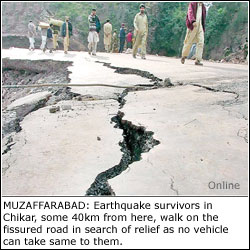 ISLAMABAD, Oct 27: Initial feedback of the relief operation so far has revealed inequitable distribution of aid and overlapping of roles because of lack of coordination between relief agencies working on the ground.
A United Nations Joint Logistic Centre (UNJLC) bulletin on Thursday said lack of coordination was evident with many easy-to-reach areas being over-serviced when other localities were overlooked altogether.
Moreover, there has been anecdotal evidence of dual assessment missions by different agencies and non-government organizations to the same places, but none to the others.
“Each party responded as they saw fit without taking into account how they might take best advantage of the economies of scale and efficiencies inherent in logistical coordination and deconflict their work with others,” the bulletin said.
In view of the approaching winter, it has been suggested that closer logistics coordination is now an imperative.
It has been therefore decided that it would be mandatory for the key UN agencies and NGOs to attend the logistics cluster group so as to benefit from the hubs being set in NWFP and Azad Kashmir.
“A failure by any NGO to share information now may lead to services being unavailable later to that NGO when required,” the UN in its bulletin warned.
Meanwhile, an interesting aspect revealed by the UN bulletin was that many more military personnel were hospitalized than were recorded as injured, and that the proportion of injured civilians hospitalized was low. The government has replied to this observation saying a large number of civilians were treated at military hospitals.
The cargo carrying capacity of the combined Pakistani and international copters deployed for relief operation would double in the next week and a half with the arrival of heavy lift military helicopters.
Presently some 95 helicopters are in operation.
More helicopters are being expected from the US, Britain, Germany and the UN.
Constraining factors limiting the deployment of additional helicopters have been identified as ground space for parking and loading and the complexity of coordination between the respective air asset taskers as more aircraft operate in a challenging flying environment.