0
0

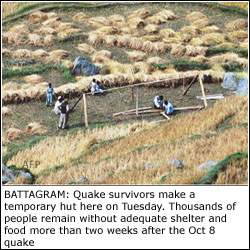 ISLAMABAD, Oct 25: The United Nations World Food Programme (WFP) warned on Thursday that unless donors moved fast, blocked roads, snow and a serious lack of funding could put tens of thousands of quake survivors in a death trap.
“It must be clear to everybody that many people could die if we do not move more quickly. We must have much more funding, much sooner, to gain as much speed as humanely possible in the face of gigantic logistics difficulties,” WFP Regional Director for the Middle East, Central Asia and Eastern Europe, Amir Abdulla, said in a statement issued here on Tuesday.
“A critical window of just five weeks remains for WFP to preposition food stocks to last six months for tens of thousands of people in the most remote areas that may be completely cut off by the onset of winter,” he said.
The WFP sent on Tuesday 36 tons of high-energy biscuits, procured locally with a Japanese donation, to Muzaffarabad. This is the first shipment of over 2,500 tons of high-energy biscuits for which the government of Japan has agreed to provide funds to the WFP to purchase ?and distribute among earthquake victims.
Japan, which confirmed its contribution of $2.5 million just one week after the WFP sought emergency aid as part of the UN’s overall flash appeal, was among the first countries to donate to WFP’s relief effort.
WFP’s executive director James Morris has warned that time was running out to reach the hundreds of thousands of people in desperate need of assistance and urged more donor support for the unprecedented aid challenge.
To date WFP has received $16.5 million of the $88 million it requires, with a shortfall in funding of 81 per cent.
Since the massive Oct 8 earthquake the WFP has been able to send nearly 3,000 tons of food using planes, helicopters, trucks, rafts and pack mules to hundreds of thousands of affected people in one of the most rugged terrains in the world.
However, the UN food aid agency has so far received only about 13 per cent of its $56 million food appeal targeted at about one million people until mid-April 2006.
“These figures will probably rise once we conclude our rapid assessments. In addition, up to three times as much money could be needed for the land and air logistics operations that WFP is handling on behalf of almost all humanitarian agencies in Pakistan,” Mr Abdulla added.
People stricken by grief and loss — and further traumatized by continuing aftershocks — are expressing frustration and anger. In remote mountainous areas southeast of Muzaffarabad, angry residents expressed their concern about the slow pace of relief supply.
Road blockages are still preventing access to hundreds of thousands of people in the upper slopes, while landslides in various places such as Neelum Valley continue to pose a threat to the movement of people and vehicles. Helicopters are being used to move food into many villages in the valley and ferry out the injured.
“Villagers from 11 communities came down from the mountains to Bheri village where distributions were being conducted by the Pakistan army. They wanted more food and desperately need shelter. On the way out of the valley, we took four injured people with us in the chopper,” a WFP aid worker said.
The most seriously affected areas are in Azad Kashmir in the foothills of the Himalayas, where thousands of villages and isolated settlements are scattered over 28,000 square kilometres. Most roads and bridges were destroyed.
Night temperature has already fallen under the freezing point in many places and in less than three weeks it will become much colder and many areas will become more difficult to reach.
In Mansehra and Bagh districts, food distribution is moving more smoothly. In Bagh district, nearly 11,000 people received pulses and vegetable oil earlier this week.
Contributions to WFP’s emergency operation to provide food to the earthquake survivors include Saudi Arabia ($3.3 million), Japan ($2.5 million), Australia ($1.5 million), Iceland ($75,000) and private donations ($18,000). Canada has contributed $4.7 million to the WFP’s $23.6 million appeal for air support for the relief operation; other contributors to air support so far are the US ($3.5 million) and Switzerland ($500,000).