



 0
0

 BAGHDAD, Oct 23: A key witness dying of cancer gave testimony on Sunday to the Iraqi court handling murder and torture charges against ousted Iraqi president Saddam Hussein.
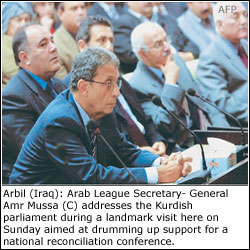
Arab League chief Amr Mussa, meanwhile, addressed the Kurdish regional parliament in northern Iraq as part of his efforts to organize a national reconciliation conference.
The Iraqi Special Tribunal which is trying Saddam feared that Waddah Khalil, a former senior intelligence officer in the fallen dictator’s regime, could die before its next session.
Court officials ‘recorded the testimony of this individual’, a source close to the court told AFP. “His words were recorded and written down on paper.”
Khalil occupied a key post in Saddam’s intelligence services at the time of the Dujail massacre. “He then left the service to pursue his trade as a lawyer,” the source said.
The ill man is under arrest on separate charges described as ‘non-political’, the source said, giving no further details.
Saddam and seven co-defendants face charges related to the killing of 148 Shias from the village of Dujail following a failed attempt there on the Iraqi leader’s life in July 1982.
The defendants have all claimed their innocence.
After the first day in court on October 19 the trial was adjourned until November 28, but a special session was held for Sunday’s witness because of his ill health.
The trial was adjourned for 40 days in part because several witnesses and people affected by the massacre were not present at the court, the source said.
Saddam’s Iraqi lawyer, Khalil al-Dulaimi, asked for an adjournment in order to examine evidence collected against his clients.
Court officials also have to correct several technical problems that bedevilled the opening day, including faulty audio and video systems.
On the political front, the secretary-general of the 22-member Arab League, Mussa, addressed the Kurdish parliament on Sunday.
“I hope stability and security will reign in Iraq, and that fraternity and cooperation will prevail between its different communities,” Mussa told lawmakers, who gave his speech a standing ovation.
Mussa’s visit marks the Arab League’s de facto recognition of the Kurdish autonomous region. It is his first since the US-led 2003 invasion that toppled the Saddam regime.
“Iraqi Kurdistan is an important part not only of Iraq, but also of the Arab world and the Middle East,” Mussa said.
On Saturday Mussa met Kurdish regional president Massoud Barzani, just hours after meeting in southern Iraq the country’s supreme Shia leader, Ayatollah Ali Sistani.
Mussa met Friday the pre-eminent Sunni religious body, the Committee of Muslim Scholars, and several members of the government in Baghdad.
Thirteen Iraqis, including two small children, were killed on Sunday in a series of attacks across the country that also wounded more than 30 people, among them five US soldiers, security sources said.
In Saddam’s home town of Tikrit, a police colonel and his two children were killed along with two passers-by in a bomb explosion targeting the police official, an Iraqi security source said.
In central Baghdad, a car bomb slammed into a police patrol, killing four people, including at least one police officer, and wounding 13 others, security sources said.
And five US soldiers were injured in three separate attacks on US patrols in eastern and northern Baghdad, a US military spokesman said.
On Saturday, the US military announced the death of four of its troops in Iraq, moving the overall toll since the invasion closer to the psychologically significant total of 2,000..—AFP





























