



 0
0

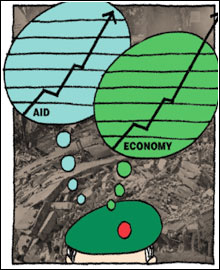 THE ferocity of the October 8 earthquake is likely to hurt the government’s fiscal deficit target for the current year and may have significant implications for the pattern of allocations of development spending in the medium-term while a host of industries is poised to gain from economic activity generated through the reconstruction effort.
However, there is not likely to be any major impact on the economy in terms of mitigating GDP growth, which is still expected to be in the rage of seven per cent.
The reason: The areas hit by the quake were not centres of either industrial, commercial or agricultural activity.
Moreover, the country’s backbone economic infrastructure—ports, telecommunications, power plants, oil refineries and the financial system—have remained unaffected and in any event, economic activity in Azad Kashmir is not counted as part of the National Accounts, according to the finance ministry.
In the most immediate term, the major fallout from the quake has been evidence of mass profiteering in every sector from textiles—where in some cases the prices of shrouds to cover the dead shot up from Rs 130 to Rs 600— to tents where the shortage led suppliers to multiply prices.
Even the rates of house insurance are reported to have climbed following a sudden upsurge in demand from house owners worried about earthquakes in the major cities.
Fiscal deficit: The government’s target for the fiscal deficit set at 3.8 per cent of GDP is likely to be overshot this financial year as costs in the relief effort escalate beyond initial estimates of Rs five billlion.
Dr Ashfaque H. Khan, the government’s economic adviser in Islamabad says that while the earthquake will have definite budgetary implications, every effort will be made to meet the target. This, he says, will be possible because substantial aid receipts will help the government absorb the rescue and relief costs.
While aid will alleviate the pressure on the budget, it is unlikely to be enough to keep the deficit within target level, most experts agree. “The fiscal deficit will inevitably go up,” says Teresita Schaffer, director of the South Asia Program at the Center for Strategic and International Studies, a Washington DC think tank.
“How much [it goes up] depends on the overall aid receipts.” So far, the President’s relief fund has received Rs4 billion and $600 million but these funds are to be used in the reconstruction rather than relief effort.
The managing director of the IMF Rodrigo de Rato also said during his visit to Pakistan last week that some temporary widening of the budget deficit may be unavoidable but he recommended a reassessment of defence spending given the circumstances.
Sakib Sherani, chief economist at ABN Amro Bank in Islamabad forecasts that the fiscal deficit will rise to 4.1 to 4.3 per cent of GDP depending on how well the CBR performs in revenue collection.
Inflation: Sherani also estimates that the prices of food and construction material will be pressured upward as the loss of food grain stocks and livestock in the affected area and the push to donate basic necessities reverses the recent downward course of food prices.
He also says pre-quake expectations that the onset of winter in the North and in Afghanistan will slow construction activities and therefore bring the house rent index (a key component of consumer price inflation) down, no longer hold true since the reconstruction effort will require cement. Therefore, prices will trend upwards, causing pressure on the CPI.
Employment: Perhaps one of the hardest financial blows from the earthquake will be to the local economy of the already economically depressed Azad Kashmir. Virtually no development has taken place in this neglected region over the last several years and pre-quake livelihoods were based primarily on livestock farming and some small retail activity.
“The people of the affected areas face several extraordinarily difficult and painful years made worse by the fact that AJK is already economically depressed,” Schaffer says.
The International Labour Organization said last week that the earthquake cost 1.1 million jobs, mostly in agriculture, some in the informal services sector and less in industry and mining. The ILO said the quake-hit areas made up one of the poorest regions in the country where two million of 2.4 million people lived below a poverty line of two dollars per person per day. The organization warned that unless labour-intensive jobs are created, poverty in the region would worsen.
The bulk of the workforce in the region is made up of unskilled and semi-skilled labour. And an immediate concern the government will have to address will be the creation of long-term employment opportunities within the region. As Sherani points out, this will be essential to help prevent the negative impact of economic migration to urban centres.
Given the extent of unemployment already prevalent in the big cities (the recovery is seen by many to be a jobless one) an influx of workers from up north will worsen the job prospects of the unemployed in urban centres.
Already there are signs of this form of labour market disruption. Builders in Karachi report a slowdown in construction activity as labour from the north has left to tend to family affected by the quake.
Similarly, small retail businesses are without their usual labour, most of whom come from Mansehra and Kashmir. And there is also evidence to show that many of these workers have in search of work and refuge from the cold.
Prime Minister Shaukat Aziz said last week that he aims to raise livelihoods to above pre-quake levels. However other than the temporary solution he provides—that labour will be needed for reconstruction and some 200 NGOs will also looking to employ in the region—it is unclear how he will achieve this.
President Musharaff’s pledge to use microfinance to provide income generating activities in the region is welcome given regional success with microfinance but is less-than-reassuring given the government’s recent historical record with microfinance.
Development spending: The reconstruction effort, which is estimated to take at least five years and cost in the range of $5 billion, is likely to result in a reorientation of the Public Sector Development Program that governs development spending in the budget.
“Fifty years of development was wiped out in five minutes,” says Dr Khan. “So we have to start from scratch and the PSDP will have to be readjusted.”
Of course not a whole lot of development beyond the very basic infrastructure ever took place in Azad Kashmir. Now, the Prime Minister says he plans to build model cities and villages in the region complete with the most modern facilities.
Whether that happens or not, at least the basic infrastructure destroyed in the quake—schools, hospitals and government buildings—will immediately take priority over other projects in the rest of the country. Dr Khan, however, does not expect the Rs272 billion PSDP to increase significantly in size.
But economists have questioned how feasible re-prioritization of PSDP funds will be. “Maybe Rs10 billion to Rs15 billion can be reprioritized,” says Sherani. “But most of the high priority projects in the PSDP are water and infrastructure projects which are essential.”
Another worry is that utilization of PSDP funds may slow down as managerial resources are diverted to the North both from the government and the NGOs which will be focused on the quake-hit areas. “There will be real problems of resource allocation rather than financial allocations,” says Nadeem Naqvi, CEO of AKD Securities. “And that’s where the problems [with other projects] could lie.”
Then there is the question of where funds will come from to meet the estimated reconstruction requirements of $5 billion over the next five years. President Musharraf said reconstruction will require “much more [than the President’s relief fund has received] which is beyond the capacity of the Pakistan government.”
Although 32 countries have helped with the relief effort and the United Nations has scheduled a donor conference in Geneva on October 24 (today), and multilateral donors have promised help, worries persist about whether enough funds will be generated to meet reconstruction needs, especially given the number of natural disasters to hit the world in recent times which has depleted donor funds. Pakistan’s borrowing levels may have to rise to meet the requirements.
Naqvi points out, however, that as pledges for aid, especially from the Middle East continue to rise and inward remittances (that have averaged $4 billion per year) grow to about $4.7 billion this year as donations from expatriates rise, foreign exchange reserves will also rise to $15 billion and this will help keep the rupee strong.
He also forecasts that the State Bank will slow its pace of monetary tightening, especially since fears of overheating have begun to recede in the last two months as credit off-take has slowed, and the persistence of interest rates at these levels could encourage further investment
Business activity: Also on the positive side, analysts expect the construction industry and its 30 odd allied sectors—such as paints, bricks, bulbs, sanitary fittings, plastics, electrical equipment pipes etc—to see major growth as reconstruction gets underway. “A whole host of industries are going to go into high gear over the next 12 months,” says AKD Securities’ Naqvi.
He expects the major construction related businesses to double in size over the next two-and-a-half years. The cement industry, for one, has been building capacity and is up to a utilization level of about 90 per cent. Dr Khan even estimates that the pharmaceutical industry will have to ramp up production to cope with higher demands for medicines and the textile industry will have to do the same to meet demands for shrouds to bury the dead, the toll for which will continue to rise. Analysts however say that global transfer pricing will prevent an upsurge in profits for local pharmaceutical companies although volumes may rise.
Once the relief effort stabilizes, the hope is that the reconstruction phase will focus heavily on investing in real development in the battered local economies of the region and that the national economy will remain largely insulated from the mass-scale losses that have wracked the country.






























