0
0

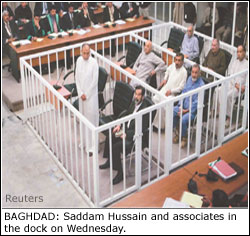 BAGHDAD, Oct 19: Saddam Hussein challenged the legitimacy of the US-backed court, but then entered a plea of not guilty as he went on trial on Wednesday over charges of crimes against humanity.
After a three-hour hearing during which the former Iraqi president and his seven co-defendants were charged with the murder of 148 Shia men, the chief judge adjourned the trial until Nov 28.
Afterwards, as he was being led out of court, Saddam Hussein angrily ordered two jailors not to hold his arms. He shoved one of them in the shoulder, and then they let him walk out untouched.
The judge, Rizgar Mohammed Amin, who is Kurdish, said the main reason for the adjournment was that dozens of witnesses, some of them relatives of the men killed, had been too frightened to show up and testify.
Grey-bearded and wearing a dark jacket over an open-necked white shirt, a proud Saddam harangued Rizgar Amin from his seat inside a shoulder-high white metal pen on the floor. The other defendants sat quietly in other pens around him.
Asked by the judge for his full name, Saddam, 68, shot back: “You know me. You are an Iraqi and you know who I am.
“I won’t answer to this so-called court ... Who are you? What are you?” Saddam said. “I retain my constitutional rights as the president of Iraq.”
Mr Amin said: “You are Saddam Hussein al Majid ... former president of Iraq,” at which point Saddam raised his finger to interrupt, saying testily: “I did not say former president.”
Saddam was the last to enter the marble-floored court before the trial began shortly after midday (0900 GMT). He asked the jailers escorting him to slow down as he walked to his spot facing a panel of five judges. He carried a copy of the Holy Quran.
“This is the first session of case number one, the case of Dujail,” Mr Amin told the court, referring to the town where bloodshed followed an attempt on Saddam’s life on July 8, 1982.
‘NOT GUILTY’: The judge told the defendants the charges included murder, torture and forced expulsions, saying the crimes could carry the death penalty, and informed them of their rights, including a fair trial. In turn, Saddam first, they pleaded not guilty.
Then followed brief arguments by the defence and the prosecution, before the judge agreed to an adjournment, although he did not give the three months requested by Saddam’s lawyer.
Iraq’s government, struggling for popularity before elections in December, had pressed for an early trial.
International observers, including several human rights groups, were in the court inside Baghdad’s fortress-like Green Zone to monitor the trial.—Reuters