0
0

 KARACHI, Oct 19: The Sindh Assembly on Wednesday passed two government bills into law by majority votes while two other government bills were introduced and six ordinances were laid before the House.
The Speaker also announced that the governor had given assent to the four bills. They are Sindh Boards of Intermediate and Secondary Education (Amendment) Bill, 2005, the Sindh Finance Bill 2005, the Sindh Civil Servants (Amendment) Bill 2004, and the National University of Management Computer Science and Technology Bill, 1999.
The consideration of government resolution regarding amendment to the Seed Act 1976, which was moved by the law minister, was deferred to Monday.
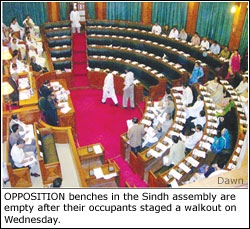
However, prior to the legislative business, the House witnessed a token walkout by the combined opposition and the proceedings were suspended by the speaker for half-an-hour prior to Zuhr prayers over a rumpus scene in the House.
The opposition staged the walkout when Speaker Syed Muzaffar Hussain Shah, ignoring the objection from the opposition benches, put the motion for taking up item No VI on the agenda out of turn which was carried by voice votes.
Law Minister Iftikhar Chaudhry, moving his motion for suspension of rule 41 under rule 211 of the Rules of Procedure had stated that the question hour should be deferred for Thursday.
One of the two bills adopted by voice votes was bill No 12 of 2004 to amend the Sindh Animals Slaughter Control Act, 1963. The law minister, while moving the bill, stated that as there was ban on slaughter of animals for two days in a week, the government finds itself helpless on religious occasions, like Eid, and Moharrum, if they fall on meatless days.
By this amendment, the government was empowered to allow slaughter of animals on meatless days and to defer the meatless day to some other day of the week so that meat could be made available on religious festivals falling on meatless days, as such the bill was in the public interest.
Syed Qaim Ali Shah of PPP opposed relaxation of rules. The government only wanted to show its performance, otherwise, there was no need for the bill, he said.
Rafique Engineer said that the government had failed to enforce law to check illegal slaughter houses which were operating in different parts of the city.
Ali Anwar Mehar, Munawwar Ali Abbasi, Ayaz Soomro, Ferheen Moghal of PPP, Hameedullah Khan and Maulana Omar Sadiq of MMA also opposed the bill, saying that the government had failed to enforce them in public interest.
Syed Murad Ali Shah of PML-Q favoured the bill, saying that it was in the interest of the people.
Mohammad Hussain of MQM said during the last 10 years, there had been an increase in consumption of meat. He said it was in their knowledge that animals were being slaughtered even on meatless days and by this amendment, the government wanted to check this illegal slaughtering.
Murad Ali Shah of PPP moved a motion to refer the bill to the Islamic Ideology Council and drew the attention of the Speaker to the rule in which it was defined that if a member raises the objection that the bill or any part thereof is repugnant to the injunctions of Islam and a motion to that effect is passed by the two-fifth of the total membership of the assembly, the assembly shall refer the bill to the council for an advice.
The speaker put the motion to the House which rejected it by voice votes. On this, the entire opposition started a protest.
Murad Ali Shah, Nasrullah Shaji and Shazia Marri took the stand that under the rule 87 if the mover had the support of two-fifth assembly members, the matter be referred to the council.
The Speaker was of the view that as he had taken the opinion of the House while Murad Ali Shah and Shazia Marri insisted that the rules do not permit it.
Provincial Minister Irfanullah Marwat, rising from his seat, accused the opposition of blocking the legislation by raising objections.
On these remarks, there was a din in the House. Failing to restore order and discipline in the House, the speaker issued notice to Murad Ali Shah and adjourned the session at 12.30 pm for half-an-hour to meet at 1 pm.
When the session resumed business around 1.20 pm, the Speaker said that the motion of Murad Ali Shah to refer his move to the council does not have support of the two-fifth members and he had exercised his authority as Speaker to put the motion to the House which rejected it.
He reminded the members that the bill was presented on Friday, but not a single member submitted any amendment.
Nisar Khuhro pointed out that he had presented an amendment to the bill. The Speaker said the amendment should have been submitted two days back.
Mr Khuhro made an attempt to move an amendment under Rule 89(2) to refer the bill to the select committee for eliciting public opinion.
The House did not allow him to move the motion under Rule 89 as it was rejected by voice votes.
Ms Shazia Marri also sought permission to move an amendment after dispensing with rule 94 and 95 which was rejected by the House.
Murad Ali Shah, by another motion, wanted to amend the bill to correct a typographical mistake. But his motion was rejected when put to the House. At a later stage, the mistake was realized by the law minister and he wanted to allow the opposition member to move the amendment. But, the Speaker gave the ruling under rule 185(3) that the mistake be rectified by the secretary of the assembly.
Later, the law minister completed the third reading of the bill which was passed into law by voice votes.
When the law minister made a motion for considering Bill No 3 of 2005 pertaining to amending the Sindh Water Management Ordinance, 2002, and when Syed Murad Ali Shah tried to drew the attention of the Speaker, the Speaker reminded him that he was addressing the chair in a rude manner.
“You may disagree with me the way I conduct the House, but this is not the way to address the chair.”
Murad Ali Shah said he would continue to refer rules even if he was thrown out of the assembly.
The law minister presenting the bill No 3 of 2005, which pertains to amend the Sindh Water Management Ordinance 2002, for consideration said the purpose of the amendment was to make the irrigation minister as chairman of Sindh Irrigation and Drainage Authority for fair distribution of water.
Shazia Marri said she had submitted an amendment bill three months back but it was never taken into consideration. Water management, she said, was an important sensitive issue as such all amendments be made once before the bill was passed into law.
Munawwar Abbasi said after failure of SIDA to deliver, there was no point to give powers to the irrigation minister.
Ayaz Soomro termed it a conspiracy against Sindh and pleaded to send it to the standing committee.
Humera Alwani said that due to theft of water in upper Sindh, amendment should be brought against those who indulged in water theft.
Anwar Mahar said it would be useless to make the irrigation minister chairman of the SIDA.
Irfanullah Marwat said that amendment was being introduced on the line of a resolution adopted unanimously by the House but the opposition was criticising it.
Rafique Engineer said Gen Musharraf wants strengthening of devolution plan, while in Sindh minister for irrigation was being made more powerful by making him chairman.
Nisar Ahmad Khuhro recalled that the SIDA was established in the country because of incompetency of the irrigation departments. He denied the assertion by Mr Marwat that any resolution was passed jointly to make amendment in the ordinance.
He pointed reported towards corruption in the irrigation department and said that Nadir Akmal Leghari was not paying attention to this aspect and if the irrigation minister was made chairman of the SIDA, it would multiply corruption.
The Irrigation Minister, Nadir Akmal Leghari, said misunderstandings should be removed that any powers were being given to the minister by making him chairman of the SIDA.
Murad Ali Shah of the PPP said that the bill should be sent to the standing committee for irrigation. In this connection, he also made a motion under rule 89 which was rejected by the House.
After rejection of the motion, the law minister made the motion and the bill was passed into law by majority votes.