



 0
0

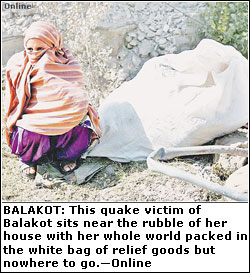 BALAKOT, Oct 17: The October 8 earthquake almost destroyed this once thriving town but what pains the survivors more is that help arrived too late. Had rescue operations begun sooner, the survivors lament, at least some of the thousands of their dear ones buried alive under the debris could have been saved.
But alas! the focus of the media and the government was on Islamabad, Muzaffarabad and Bagh during the crucial first 72 hours.
When this correspondent left Mansehra with other journalists on the morning of October 9 to get the story, fallen buildings, cracked roads and land slides were frequent sights as we came closer to Balakot town.
About five kilometres short of Balakot on Sunday evening, we came across a scene of mass exodus. Survivors carrying whatever belongings they could take were heading for safer grounds.
Many were carrying their loved ones on makeshift stretchers whom they had dug out from under the rubble of their collapsed homes. Several were carrying their dead.
Roughly a kilometre ahead three major landslides blocked the road to Balakot. Bulldozers were trying to clear them. Unable to cross, this correspondent with BBC’s Andrew North and Cara Swift had to return to Mansehra for the night.
On October 10, at 80am, Balakot town was a scene of misery and ruin. Debris, twisted metal and toppled cars and buses littered the main market street. Nothing was standing. Over 80 per cent of the city was destroyed and what remained could be brought down just by a push.
Some places sank and others were raised. Schools were turned literally into mass graves.
People from as far away as Abbottabad walked to Balakot with picks and shovels to help rescue people from under wrecked buildings.
“I was lifted (by the powerful earthquake) and thrown into the air. Devastation struck in seconds. Many children are still buried under the rubble”, said a teacher of Government High School Balakot (GHSB), Mohammad Sajid, who was sitting in school lawns at the time.
Tenth grade student Mubashir, was writing an essay when the walls and roof of his classroom caved in. “We had no time to run. Students pulled me out. I was not badly hurt. And I helped find others,” he said.
“All government schools in these regions were in chronic disrepair,” said Abdul Rasheed, an official of the Construction and Works Department, Abbottabad. “Girls High School, Shaheen Public School for Girls and GHSB were faulty constructions and had never been renovated.”
Army troops, some 200 men divided into groups of ten to 15, searched for survivors under the rubble here and there.
“Where is the army? Where is help?” Cried a man, oblivious of the havoc wrought to the road communications. All that he knew was his personal pain.
Around 11am landslides were cleared and first signs of aid started coming into Balakot.
By midday French and Chinese rescue teams arrived and set to work immediately, labouring through the night to cut through the mangled mountain of the Shaheen Public School, hoping to find girls believed trapped beneath the rubble. They pulled out nine girls alive.
On October 11, at 8am Army trucks rolled into Balakot. A base for helicopters had already been setup to bring in supplies and to fly out the injured to hospitals. An emergency medical camp was also established at the base which provided first aid.
Brig Khalid, the man in-charge, was asked why military’s response was so slow in Balakot.
“The devastation is overwhelming. I have 2,000 men for the 600,000 people affected in this entire region. I have only four helicopters because everything is being diverted to Muzaffarabad.
“There are at least 15 villages which have been destroyed farther up but the road is completely gone. It will take a month to create a foot track and three months plus for a jeepable road. Aid is in abundance but I have no means to deliver them. I need more resources”, he said. Army was doing its best but media was misreporting, he added.
A survivor burst out on seeing some soldiers, “Why do they have guns when they should be carrying picks and shovels? They walk as if they are patrolling during a war”.
There is already snow on the mountain tops and it is bitterly cold. Rains slowed relief and rescue efforts later that day.
Survivors looked for any structure that could provide shelter to battle against these elements. Stench from the dead under the rubble made breathing difficult and spread of disease is an increasing concern.
Wednesday, October 14, 6am helicopters were air lifting supplies and men to villages in Kaghan valley like Kawai, Mahandri, Jraid, Kanshian, Bhooja, Khanian, Ghanool, Dhaya, Manoor, Paaris, Rajwal and Sanghar, towns believed to be severely devastated if not completely perished.
Thousands of survivors from these shattered places started trekking to Balakot when aid failed to reach them even four days after the quake struck. Sunk in distress they carried the wounded who had by now developed gangrene, to the base in Balakot.
Stealing and looting was another major worry.
Criminals from Mansehra, Abbottabad and other nearby towns were rummaging through the rubble of the shops in the market. Much had been stolen from a jewellry shop. Gold rings and chains and other jewellry were reportedly had been taken off the dead.
Posters were put at some places urging people to help the quake victims, not rob them.
“Look sahib they are stealing from my shop,” Khawar told this correspondent sitting across the road.
Survivors complained that they were not getting the aid coming and outsiders were taking everything.
On October 13: It was the same story everywhere. Arif had lost 22 members of his family. Survivors were sleeping under open skies. Deserving were getting neither food, nor medicines nor tents. Rescue teams plucked survivors from flattened buildings and were deciding to move on. Injured were developing gangrene.
All those pulled out from the debris owe their rescue to foreign teams and very few to the domestic effort.





























