



 0
0

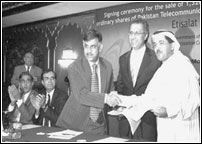 WHAT is going to be the fate of Pakistan’s much hyped privatization programme? This question is boggling many a minds in concerned circles both at home in Pakistan and abroad these days.
With each and every passing day that is taking us closer to the end of this month, the clouds of uncertainty are darkening over the possible take-over (or in the worst case otherwise) of Pakistan Telecommunication Company Limited (PTCL) by Etisalat, the UAE’s telecom giant that gave the highest bid for it in June bidding. The extended last date given to the company for depositing remaining 90 of the bid money is October 28.
What a difference a quarter of a year can make! Everybody at the helm of affairs in Pakistan’s Privatization Commission (PC), including Dr Abdul Hafez Sheikh, Federal Minister for Privatization and Investment were seen in jubilation on June 18, when Etisalat offered $2.59 billion for 26 per cent shares of PTCL along with its management control.
Huge claims were being made and people were being convinced to believe that it was an historic moment. It really was. Though still signed just on paper, the deal was single largest in history of Pakistan.
Concluded on initial time framework by last month, it could well have been the largest transaction ever made in Pakistan. However, it has not materialized yet. The result is that privatization authorities, again including the minister himself, are reportedly trying their best to avoid the representatives of media. Why? The answer is not hard to come by. They doubtlessly have little to tell and explain.
Etisalat says there are some “serious issues” to be discussed, before putting the seal on the deal. It is being argued by some that it will be least possible for Etisalat to let the deal fall flat, citing good relations between UAE and Pakistan, and its outward longer term expansion plans. One should always hope for the best, but it is needless to stress that in economic deals, profits and capital gains are the real decisive force.
In fact, it has not been a smooth sailing since the bidding was held and the second thoughts of sheikhs are an open secret. As such, full payment by Etisalat and handing over and taking over of Pakistan’s largest company should have been completed by August 28, 2005. The final date kept moving ahead. And after its CEO’s meetings with higher ups in Islamabad recently, the company has now been given the date of October 28 to deposit the remaining money and take over PTCL.
Despite this extension one can not say for sure what is going to follow on this regard. This is thus becoming second similar episode after Kunooz al-Watan Group of Saudi Arabia disappeared after bidding highest price for Karachi Electric Supply Corporation, apparently because of some differences on billing system of corporation.
The finalization of PTCL deal, whichever way it goes, holds a lot of importance for the economy, privatization process in particular. And this is because telecom, a rapidly expanding sector is closely linked with almost all sectors of economy. Specially two-third of next year’s FDI inflow target set by the government is directly dependent on PTCL deal.
The uncertain environment caused by it is already taking its toll. KSE index and investors of PTCL shares have been hit. It is however good to note that PC has been able to move ahead with privatization of Musthkam Cement, Bolan Textile’s machinery and 17 EoIs have been received for Pakistan Steel Mills.
Secretary PC was quoted as explaining that the deal with Etisalat was a big one and some issues may arise in such big deals. He seems absolutely true. But even if the process comes to finalization after the delay that has already been caused, by one reason or other, the near repetition of Kunooz episode by Etisalat poses some critical questions.
The foremost is that what really creates doubts in minds of international investors, even after biddings and paying initial amounts that too come in hefty sizes as has been the case with Etiselat. Are the procedures leading to privatization of sate enterprises not transparent enough? This is already under extensive debate in the country, including in the parliament.
Do we create hurdles in the way of buyers, intentionally or un-intentionally, even after the deals are made? And finally, did we overplay the bid of Etisalat, way ahead of second runner up, giving signals that we have fetched too good a price and warning the buyers that it was not a right bargain for them?
Privatization has always been riddled with problems and controversies, be it sale of a cement plant, bank or now an infrastructure company. What people are concerned about is the ways it has been carried out so far. All the above mentioned questions demand satisfying answers and indicate that we surely need to put our house in order if the intention is to run this process successfully in the longer run. It is time to ponder and act wisely.






























