



 0
0

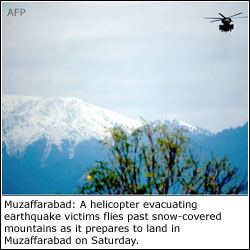 CHAKLALA AIR BASE: When the earthquake struck, computer engineer Mohammed Salim immediately left work in Islamabad and headed north toward his home village of Chokathi, deep in the mountains near the centre of the quake zone. But landslides blocked the roads, so he got out of his vehicle and walked for two days — arriving to find his brother dead and his family homeless.
Six days later, Salim found himself back in Islamabad with his injured nephew and sister, courtesy of a US Army Chinook helicopter. “There are no trucks because there are no roads, only helicopters. And the helicopters can’t provide enough,” he said on Friday. “We need everything: flour, rice, vegetables, tents, medicine. I’ve seen 10 or 20 helicopters fly by. We need hundreds.”
From the first hours after the 7.6 magnitiude earthquake last Saturday, helicopters have crisscrossed the skies over Azad Kashmir, forming a vital link to isolated mountain villages cut off from the world. An international collection of chopper pilots and crews now operate out of the Chaklala Air Force Base, running a steady series of identical missions: supplies go in and casualties come out.
“Without helicopters, we can’t do anything,” said Pakistan Air Force officer Wazeer Ahmed. For residents of villages like Chokathi, remote under even the best of circumstances, the distant sound of rotors signals the arrival of desperately needed relief. Some villagers have even taken to creating their own fake landing pads — makeshift circled H markers — hoping to trick chopper pilots into thinking their village is a scouted and approved landing zone.
“I think half the bags of flour we’ve dropped have been used to make Hs and circles,” said Lt. Col. Wiley Thompson of the US Army’s 12th Aviation Brigade, which is at the heart of the multi-national helicopter contingent. A total of 30 foreign transport helicopters run from Choklala, squeezing in as many missions as possible each day before sunset. The US Army is using two Black Hawks and five massive twin-rotor Chinooks sent from Afghanistan. Four more helicopters have been supplied by the fledgling Afghani Air Force, whose presence, admits 12th Brigade commander Col. Mark McKearn, is “very symbolic.” Through Friday, the foreign contingent had run 131 sorties, ferrying 392,000 pounds of supplies and more than 1,000 casualties.
The Pakistan Air Force has its own collection of around 65 helicopters, but few of them are “heavy lifters” like the Chinooks and Black Hawks. So a natural division of labour has emerged: the foreign choppers carry massive shipments of supplies to central collection points in cities like Muzaffarabad and Rawalakot. From there, the smaller Pakistani aircraft branch out to remote mountaintops and secluded valleys. “We’re now pushing into the deeper areas,” said Maj. Gen. Javed Tahir, the army’s commander of aviation. In areas too remote or hilly for a proper helicopter landing, crews are hovering and dropping out boxes of tents, blankets and food. Still, Tahir estimated, as much as 15 per cent of the quake-stricken area has yet to receive relief. On Friday morning, a Chinook took off carrying a load of tents and blankets. The short trip north to a small airfield in Rawalakot was uneventful and there was no sign of destruction in the tin-roofed homes scattered among lush soaring mountains and terraced fields. After unloading its cargo in Rawalakot and continuing north, however, the scope of the disaster began to emerge. Individual homes could be sighted, flattened by the quake, then half of the homes in an area, and finally all the structures on certain hillsides.
The helicopter landed at a remote field hospital near Chokathi village, where a group of army officers and a ring of barbed wire kept villagers from rushing the craft. Once they received the all-clear signal, villagers hustled wounded relatives onto the chopper, many carried on makeshift stretchers and bed frames. Men cradled bandaged babies; others carried elderly women on their backs. Space was too tight to allow stretchers on board, so the wounded were literally laid out on top of each other. At least 50 people packed inside, turning the helicopter into a gallery of dazed faces and crude bandages, soaked in the reek of hospital antiseptic. All told, the helicopter was on the ground for 10 minutes, and back in Islamabad two hours after it left, reloading for the next flight.
But it doesn’t always go that smoothly. Earlier in the week, Col. McKearn’s Black Hawk landed on a white circled H — indicating the area had been scouted and approved as a landing zone. Within a minute, the crew knew something wasn’t right; there was no sign of soldiers, just an eager crowd of villagers standing far too close to the landing pad. “Next thing you know, they bum-rushed the aircraft. ... They just poured in,” said McKearn, a native of Beloit, Wis,, who jokingly dubbed the incident, a “humanitarian ambush.”
For several minutes, the outnumbered crew struggled to unload relief supplies while keeping desperate villagers out of the path of the helicopter’s rear rotor. Finally, an army officer on board started yelling for the crew to leave. They pushed out most of the remaining supplies and beat a quick retreat, but not before three villagers managed to make it onto the craft. That and other incidents have left the helicopter crews increasingly cautious and mindful of the sheer level of desperation taking hold in the Kashmir hills.
“Some places you just go up to an open area so we don’t get rushed and we leave the supplies there, knowing people will find it,” McKearn said. —Dawn/LAT-WP News Service



























