0
0

 KARACHI: Major political parties believe that it is the government’s responsibility to provide basic amenities to the people and that indiscriminate privatization of public utilities only brings into question the justification of having a huge government apparatus at the expense of the taxpayers.
When these leaders were asked whether their parties differentiate between basic amenities based on natural resources of the country (water, power and gas) and commodities and whether they saw any role for the government in the provision of these amenities to all Pakistanis irrespective of their financial status, there was varying degree of convergence in their points of view.
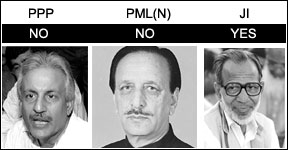
Pakistan People’s Party’s Deputy Secretary General Mian Raza Rabbani’s response was an emphatic ‘no’. The PPP, according to him, sees a clear distinction because in a developing country it is the responsibility of the government to provide basic amenities to people, such as water, gas and electricity.
Raja Zafarul Haq of the PML (N) was of the view that in a welfare state it is the primary duty of the government to provide basic amenities to all its citizens. Senator Prof Ghafoor Ahmad of the MMA said that basically it was the responsibility of the government to ensure provision of basic utilities. “But we see the government has not done that although it has claimed that by 2007 it will provide clean drinking water. But, the fact is that many people have died of drinking contaminated water in Karachi and elsewhere.”
They were asked whether they favoured privatization of these utilities and how can monopolization in the private sector be restricted in case of their privatization. Mr Rabbani claimed that his party did not believe that essential and sensitive public utilities and institutions should be privatized because it would be tantamount to placing public and national security at risk and at the mercy of foreign investors.
PPP carried out privatization but refrained from privatizing institutions like the KESC, Pakistan Steel or the PTCL. Creation of monopolies was yet another factor that influenced PPP’s decision not to privatize public utilities, he said, adding that no market force was available to prevent such a situation from emerging. In this context he cited deregulation of petroleum prices, where multinational companies are fixing prices for maximizing their profit at the cost of the general public.
According to Raja Zafarul Haq, studies carried out by some European countries suggested that privatization could lead to emergence of cartels and monopolies at the cost of consumers. He said that the PML government of Nawaz Sharif had kept this in mind while engaging in privatization issue.
But Prof Ghafoor said he was not opposed to privatization in principle, because it is not the job of the government to run factories. But privatization should be done in a transparent manner and after discussion in parliament and not in the manner where Habib Bank was sold for peanuts or the KESC case where the successful bidder backed out. When these leaders were asked to name any country where amenities (water, power and gas) were privatized and its performance and coverage had improved over the last five years to the satisfaction of its people, Mr Rabbani’s contention was that there is no such developing country where these institutions have been privatized. But in the Far East, there are some countries where power generating units were handed over to the private sector but they did not perform well, he said.
Raja Zafarul Haq did not think that privatization improves the quality of work.
Prof Ghafoor said that privatization was now a universal trend and even in India this was being done.
When the issue of profit as a motive behind private business was raised with these leaders and they were asked as to why a private water company would provide water to a far flung area where sale prospects would be limited and the cost of doing business very high, the PPP’s contention was that since the private sector is driven by profit, a policy of privatizing public utilities would hurt the end user of gas, water and electricity the worst. It would seriously affect the poverty alleviation programme.
Raja Zafarul Haq said that it is one of the negative aspects of privatization and should be prevented by the government by overseeing the terms of contract and its strict implementation. Prof Ghafoor Ahmad was of the view that the terms of contract should be transparent and strictly adhered to, so that those who took over the utilities do not abandon the ordinary consumer despite having profit as the driving force.
They were also asked if the government’s abdication of its major responsibility of providing safe drinking water, power and gas meant that there was then no need for such a big government apparatus and that leaner government with limited supervising responsibilities would need fewer revenues, which in turn would justify reduction in taxes. There was a convergence of ideas on this though with some variance. To Raza Rabbani the basic question was not of reducing taxes when the state is unable or absolves itself from providing the basic amenities. He was of the view that the concept of the state would come into question because if it could not provide such basic amenities, then what was the moral or constitutional justification for it to exist? Raja Zafarul Haq said the whole tax structure had to be reorganized because there is no justification for the levy of taxes on the poor.
Asked how their party intended to tackle inefficiencies in Wapda, the water boards, power distribution companies and gas companies, and keep user charges at affordable levels, the PPP’s contention was that it could be done through a demilitarization of the public utilities and introduction of professional management. To make them competitive, the wage structure should be revised.
Prof Ghafoor was of the view that strict adherence to the terms of contract by parliament would prevent the possibility of endangering national security and these units slipping into the hands of those who are outsiders. He did agree however that if the government failed to provide these basic amenities to the people at large its moral justification for such a huge establishment comes into question. Raja Zafarul Haq was of the view that committee should be formed for evolving a mechanism for improving inefficiencies of the public utilities.