



 0
0

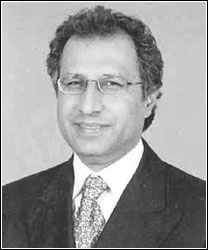 ISLAMABAD: People in Pakistan have been supportive of the privatization programme but there are hidden forces within the government like ministers, bureaucrats and heads of companies who resist privatization to save their empires, authority and powers.
Dr Abdul Hafeez Sheikh, federal minister for privatization and investment, told Dawn in an interview that there was no general policy on privatization of all utilities and a decision to sell a utility was always based on a number of economic factors.
He said it was important to put in place strong regulatory bodies before selling the utilities so that private sector was unable to create monopolies or cause unilateral price hikes.
Following is the text of his interview:
Q: Do you intend to privatize utilities based primarily on the natural resources of the country? How can monopolization be restricted in case of their sell-off?
Ans: The decision to privatize a utility or any company is taken by the government through the Cabinet Committee on Privatization (CCoP). This decision is motivated by several factors including the condition of the company, the economic impact of privatization, the efficiency gains that are possible through privatization and variety of other considerations. The privatization policy of the government at the moment is, to be selective in the privatization of utilities and therefore, there is no general policy on the privatization of all utilities.
Up until now, a very few utilities have been privatized and two utilities are in advance stage of sale including Karachi Electric Supply Corporation (KESC) and Pakistan Telecommunication Company Limited (PTCL). After their successful privatization, Insha Allah the possibility of taking on other utilities would be considered based on their own merits. At the moment, there are some other utilities in the gas sector as well as in electricity distribution sector which are under consideration for privatization and are in the pipeline. However, it will take a few months or longer before they reach the stage of actual privatization.
Regarding as to how monopolization can be restricted in case of their privatization, this is a very important consideration because if unchecked, monopolies in the private sector can lead to no ideal outcomes from society’s point of view.
Therefore, this government and other governments in the past have been very careful in putting together regulatory mechanism in the utility sector, so Nepra has been set up in the electricity sector, PTA in the telecom sector and OGRA in the gas sector, SBP already exists in the banking sector and so on. But one has to rely upon the effectiveness and capacity building of these regulatory bodies to ensure that any monopolistic tendencies do not appear in the utilities.
At the same time, the government has also been keen to try and deregulate different sectors and allow other new players to come in so that monopolies are tackled on their own irrespective of whether privatization takes place or not, because competition is considered as superior market structure than monopolies.
Q: Is there any country where amenities (water, power and gas) were privatized and their performance and coverage has improved over the last five years to the satisfaction of the people of the country?
Ans: Many countries in the world have privatized their utilities. I think most of the developed countries have utilities that are already in the private sector and many of the more advanced developing countries have been privatizing their electricity, gas and telecom companies. At the same time there has been a trend to try and bring in private sector either through direct privatization, or through management contracts or through concessions in the water sector and by and large this experience has been favourable. And it is because of favourable experience of privatized utilities that other countries have been trying to emulate and follow on this trend.
I think there is great deal of literature that has emerged that documents this improving efficiency — but obviously in any research there can be differing points of view. But, by and large, there is an agreed body of evidence that suggests that the country as whole is better off, that government are definitely less burdened and citizens are likely to gain from better services and if there is competition through better prices as well.
Of course it is also important that in order to get the desired results we have to do our job well and the transactions are designed properly and they have to be marketed properly and ensure that good quality players come in that compete with each other aggressively and the process is transparent and once privatized the regulatory bodies do their job properly to extract maximum possible gains.
Q: Except for trade unions do you see any resistance from any other segment of society for the privatization programme of the government.
Ans: The truth of the matter is that Pakistan has privatized about 148 companies so far and even in the last two and half years 27 transactions some of them very major transactions have been undertaken and except for one or two instances the trade unions have been very cooperative.
It has been the effort of the government in the past as well but particularly in our government to try to engage the trade unions and employees as major stakeholders and try and design transaction in a way that they are ensured to be beneficiaries.
So, I think that if we are considerate as we are and if we engage them as we have been then by and large the employees support the privatization programme.
Of course, there may be instances where some of the leadership of the unions may not find privatization in their interests but this is exception, it has not been the rule in our case. However, we do encounter that while labour has generally been supportive that there are other forces that resist privatization and in fact these other forces try to misguide the employees and create and stir up trouble.
These forces can be both sometimes in the government and sometimes outside the government but in any case like this we have to analyze that who are the potential gainers and who are the potential losers and usually the people who stand to loose are those who are gaining now and sometimes even the government ministers who fear the loss of their empire and senior governments and heads of these corporations and companies and utilities and so on.
So we have a situation where many of them are supportive and some are not and some of them are hidden opponents who are not openly opposed because they don’t have the courage and ground.
Q: Private business is driven by the profit motive. Is there any mechanism in place to monitor pricing of utilities after privatization? Do you see cost of doing business rising if utilities are privatized?
Ans: I think it is very important to ensure that in the case of privatization of utilities that there are mechanisms in place to monitor the prices and to agree on pricing regimes and pricing formula. It is not the actual price prior to privatization. So, for example when KESC’s privatization was being designed it was important to get a seven year tariff formula and that is what was done. So that if now the KESC gets handed over the private sector they are bound by the privatization contract and document to a specific tariff formula and they cannot increase the tariff unilaterally.
Similarly, when you have the case of telecom companies being privatized that any kind of a tariff adjustment has to be done through the PTA and there is good understanding of what the pricing regime will be but this is an important area and what this points to, is that the capacity of the regulatory bodies has to be strengthened and the powers they exercise has to be strengthened so that they can actually enforce the aim of the government of keeping the prices within a reasonable level.
Q: Do you see any link between the size of the government and responsibilities it is willing to handle? Shouldn’t government be leaner and indirect taxes be lesser?
Ans: I think there is a direct link between the size of the government and its effectiveness. If the government becomes too large and too diffuse and too spread into diverse activities then it loses focus and it is not able to concentrate in doing its own job. So we feel that it is very important for the government to focus upon its principal activities which can be listed as national defence, internal security, the provision of justice, the provision of law and order and provision of basic human needs, human resource development, social sector service delivery and in providing a macro economic environment and good regulatory apparatus.
These tasks are so important and so demanding that if the government concentrated on these alone it would not have time and resources left to be running around and managing transport companies and cement companies and fertilizer companies and so on. Therefore, we feel that it is important to narrow the government’s scope and make it concentrate.
Q: How can inefficiencies in Wapda, water boards, power distribution services and gas companies be minimized by changing the ownership rights?
Ans: Typically, the view of the economics is that if the incentives are designed properly and if the people are given the right to have a share in the profits then they are more likely to be motivated to enhance the efficiency to create more value in the company. At the same time once the ownership is changed then the private sector is not encumbered in the same way as the public sector managers are through bureaucratic procedures of doing things and therefore the speed of decision making improves.
There is high flexibility of response to changing market conditions and there is the ability to pay right people the right salaries and also to get more out of the workforce and I think due to a combination of these factors and ownership change combined with injection of newer technology that a management brings in, upgrading of the infrastructure and so on can be better.






























