0
0

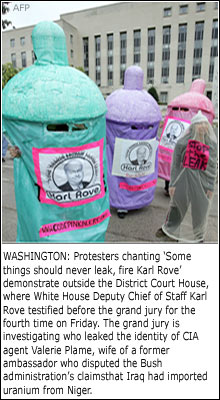 WASHINGTON, Oct 14: US President George Bush’s top political adviser, Karl Rove, testified at length on Friday before a federal grand jury investigating the leak of a covert CIA operative’s identity, making a fourth appearance as prosecutors neared a decision on whether to bring charges.
Mr Rove, the most powerful and controversial political strategist in Washington, had no comment as he entered the federal courthouse in the morning to begin his testimony, hoping to convince grand jurors he did nothing illegal. He also declined to comment when he left 4-1/2 hours later, mouthing to reporters: “Not supposed to take questions.”
Two sources close to the case said Rove’s lengthy appearance suggested prosecutors wanted to closely scrutinize his earlier testimony or that he was questioned about new information obtained by prosecutors.
“Being in there that long after testifying three times before can’t be viewed as a particularly positive sign,” said a legal source involved in the case.
Prosecutors had told Rove they could not guarantee that he will not be indicted over the leak of CIA operative Valerie Plame’s identity.
Plame’s diplomat husband, Joseph Wilson, says administration officials outed his wife, damaging her ability to work undercover, to discredit him for criticizing Bush’s Iraq policy in a New York Times opinion piece on July 6, 2003.
While special prosecutor Patrick Fitzgerald could bring charges against officials for the crime of knowingly revealing the identity of an undercover CIA operative, several lawyers in the case said he was more likely to bring a broad conspiracy charge or easier-to-prove crimes such as making false statements and perjury.
INDICTMENTS POSSIBLE NEXT WEEK: Fitzgerald could send out “target” letters to senior administration officials at any time, advising them that they are targets of the investigation, and bring indictments as early as next week, the lawyers said.
Rove’s attorney, Robert Luskin, says his client was not part of “any scheme to punish Joe Wilson by disclosing the identity of his wife.”
Fitzgerald also might decide that no crime was committed and issue a report of his findings.
The outcome could shake up an administration already reeling from criticism over its response to Hurricane Katrina and the indictment of House of Representatives Republican leader Tom DeLay of Texas on charges related to campaign financing.
Asked if the investigation was a distraction for the White House, spokesman Scott McClellan reeled off the president’s priority list, from Iraq to hurricane reconstruction to expanding gasoline refining capacity.
“We are aware of all those things but we’ve got a lot of work to do and that’s where we’re focused,” he said.
Two years ago the White House assured the public that Rove and Vice President Dick Cheney’s chief of staff, Lewis Libby, had no role in the Plame leak. Since then, reporters have identified Rove and Libby as their sources.
Judith Miller, a New York Times reporter who was jailed for 85 days before reaching an agreement to reveal her source, testified twice before the grand jury about three conversations she had with Libby. Time magazine reporter Matt Cooper testified Rove was the first person to tell him that Wilson’s wife worked at the CIA, although Cooper said Rove did not disclose her name. Cooper also discussed Wilson and his wife with Libby.
Zachary Carter, a former US Attorney in New York, said any time an official testifies multiple times “there’s always the risk that they may be perceived as having testified inconsistently.”
Fitzgerald appears to be focusing on evidence that top White House officials began seeking information about Wilson and his wife in June 2003, if not sooner.
Wilson had investigated for the CIA an administration charge that Iraq was seeking nuclear materials in Niger and concluded it was unsubstantiated. Cheney’s office was eager to discredit Wilson’s findings and his assertion that he was sent to Niger at the urging of the vice president, critics say. —Reuters