0
0

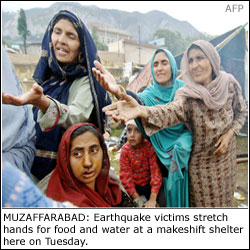 ISLAMABAD, Oct 11: Two more divisions and several brigades of Pakistan Army have been moved to Azad Kashmir and Mansehra district to cope with the “unprecedented catastrophe of Pakistan’s history” as official estimates of death toll climbed to 23,000 and injured to 51,000 on Tuesday.
Prime Minister Shaukat Aziz told a news conference on Tuesday evening that the number of casualties could go up further as rescue activities come into full swing in far-flung and so far inaccessible villages of Azad Kashmir. About 2.5 million houses have been destroyed and the number of homeless people is in the region of 13-15 million.
The increase in deployment of two divisions and several brigades in the earthquake affected areas is in addition to three divisions of armed forces already operating through their head offices in Murree, Mangla and Northern Areas. One division each has been deployed in Azad Kashmir and Balakot.
He said a major operation would also begin on Wednesday to treat decomposing bodies in Muzaffarabad, Bagh and Rawalakot districts and adjoining villages in Azad Kashmir and Balakot in Mansehra with sprays. These will then be buried to avoid the spread of an epidemic.
He said friendly countries had provided about $300 million in assistance to Pakistan for relief activities and local Pakistanis had deposited Rs600 million in the President’s Relief Fund within 48 hours of the tragedy.
The federal government on Tuesday paid Rs500 million each to the governments of Azad Kashmir and NWFP out of the Rs5 billion earthquake relief fund initially established by the federal government.
He said 432 members of the armed forces lost their lives while 709 suffered injuries. He said the initial response to the earthquake by civilians, armed forces and other organs of the government was immediate but was disrupted by destruction of roads, communication breakdown and hilly terrain.
The worst-hit areas, he said, were Muzaffarabad, Bagh, and Rawalakot in Azad Kashmir and Balakot and adjoining areas in the Mansehra district. He said main roads to Azad Kashmir had been cleared and link roads were being worked on at present.
The prime minister said 11 foreign medical teams and 15 rescue teams had started their operations in the quake-stricken areas and eight field hospitals had been established by foreign countries.
He said 35-40 helicopters had been mobilized for sorties but sometimes their work was halted by inclement weather.
He appealed to the world to provide assistance to Pakistan in the priority order of financial assistance to buy required local things, followed by tents, blankets, medicines and medical equipment, engineering equipment and material for reconstruction.
Responding to a question, the prime minister said Pakistan and India always shared each other’s tragedies and Indian assistance would be welcome if it was in line with the above mentioned priority list.
He said the strategy of rescue and relief operation has now been shifted to focus more on far-flung and inaccessible areas compared with big towns and the reinforcement would fan out to these areas.
He said as part of the two-phase of mammoth exercise of rescue and reconstruction, three federal ministers have been posted in the AJK and three in Mansehra to assist local people, interact with them and report feedback to the federal government.
He said it would still take a few more days to reach out to every nook and corner of the country but several satellite telephones were being established in various parts of Azad Kashmir as public call offices (PCOs) to reduce mental trauma of the people.
The prime minister said one of the biggest challenges for rehabilitation was shortage of time because winter season had already started in the affected areas and shelter would have to be provided to them before it turns harsh.
He said the two-phase reconstruction programme would involve short-term shelter in the form of tents, revival of hundreds of thousands of houses, setting up of hundreds of thousands of villages, damage assessment, restoration of roads, schools, hospitals, water supply, electricity, telecommunication and rehabilitation of children who have lost their parents.
Mr Aziz said the whole government machinery was working in coordination and Maj General Farooq Ahmad who was working as head of prime minister’s inspection commission had been appointed as Federal Relief Commissioner as a single window to coordinate with the outer world and local relief activities.
He said this major catastrophe had put the nation to a stern test. The people responded remarkably and the extent of their voluntarism was at an all-time high. This made the government’s job easier.
He ruled out transfer of AJK administration to the armed forces and said there might have been individual incidents of lawlessness in Azad Kashmir and Mansehra districts.