0
0

Developing nations blast UN for appeasing US
UNITED NATIONS: The 132-member Group of 77, the largest single coalition of developing nations, has sent a letter of protest to Secretary-General Kofi Annan implicitly decrying the UN Secretariat’s efforts to appease UN-bashing right-wing conservatives, both inside and outside the US Congress.
“The Group of 77 (and China) is constrained to seek clarification as to whether it is now the practice of senior officials of the Secretariat to report directly to national parliaments on actions taken by the membership of the United Nations,” the G-77 chair Ambassador Stafford Neil said in a letter to Annan. At a meeting of the Group of 77 last week, several delegations criticised the appearance of Annan’s chief of staff Mark Malloch Brown before the US Congress in Capitol Hill last month. The UN Secretariat, Neil pointed out, is accountable to the (191-member) General Assembly and not to individual member states.
The role of the Secretariat, he said, “is to implement the legislative mandates of the Organisation and accordingly, public utterances by Secretariat officials critical of decisions taken by the Assembly are not acceptable”. As a follow-up to the recently concluded summit meeting of world leaders, Malloch Brown recently briefed the House International Relations Committee, seeking US support for the proposed reform agenda of the United Nations in four main areas — development, security, human rights and management restructuring.
“To help achieve this,” Malloch Brown told US Congressmen, “we rely on our friends not only in the (Bush) administration but also here in Congress. You, after all, have the power of the purse, and that ensures you an attentive audience wherever you go,” he added. Malloch Brown’s visits to Capitol Hill have followed strong criticisms of the United Nations by some legislators who have not only threatened to reduce US funding for the world body, but also demanded Annan’s resignation over charges of fraud and mismanagement of the UN’s now-defunct oil-for-food programme in Iraq.
The Group of 77, on the other hand, has also objected to statements in several news media interviews where Malloch Brown took some passing shots at member states.
This, Neil says, is in violation of the UN charter, “which requires the staff of the Secretariat to be politically neutral and to refrain from any action inconsistent with their status as international civil servants responsible only to the Organisation”. Asked about the charges of “management failings” in the UN Secretariat, Malloch Brown bluntly told a TV interviewer last month: “We have a hell of a structural problem. The Security Council and member states generally interfere in the management of this organisation. They’ve not given the secretary-general the authority or the resources or the means to run a modern organisation that can be held properly accountable to its membership”.
He also accused member states of interfering in the work of the Secretariat: “We instead have a highly politicised interference in the day-to-day decision-making by ambassadors and their minions.” Explaining the division of powers between legislative and executive bodies in the United States and Britain, Malloch Brown said: “And in the UN context, the congress or legislature has run wild and has trampled all over the freedom of management to manage, so that every single post, every single mini bit of the budget has to be approved by a vast governmental committee of 191 members. And we’ve got to push back against that.”
In his letter, Neil told Annan: “I have been requested by member states of the Group of 77 and China to write to you to express their concern regarding the content of public statements being made by senior officials of the Secretariat which the Group considers inappropriate and reflect negatively on the Organisation.” The letter also referred to the negotiations over the “outcome document” — a global political and economic plan of action adopted by world leaders at the Sep. 14-16 summit meeting.
“In this context, I have to draw attention to recent statements that were made in the media concerning the process of the negotiations among member states and the results achieved in the Outcome Document. Some of the interpretations given of motives and actions of Member States are unfortunate and regrettable.” “Particularly troubling,” the letter said, “is where decisions taken by Member States are not interpreted in a positive light and where views are expressed which embraced one position over another.”
Asked for Annan’s comments, UN spokesman Farhan Haq told IPS: “It is clear that the Secretariat is accountable to the General Assembly. The Secretariat takes its guidance from decisions reached by the member states, as it is doing with the outcome document, where the secretary-general and his senior staff are working hard to implement the decisions on which the member states reached agreement last month.” —Dawn/Inter-Press News Service
Tarbela, Mangla and the quake
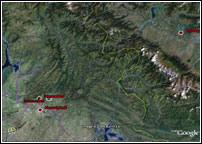 KARACHI: Among the many repercussions of Saturday’s fateful earthquake that read 7.6 on the Richter scale, engineers, hydrologists and sociologists are worried over the possible immediate and long-term effects on the Tarbela and Mangla dams, both located in the devastated area.
Wapda has said no damage has been noticed to the two dams. However, some points need to be considered.
The Tarbela Dam was constructed during the mid-1970s as part of the Indus Basin Project including the Margla Dam and associated infrastructure.
The Richter scale is logarithmic in nature; an increase of one magnitude unit represents a factor of ten times in amplitude. The seismic waves of a magnitude six earthquake are 10 times greater in amplitude than those of a magnitude five earthquake. However, in terms of energy release, a magnitude six earthquake is about 31 times greater than a magnitude five. It is also true that the intensity of an earthquake varies greatly according to distance from the earthquake. A 7.6 magnitude on the Richter scale can cause major devastation up to distances of 150-200 kilometres.
The magnitude of an earthquake is a measure of the amount of energy released. Each earthquake has a unique magnitude assigned to it. This is based on the amplitude of seismic waves measured at a number of seismograph sites, after being corrected for distance from the earthquake. Magnitude estimates often change by up to 0.2 units, as additional data are included in the estimate. It is calculated that a 7.6 magnitude on the Richter scale equals 160 megatons of a TNT explosion — the atomic bomb dropped over Hiroshima had a force of just 13 kilotons of TNT and killed 80,000 people.
The aerial distance of Abbottabad or Mansehra is less than 30 km from Tarbela Dam and only 45 kms from its tunnels. At less than 45 km southeast of Islamabad, Mangla Dam is also very close to the area that has suffered massive destruction caused by the earthquake. It is being considered as having occurred at a very shallow depth of less than eight km, resulting in over 150 aftershocks, many with a magnitude of over six on the Richter scale. In view of these facts, it must be seen whether any damage has been caused to the by now fairly old structures of the two dams.
Scientists and environmentalists opposed to the construction of big dams have repeatedly pointed out the danger of such seismic activity, especially in our case due to the continuous ploughing of the Indian plate into the Eurasian plate. Many scientists are worried that Wapda and the other federal authorities who are more than ever before trying to advocate a case for Kalabagh Dam may try to downplay any negative fallout about the earthquake’s possible effect on the two dams.
| © DAWN Group of Newspapers, 2005 |