



 0
0

 WITH a view to accomplish economic growth aspirations, the government plans to increase national power generation capacity, from present installed capacity of 19,540 MW of electricity to 162,590 MW by the year 2030.
Thus, an additional capacity of 143,050 MW will be created, under a phased programme, utilizing thermal, nuclear, hydro and other renewable energy resources.
Larger contribution of nuclear power generation to the total energy mix is planned as it is projected to increase to total 8,800 MW capacity, progressively, within 25 years.
At present, Pakistan has two nuclear power plants with a cumulative net capacity of 425 MW, whereas a third reactor of 300 MW capacity is to be constructed shortly. The country’s first nuclear power plant (KANUPP) of 125 MW net capacity was established at Karachi that has already achieved safe completion of its design life.
The second plant, Chashma Nuclear Power Plant unit-1 (CHASNUPP-1) of 300 MW net output, constructed with the economic and technical assistance of the People’s Republic of China, started commercial operations in September 2000.
Another power plant CHASNUPP-2 proposed to be a replica unit of CHASNUPP-1, having the same size, technology and location is scheduled to commence construction in the year 2007.
After CHASNUPP-2, Pakistan Atomic Energy Commission (PAEC) plans to install another 10 to 12 nuclear power plants to achieve its target of generating total 8,800 MW.
Necessary survey of the prospective sites along the Indus River, the Arabian Sea coast and the neighbouring Gulf coast has already been initiated. Module capacity of these units would be increased from present 300 MW to 600 MW, in the next phase, and subsequently standardized at 1,000 MW, based on technology of the respective foreign suppliers of nuclear power plant.
The scenario presents tremendous potential for participation of domestic engineering industry in the construction of nuclear power plants, besides undertaking civil works, through supply of machinery, equipment, accessories, parts and components, as well as extending technical services for design, engineering, installation, erection and maintenance required for the proposed units. The engineering industry has heavily invested in recent past towards installing additional machinery and developing human resources that can be effectively utilised in the area of nuclear power generation.
There exists reasonable know-how for operation and maintenance as engineers operate CHASNUPP-1 entirely on their own, with availability factor higher than 95 per cent that is claimed as one of the highest and safest experience the world over. Likewise, KANUPP is being operated, since 1974, singularly by Pakistani engineers, and the plant has been renovated and refurbished to extend its life by employing indigenous efforts for technical resources, primarily through innovations.
A nuclear power project comprises four major areas; namely civil works, nuclear island, non-nuclear island or conventional equipment, and control and safety system. While the civil works is done indigenously, and Pakistani engineers mostly undertake services for project management and erection/installation of the plant, almost all the major equipment is being imported, at present.
Through collaborative efforts with the Chinese however, local engineering industry has contributed towards manufacturing and supply of some conventional equipment and components for the CHASNUPP-1, though it is estimated value-wise a small fraction of total project cost, but of reasonable share by weight. Nonetheless, there is a definite need to increase share of local content so that long-term objective of self-reliance in this field could be achieved. At present, reasonable capacity and capability exists for undertaking part of project engineering, design and manufacturing of substantial equipment, as discussed below.
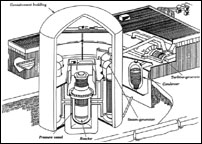
Nuclear Island consists of reactor, steam generator, pressurizer, fuel handling and fueling system, electric overhead travelling (EOT) cranes and other equipment. Conventional Island or non-nuclear equipment covers: * water intake structure, consisting of gates, trash screen, EOT crane and steel structure; raw water collection and distribution and essential water services system, consisting of trash cleaning devices, EOT crane, gantry crane, steel distributor header and vendor items; circulation water cooling system, consisting of EOT crane, trash cleaning devices and vendor items; water treatment plant, consisting of pressure vessels, tanks, heat exchangers and vendor items; turbine-generator house consisting of deaerator, degassifier, moisture separator, HP (high pressure) heater, LP (low pressure) heater, condensers, heat exchangers, EOT crane and vendor items; tank area, consisting of tanks, vendor items and other accessories; chemical house (regeneration system), consisting of pressure vessels, tanks, vendor items and other equipment; floculators (stirrer arrangement); sludge pump house; chemical dozing house, consisting of tanks and vendor items; auxiliary boiler (complete boiler house), comprising boiler, fuel storage, fuel pumping & heating system, chemical dozing system and vendor items; steel structure for building and plant; piping including spool, pipe racks & supports and vendor items, and mechanical workshop , consisting of various items of machine tools and EOT cranes.
All the non-nuclear equipment can be manufactured indigenously, though a few components (vendor items) need to be imported. It is estimated that about 300 Nos. pressure vessels, heat exchangers and storage tanks are required for a nuclear power plant.
About 70 per cent of such equipment belong to non-nuclear category and can be manufactured locally as per international standards and codes, such as the American Society of Mechanical Engineers (ASME) and the Tubular Exchanger Manufacturers Association, USA, (TEMA). The well-established engineering units are either accredited for such standards and codes, or capable of complying with the same, whereas these units have also designed and manufactured equipment to withstand severe seismic conditions.
Likewise, local industry has designed and manufactured pneumatic and EOT cranes which are not only capable of withstanding seismic load conditions, but also are explosion-proof and equipped with remote control systems as well.
Most of the electrical equipment for nuclear power plants such as station service switchgears (low tension), motor control centres, switchboards, relay panels, cable trays and other items can also be manufactured locally.
Some of this equipment will have to be designed for seismic conditions and conforming to quality requirements for nuclear environments. Some of the vendor items required for various equipment mentioned above include pumps, drives, valves, gauges, instruments, controls, fasteners, seals etc, which can be produced and procured locally.
Indeed, the most critical parts of a nuclear power plant are reactor (major components are calandaria, pressure tubes, end-fittings, booster and absorber rods), fuelling machine, steam generator and pressuriser. The reactor and steam generator vessels are very heavy—-weighing about 200 tons and 85 tons, respectively, for a 600-MW module and are manufactured to fine tolerances that need special care in handling during various production processes. The engineering industry will therefore require balancing and modernization to develop its capability to undertake progressive manufacturing of these critical heavy components of a nuclear power plant.
Utilizing the existing infrastructure of engineering industry, it is estimated, at least 30 per cent of the plant machinery value-wise, and much more by weight, can be manufactured locally, in the first phase.
Subsequently, a deletion level of about 60 per cent by weight, and equally value-wise, can possibly be achieved, with the existing infrastructure and planned additional investment.
Currently, total cost of a power plant of 300-600 MW capacity is estimated to be in the range of one to two billion dollars, depending on the source, and as such maximum deletion would result in major employment opportunities nationwide and many other socio-economic benefits. To achieve the indigenization targets, however, extensive programme of technology transfer and training of manpower in a number of engineering disciplines will have to be pursued.
Since nuclear technology is not being made available easily and readily by foreign sources, indigenous efforts for design and engineering may take considerable time, as is the case with assimilation of any sophisticated technology. Seemingly, the PAEC is seized of the situation, having taken a number of measures in this direction.
Engineers and scientists are receiving higher studies in nuclear power engineering at its Pakistan Institute of Engineering and Applied Sciences at Islamabad and KANUPP Institute of Nuclear Power Engineering at Karachi.
An amount of about Rs2 billion has been earmarked for next few years to upgrade its design, manufacturing and R&D facilities related to nuclear power.
Now, full and effective participation of engineering units, in public and private sector, is required to enhance indigenization efforts optimally. This measure will underline also the need for evolving a framework agreement with the foreign technology partner—-whether the Chinese or the Western sources—-allowing transfer of requisite technology to the domestic engineering industry.






























