0
0

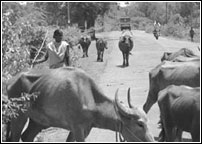 FEDERAL Agriculture ministers have been promising a ‘livestock policy’ for over a decade but some how they have not produced a plan for the development of the sector. That position persists today as much as it did in the past.
There can be no disagreement that the sector needs a clearly defined policy because livestock contributes substantially to the national economy and it is vital for the alleviation of poverty that is rampant in rural Pakistan, the areas where livestock is bred and maintained.
It was in May this year that the present in-charge of the Ministry of Food, Agriculture and Livestock first gave the tidings of a policy being in the pipeline that would be made public in September. Its plan was reportedly sent to the prime minister’s office. What happened after that is un-stated. But the idea has not been abandoned and the policy, we are told by informed sources, would be laid down in the next quarter of the current financial year.
Other information on this count is essentially the same as before. MINFAL has tied its end and the PM’s Secretariat is to clear its proposal for approval of the cabinet. But what can be expected from a policy when parameters of the sector are not demarcated? Inaccurate demarcations in fact need to be erased before a practical, meaningful and worthwhile livestock policy can be devised.
The government has now been in power for six years but, most remarkably, many basic and critical issues related to the agriculture sector, rightly regarded as the backbone of the economy, are yet to be touched. Livestock is one of them. Adhoc-ism presides over the sector which continues to be subjected to an unimaginative and irrelevant routine.
Bare features of the formulated policy appearing in some sections of the press do not promise any major departure from the set pattern. Stale preparations are more likely to be attractively bottled anew and presented as the latest brew.
One should however discuss a yet to be announced policy. However, the known view point of MINFAL can be taken up and one can say that if things move in the existing direction, livestock would not just remain stuck in a groove, it would sink too.
The government looks at livestock as animal health and has been dealing with it accordingly. The emphasis has been on veterinary aspects of the sector and its milk and meat produce, meat more than milk, have been largely ignored. Milk, however, has received comparatively enhanced attention. This is evident from the fact that Punjab’s department for the sector is titled Livestock and Dairy Development.
Nevertheless, the emphasis for the department is much more on animal health than milk. Meat has little, if any importance for the government. The idea is that production of milk is dependent on the quality of stock and its maintenance. There can be no denying of this but other factors also play roles in the development of livestock along productive lines.
The planned breeding policy of Punjab, the province with the largest livestock resources set the governmental priorities. It concentrates on improving prevailing level of milk production in buffaloes and dairy cattle breeds, reduce their age at puberty and calving interval, conserve Nili Ravi buffalo and recognized cattle breeds , maintain the desired level of exotic inheritance in cross breed cattle for optimum performance and ensure quality indigenous animals for drought purposes.
The policy has little to say about beef production. In fact it virtually washes its hands of beef, conceding that experimental cross breeding for beef cattle was carried out at a limited scale but, due to non availability of surplus buffalo and cattle male calves ‘for fattening, breeding for beef was likely to be less fruitful in the present scenario’.
Ignoring beef production has a negative impact on the development of the sector and that is the reason why measures adopted for promoting the dairy sector have not produced worthwhile results so far. Unless this glaring shortcoming is overcome, little positive is to be expected from any initiative and policy.
In June this year, the federal minister for Industries, Production and Special initiatives announced the launching of a Rs2.5 billion project for developing 11,000 model dairy farms by 2015 to promote rural entrepreneurship and create jobs.
A somewhat refined and improved version of the initiative was made public by the minister the other day with the announcement of the prime minister’s approval for a dairy sector development plan that would create a ‘white revolution’ in the country by generating 3.1 million new jobs through 11,200 dairy farms in the next ten years.
One aspect of the plan is that it covers much of the area the agriculture minister is expected to cover in a livestock policy. Another is a built-in devise in the scheme for dismantling the existing system and eliminating small land owners maintaining a few animals and landless population breeding on a subsistence level.
Major dairy farming would virtually force this segment out without enhancing viability of such farms. This would be introducing corporate culture in the milk sector at the cost of majority of breeders and enhance poverty in rural areas no end.
According to official statistics based on Punjab’s livestock census of 2000, about five per cent of cattle are raised in urban centres while the rest of the 95 per cent are bred in rural areas. The case of buffaloes is somewhat different because large milk colonies have been established around major urban habitats but buffalo breeding generally follows the pattern of cattle and milk animals are supplied by rural breeders. How this source would be affected by large scale farming is anybody’s guess.
Dairy farming would obviously have no role in enhancing beef production that already suffers because of the inability of small breeders to afford feeding of male calves after they are weaned away. Beef leaves them cold because it offers no financial mileage to small breeders. As a result, beef reaching the market comprises superannuated animals whose milk producing life has been exhausted.
Dairy farming’s ends would be served by high milk yield animals. Dairies would, although for reasons different from managers of urban milk colonies, would go for the best animals. That is fine but breeding features nowhere in this scheme of things.
Such animals would require expensive heavy feeding. Dairy farms would thus operate like their urban counterparts and try to extract the maximum from the stock regardless of what happens to animals to make ends profitable. But these colonies have scant overheads; running dairy farms as corporate business would be financially more demanding proposition.
Consequently, modern dairy farms would have no option but to raise the price of milk steeply to ensure their viability. Milk production would be enhanced but a larger percentage of the population would be deprived of milk than people who find it expensive now while the need is to improve the availability of quality food for more and more people.
It is not that the milk sector should not be modernized but undertaking that exercise without reference to local social and economic conditions would be merely a devise for allowing the sector’s exploitation by influential groups who can manage loans from local financial institutions and obtain support of international agencies that chalk out projects in the context of developed societies that heavily subsidize their farmers and breeders. .
Further, large scale dairy farming has been tried, in Punjab in particular and with disastrous results. Some investors established farms with hundreds of quality animals but abandoned them because projects were not viable. Animals need to be fed all the 365 days of a year but they produce milk for about 280 days. The feed expense disallows investors to break even, leave alone earning profit. People investing their own finances end up on the wrong side of the financial fence while influential people using public money leave massive liabilities for the exchequer in the form of unpaid loans.
They may have survived if milk and meat were treated as integral components of the sector but concentrating on one while ignoring the other was not just lopsided approach that did not work and proved detrimental to the sector’s development. Nothing has changed in the sector to suggest that reviving failed policies and practices of the past would deliver today.