



 0
0

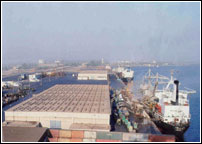 THE port sector undoubtedly, represents a key ingredient of the dynamics of the national economy. The two operational seaports, the Karachi Port Trust (KPT) and the Port Qasim Authority (PQA) – soon to be joined by the third, Gwadar Port – handled a total cargo volume of 49.984 million tons during the financial year 2004-05, inclusive of 1.431 million TEUs (twenty foot equivalent unit) containers.
The respective share of the KPT and the PQA in total throughput during was 57.35 per cent and 42.65 per cent. This indicates the order of the magnitude of the capacity of the port sector that can be substantially increased through marginal investments and improvements to better serve the trade.
Functionally, seaports have a derivative role in the national economic process to facilitate and promote fast and cost-effective movement of sea-borne trade flows, as the most vital interface between sea and land modes of transport.
Any investment related to manufacturing and involving element of imports or exports must incorporate the quality and efficiency of the ports in its profit and loss equation. Shipping being the cheapest mode of long-distance transportation of goods and commodities amongst countries, international trade, without seaports, would hardly be a commercially viable proposition. The vibrancy of foreign trade sector of an economy and the buoyancy of its port sector are mutually interlinked.
Staying competitive in the global economy is the name of the game. Economies with deficit in economic infrastructure and fragile productive systems are doomed to distress. This vulnerability should be a cause of concern for Pakistan as well. By improving and up-scaling infrastructure, Pakistan’s port sector can contribute to its competitiveness and help Pakistan to sustain itself in the mainstream of global trade, and as a catalyst to lure in new investments.
In view of the prognosis of strong economic growth for Pakistan in the ensuing years, a greater degree of connectivity both in trade and transport with the world markets will be a pre-requisite.
The evolving situation presents Pakistan with a highly rewarding opportunity to act as the regional hub of transit trade and transport corridor between East and West, accruing benefits to the Gulf States, Iran, Central Asian Republics (CAR), Afghanistan, Western China and even parts of northern India.
For CAR, Afghanistan and western part of China, ports of Pakistan happen to be the nearest ports to derive optimal benefits from the emerging potential. The seaports in Pakistan, along with other links in the chain of transportation of trade, would be called upon to provide key inputs by speedy and efficient port operation and adequate range of diverse warehousing facilities for national as well as transit/transhipment trade.
Realization of this potential of Pakistan as transit corridor between the East and the West, has spurred the government to approve recently Rs27.3 billion Asian Development Bank-assisted sub-regional connectivity and trade facilitation programme under the Medium-Term Development Framework (2005-2010) to improve trade relations with Afghanistan, Iran and CAR.
The ADB is stated to have agreed to offer Rs1.8 billion for the project. The ADB would extend $300 million for providing a linkage between the Gwadar port and Port Qasim as well as Karachi Port. The Super Highway connecting Karachi with Hyderabad is planned for up-gradation to six-lane motorway at a cost of Rs7 billion. The Indus Highway is being built at a cost of Rs26 billion to facilitate access to the regional markets. The Karakoram Highway, connecting China and Pakistan, is being up-graded to international standards.
In March this year, Senate’s Standing Committee on Railways and Communication was told that the Pakistan Railways intends to establish a rail link between Quetta and Gwadar at a cost of Rs40 billion, and the railway track between Quetta and Zahidan would also be improved as part of the effort to up-scale facilities for trade with Iran, Afghanistan and CAR.
The government is also introducing reforms to streamline the road transport to benefit the regional transit trade through a package to attract foreign investors to the road transport sector and restrict overloading of vehicles, review the Transport Internationaux Routiers (TIR) Convention to open external markets for truckers, required for future international transit trade with Afghanistan, CAR, China, etc.
To evaluate the scale of involvement of Pakistan’s port sector as trade and growth promoter and as venue for new investments, individual profiling of all the three international seaports is called for. Seen in the historic order, the KPT is the oldest and the premier port of Pakistan.
With 30 general-purpose berths, dotting the east and west side of the Port channel, with 4.9 km quay wall length, three bulk liquid terminal of 903 metre total length, connected with open sea by a 11.5 kilometre long and 12.2 metre deep navigable channel, the KPT acted as the sole gateway to the world markets for Pakistan’s trade till early 1980s when Port Qasim came on stream.
Through conversion of the general cargo berths KPT had its first purpose-built container terminal, i.e., the Karachi International Container Terminal (KICT) was set up in 1997 at the West Wharf. It has an with an annual capacity of 0.35 million TEUs and an investment of $65 million.
In its third phase of development, the KICT is extending and deepening its berths with a further investment of $55 million. The second container terminal, i.e., the Pakistan International Container Terminal (PICT), is located on the East Wharf, with 600 quay wall, 13.5 metre depth alongside, annual capacity of 0.45 million TEUs and an investment volume of $75 million.
The IFC and Opec are core financiers of the PICT. It has made a public offering of 20 per cent of its shares. Both these terminals owned and operated by the private sector, are indicative of the corporate philosophy of the KPT to act as a landlord port. During the just concluded financial year 2004-5, the KPT handled a total throughput of 28.615 million tons, inclusive of 0.912 million TEUs containers and earned a gross revenue of Rs10.5 billion (provisional).
With containerization, and ever larger bulk carriers for long-distance transportation of commodities, swaying the world shipping scene, the KPT must provide greater depths and width in the navigable channel as well as for new berths, advanced technology to handle the movements of ships and cargo in the port, comprehensive and state-of-the-art warehousing facilities to match the evolving trends and patterns in global production, trade and transport as well as administrative and corporate reforms to achieve more productive use of human and physical resources etc. This is equally applicable in case of the PQA and Gwadar Port.
To face the impending challenges, the KPT has earmarked Rs5.868 billion budget for development during fiscal year 2005-6. An amount of Rs560 million has initially been earmarked for the construction of deep-draft container terminal that eventually will have 10 berths of 375 metres each with a 600 metres wide channel, providing a draft of 18 metres, at Keamari Groyne. Realization of this development would elevate KPT from the status of a feeder port to that of a hub port.
Being highly capital-intensive, container shipping worldwide is primarily guided by the cost-benefit equation, with gigantism setting the trend for construction of container vessels.
Shipping goods on a vessel that can carry 8,000 TEUs, is 25 to 30 per cent cheaper than on a ship that carries just 4,000 TEUs. The trade can benefit this hefty cost margin only if the port sector of the country has the matching infrastructure. Pakistan’s ports are a long way to that level. The planned 18 metres draft in the channel and alongside at the KPT will cater to all such foreseeable eventualities.
Another innovative port facility to be developed at the KPT is setting up of Cargo Village (CV) for which an amount of Rs100 million has been allocated in the budget for 2005-6. The CV will act as a satellite to the port with integrated facilities to handle containers, bulk cargo, providing comprehensive storage, warehousing, packaging, processing as well as entre-port trade facilities , along with all commercial and administrative institutions i.e., port, customs, insurance, banking, shipping, freight forwarding, rail-road network etc., to provide one-window operation to the trade.
Starting at an area of 350 acres, to be eventually extended to 1250 acre with an initial investment of $250 million, CV will be a public-private partnership project where public sector is tasked to contribute the basic infrastructure and utilities while the private sector will take care of buildings, structures and their operation and management as per needs and expectations of the market.
An amount of Rs1.5 billion for procurement of trailer suction hopper dredger and Rs450 million for procurement of another dredger for de-silting along side the berths have been allocated during current fiscal year to take care of the planned dredging requirements. The KPT has also budgeted for Rs2 billion for rehabilitation and improvement of three main traffic arteries connecting the downtown with the port as well as a new flyover to be completed by the end of next year, under Tameer-e-Karachi programme.
While the present level of the KPT’s infrastructure and facilities has resulted from an evolutionary development of over a century, Port Qasim marks a planned development process triggered by the exigencies of the economic dynamics of post-1947 development, port congestion at the KPT, traffic-clogging on the urban road-network caused by the port-related traffic and the need for purpose-built port facilities to handle imports of raw materials for Pakistan Steel.
Located some 50 km from the city centre of Karachi, at the inter-face of fringes of the Arabian Sea and the sand dunes of Pipri - now known as Bin-Qasim - the foundation stone of Port Qasim was laid on August 5, 1976. It is connected by rail and road corridors with the inland transport net-work, and handled the first ship on September 30, 1980 to match the production schedule of Pakistan Steel.
About 12,000 acres of land above high water mark, owned by the PQA, marks the core resource for the PQA to play its role as the industrial port i.e., providing location to industrial and commercial units in port area that require port facilities for their imports and exports by sea, providing, thus captive cargo to the port.
The PQA is basically a bulk port where three of seven multi-purpose berths were converted in 1997 into a 600 metre state-of-the-art container terminal, the QICT, handled 0.519 million TEUs during 2004-2005. There are three dedicated heavy-duty terminals to handle iron ore and coal, bulk oil, and bulk liquid chemicals. During the fiscal year 2004-5, the PQA handled a total cargo volume of 21.279 million tons, inclusive of 0.519 million TEUs, as against 15.62 million tons last year, marking a quantum jump of 36.23 per cent, and earned a total gross revenue (provisionally) of Rs2982 million.
Two factors stand out for their contribution to the business momentum of PQA: the PQA’s role as industrial port and private sector’s participation.
The Qasim International Container Terminal (QICT), Fauji Oil Terminal (FOTCO), Engro Vopak Chemical Terminal have been developed and being operated by private sector. Further berths will be developed in private sector; the PQA playing only the role of land lord port as provider of basic infrastructure and professional expertise to ensure efficient port operation. So far, investments exceeding $3 billion have been made by the private sector in port infrastructure, and port-related facilities as well as heavy, medium and small-scale industries in the three industrial zones of the PQA.
Among investors are leading corporate names from Pakistan and abroad. In the realm of port infrastructure, the LPG Terminal and Liquid Cargo Terminal are on-going projects by private sector, while development of second container terminal, second iron ore and coal berth, second oil terminal at Fotco, cement terminal, marine workshop and grain silos are the other facilities planned for development by the private sector. Out of 8800 acres allotable land from total 12000 acres, so far 5,055 acres have been allotted to investors; 3,745 acres are left for future investors while 3,200 acres are set aside for developing utilities, traffic corridors and other back-up common facilities.
In all, 700 acres land has been handed over to Pakistan Textile City Ltd. The cost of infrastructure for Textile City is estimated at Rs3.6 billion, excluding power plant and waste water treatment plant estimated which are estimated to cost Rs5.1 billion. PQA has also given 100 acres for developing a World Trade Centre at Port Qasim. It is expected to serve as a catalyst in attracting and promoting commercial/business activities and financial services.
The PQA management is targeting early development of infrastructure and provision of utilities in industrial zones where these facilities are lacking. But, in the 2700-acres North Western Industrial Zone, where the PQA has provided all facilities and where 1,785 acres of land has been allotted to 358 investors, only 67 units have gone into production so far. The PQA is now entertaining applications for plots subject to undertaking by the investors to make their units productive within a specified period ranging between two to five years, two years in case of small-scale units and five years for larger industry.
The third in historic order of development of Pakistan’s port sector is Gwadar. Located some 600km. west of Karachi on the Arabian Sea coast, its first phase with three multi-purpose deep-sea berths, a 4.35km long and 12.5 metre deep navigable channel, the essential infrastructure, back-up facilities and equipment has been completed by public sector with Chinese assistance at a revised cost of $298 million. It is expected to be ready for operation by June 2006.
In its functional scope, it is most comprehensive since it is assigned to perform commercial function as the KPT, industrial function as Port Qasim, and beyond that, as distribution centre, to take care of the potential transit trade of Afghanistan, CAR, Iran and China.
A vast area has been earmarked for developing the Free Export Zone for national and international investors, with public sector catering for basic infrastructure and utilities.
The second phase will be developed at a cost of Rs16.3 billion, including a foreign exchange component of Rs11.8 billion, comprising three container terminals of 2,010 metre quay length, a 305 metre long bulk grain terminal, one twin pier oil terminal of 688 metre length, 16.2 metre deep approach channel, a break-water of 600 metre length, back-up area, floating craft, cargo handling equipment and operational buildings.






























