



 0
0

 STOCKHOLM, Oct 5: Frenchman Yves Chauvin and Americans Robert Grubbs and Richard Schrock won the 2005 Nobel Chemistry prize for showing how to tailor-make molecules for cheaper, cleaner chemicals and drugs to combat major diseases.
The Royal Swedish Academy of Sciences awarded them the 10 million crown ($1.3 million) prize for work in metathesis, where molecules “dance round and change partners” to create new molecules.
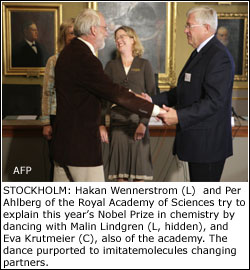
In an unusual step, two men from the committee then took to the floor of the wood-panelled academy hall and danced quietly with two women, swapping partners to give a simple illustration of the trio’s complex work.
The research into molecule synthesis has laid the groundwork for the production of new drugs to treat illnesses like Alzheimer’s, Down’s Syndrome, HIV/AIDS and cancer, as well as having uses in agriculture, chemicals and plastics.
“Imagination will soon be the only limit to what molecules can be built,” said the Academy citation, calling metathesis “an example of how important basic science has been applied for the benefit of man, society and the environment”.
The three prize winners have “revolutionised the way we think about and make our molecules today”, Professor Steve Ley, of Cambridge University in England, told Reuters. “It has important implications for the pharmaceutical and agrochemical industries.”
Schrock told Reuters TV outside his Massachusetts home that he was notified of the prize at 5:35 a.m. (0935 GMT) and that he was “very excited, very nervous. I have almost stopped shaking”.
Grubbs, lecturing in New Zealand, said the news was “still sinking in. I’ll probably have a couple of drinks”.
CHANGING PARTNERS: Metathesis, which means “changing places”, refers to the reorganisation of groups of atoms of carbon which form the building blocks of all organic life on earth.
Chauvin, who is 74 and works at the French Petroleum Institute, provided the “recipe” for this in 1971.
Schrock, who is 60 and works at the Massachusetts Institute of Technology and Grubbs, who is 63 and works at the California Institute of Technology, developed effective and more stable catalysts to reproduce the reaction.
Schrock said these catalysts “will do a kind of reaction that really isn’t possible with traditional organic methods”.
“Things are being made commercially now that are really based on this catalyst ... new drugs to treat diseases, new plastics, advanced plastics. In general organic and polymer chemistry is being commercialised now based on this technology.”
Only a few of the potential applications have so far been looked into including synthesis of insect pheromones, herbicides and additives for fuels. The process, which cuts the number of steps necessary to synthesise new molecules, thereby reducing cost, is also yet to be widely used in industry.
Adoption by manufacturers will be “a great step forward for ‘green chemistry’, reducing potential hazardous waste through smarter production”, the Academy said. —Reuters



























