0
0

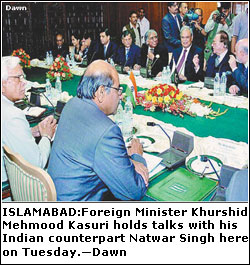 ISLAMABAD, Oct 4: Foreign Ministers of Pakistan and India on Tuesday resolved to carry forward the peace process between their countries and to maintain its momentum following a round of talks here.
The pledge was made in the joint statement read out by Foreign Minister Khurshid Kasuri with his Indian counterpart Mr Natwar Singh at the Foreign Office here.
In a specific reference to Siachen and Sir Creek issues, it added: “The two sides exchanged ideas on the Siachen issue and agreed to continue their discussions, so as to arrive at a common understanding before commencement of the next round of the composite dialogue in January next year.”
Notably, it set a certain timeframe, conveying a desire of both sides to move decisively on this front. Also, on the Sir Creek issue both sides for the first time agreed to consider options for the delimitation of their maritime boundary. They also agreed to undertake another joint survey of Sir Creek (of the horizontal section of the boundary in the area) before the year’s end and its report would be considered in the next round of the composite dialogue.
“Ideas relating to the delimitation of the maritime boundary would also be addressed in the composite dialogue with a view to its early resolution,” the statement said.
The joint statement echoed key concerns of both Pakistan and India - Kashmir and terrorism. It said: “The ministers reiterated that possible options for a peaceful, negotiated settlement of the issue of Jammu and Kashmir should be explored in a sincere, purposeful and forward-looking manner. The ministers reaffirmed their determination not to allow terrorism to impede the peace process.”
The two ministers agreed that a meeting of experts would be held in Islamabad on Oct 25-26 to start the Nankana Sahib-Amritsar bus service at an early date. They agreed that expert-level meetings would be held by the end of this year to finalise modalities for the meeting points of divided families across the LoC and to initiate a truck service on the Muzaffarabad-Srinagar route.
Also, it was agreed that technical level meetings would be held before the year’s end to discuss modalities for operationalising as early as possible the Rawalakot-Poonch bus service and starting truck service on the Muzaffarabad-Srinagar route for trade in permitted goods.
The two ministers who held the joint commission meeting in the morning expressed satisfaction at the revival of the joint commission and hoped that it would contribute significantly in strengthening the mutually beneficial relations and cooperation between the two countries.
“The two sides decided to restructure and streamline the work of the joint commission in the light of developments that have been taken place since its last meeting in 1989,” the statement said.
Elaborating on it, the statement added: “The misunderstandings reached would form the guidelines for the future work plan for the joint commission.” It said the next meeting of the commission would be preceded by technical level working groups on agriculture, health, science and technology, information, education, I.T. and telecommunications, environment and tourism.
The ministers welcomed a whole lot of measures taken by the two countries over the last one year. They also reiterated their commitment to the Iran-Pakistan-India gas pipeline project.
Foreign Minister Khurshid Kasuri accepted Mr Natwar Singh’s invitation to visit India and the dates would be finalised through diplomatic channels.
KASURI: In his brief opening remarks at the press conference Mr Kasuri stated: “On Sir Creek and Siachen we have exchanged ideas that create the possibility of resolution of these issues.” He then added: “On Siachen we have exchanged concrete ideas and we will continue discussions for reaching a common understanding.”
Jammu and Kashmir, Mr Kasuri said, was also discussed at great length. Advocating a “mature outlook” to manage bilateral disputes while trying to resolve them, he said: “We should be and are engaged in a process of conflict management and conflict resolution.”
When Mr Kasuri was asked by an Indian journalist to elaborate on the ‘concrete ideas’ on Siachen discussed at the meeting, he said it would be counterproductive to go into details. To another question on Siachen the foreign minister stressed he could not afford to say more on the issue, adding: “Suffice it is to say that we have moved forward in as much as we have been able to understand each others’ point of view.” He maintained that there was a “reasonable degree of understanding” and hinted that some proposals were seriously being considered.
NATWAR: Earlier, Mr Natwar Singh termed his talks with Mr Kasuri as “friendly, intensive and productive” and said they covered all aspects of bilateral relations. Mr Singh said he agreed with Mr Kasuri that the second round of composite dialogue achieved more positive results than the first round.
“We can expect even a more successful third round which will take place from January to July 2006,” he added.
Referring to his meeting with President Gen Pervez Musharraf in the morning Mr Singh said he conveyed to him the greetings of the president and the prime Minister of India: “We both agreed that India-Pakistan relations had made significant progress since the current dialogue process that began on January 6, 2004.”
In an echo of the joint statement he declared: “We reaffirmed our commitment not for the terrorism to impede the peace process.”
He hoped that the revival of joint commission would further expand bilateral cooperation. Pointing out that the Indian side had presented draft proposals to the Pakistani side for visa liberalisation, consular access, cultural exchange programme and on expanding both the exchange of pilgrims and increasing the lists of shrines on both sides, Mr. Singh said: “We hope these proposals will elicit a positive and early response from the Pakistani side.”
He said both sides also agreed to initiate discussions to promote bilateral cooperation in a number of areas of mutual interest such as agriculture, health, education, science & technology, information, and environment.
“Such cooperation will add greater substance to our relations both in the bilateral context as well as in the context of regional cooperation in Saarc,” he asserted.
JINNAH HOUSE: In reply to a question if the Indian government was considering Pakistan’s request for the Jinnah House in Mumbai for its consulate, Mr Natwar Singh pointed out it had been made into a Saarc Cultural Centre. When asked if it should then be considered a closed chapter, his diplomatic but evasive response was: “I think in diplomacy we shouldn’t close all doors.”
He maintained that India was mindful of the sentiments of Pakistan regarding “the House” and held out the assurance that no structural changes would be made either inside or outside it.
Answering a question on addressing the Kashmir issue, he said while positions of both India and Pakistan were known on the issue of Jammu and Kashmir it was important not to underestimate the impact of an improved atmosphere on Indo-Pakistan relations.
“I do want to assure you that there is not a single issue which we have not touched, that we consider all issues with regard to our relations of great importance,” he told a questioner.
Mr Natwar Singh said his visit to Karachi later in the day would give him the opportunity to review progress in the renovation of the Indian consulate there that will reopen simultaneously with Pakistan’s consulate in Mumbai sometime in January 2006.
After the press conference he called on Prime Minister Shaukat Aziz and discussed with him various aspects of bilateral relations. Later in the evening the Indian external affairs minister left for Karachi where he will call on the governor and the chief minister of Sindh.
At the end of the press conference when Mr Kasuri was repeatedly asked if the two countries had moved an inch or a yard forward, he just smiled and walked away.