



 0
0

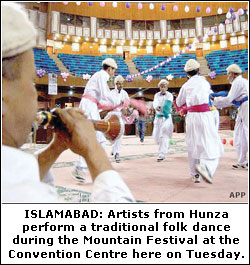 ISLAMABAD, Oct 4: The Mountain Festival 2005 concluded here on Tuesday amidst official pomp and show but left the mountain communities it was meant to project bitter. After three days of festivities which saw little presence of the natives of Gilgit-Baltistan, the organizers strongly pleaded for implementing the Mountain Areas Conservancy Project (MACP) to protect the biodiversity and ensure its sustainable use in all the mountains of Pakistan through the application of community- based conservation approach.
The festival was jointly organized by the Ministry of Environment, the IUCN, Worldwide Fund for Nature (WWF) and other agencies, to educate public about the importance of mountains in the environment of the country.
The $12 million seven-year conservancy project is funded by the Global Environment Facility (GEF), UNDP and the Government of Pakistan.
Basically aimed at showcasing the achievements of MACP and to create awareness among decision-makers, civil society, donors, academia and public about conservation of mountains, the festival comprized various parallel events relating to the life and nature in the Northern Areas.
However, a large number of people belonging to Gilgit- Baltistan felt resentful, claiming the festival was a farce played in their name.
They alleged that the documentaries shown at the festival bore no relevance to their culture but were contrary to the traditions of the mountain communities.
“People they showed in their videos as natives were in fact outsiders dressed in local attires,” the critics alleged.
“Our heads bowed in shame looking at the models of urban society pretending to be natives of Gilgit-Baltistan”, Ghulam Nabi, an environmentalist told Dawn.
He said this was totally distortion and humiliation of our rich and unique culture and traditions. They also complained that the fund spent on the festival was a waste as the mountain people needed uplift projects more than awareness about their environment.
“We don’t need to be taught mountain conservancy as we live off the environment and have sufficient knowledge how to use and sustain our mountain resources,” said Mohsin Ali hailing from the Hunza Valley.
Though arranged in the name of the people of Northern Areas, the critics said the festival was thronged by outsiders.
“You would not find more than 20 natives here,” said a group of youths from Northern Areas standing isolated in the festival grounds. “It is the families of the elite, the bureaucrats and the organizers who are enjoying the festival.”
Speaking at the closing ceremony of the festival, Federal Minister for Kashmir and Northern Areas Makhdoom Faisal Saleh Hayat said the government had increased budgetary allocation for Northern Areas by 250 per cent for its development.
In the next Annual Development Programme, the government planned to keep Rs3.4 billion for the Northern Areas. “For tourism development a new department in the area has been established with Rs20 million fund”, he added.
The minister said that for clean drinking water the government would allocate Rs50 million and the project would be initially started in Skardu, Gilgit and Chilas and would be gradually extended to other districts of northern areas.
The minister gave awards to local climbers and other peaks.
Jamal Shahid adds: On Monday night the festival had featured the music and dances of the mountain communities.
Under the theme “Celebrating The Splendour of Mountains” the festival united peoples of the various remote mountain communities through culture, arts & crafts and food. The festival had been more of a music party rich in experience and everyone was invited to join in.
The audience who had an interest in all different types of music on Monday night witnessed a splendid display of various folk dances by presenters dressed in their traditional attire.
Passionate dancers performed their traditional wedding/ceremony dance and sword dance by representatives from Gojal, Hunza and the Balti dance Maindookhtan, representatives from Diamer besides various other traditional dances of Kalash valley, Gilgit and Chitral.
These dances inspired the audience who could not resist the beating drums and the dhols pounding under the Jinnah Convention Centre dome.
Out in the spacious lawns of the Convention Centre various food, arts and crafts and thread knit stalls were set up and traders remained busy the entire day.
Earlier a presentation was arranged to spotlight various initiatives being taken for the preservation of the mountains of the north. Apart from their obvious mineral, forest, agricultural and recreational resource value the event exerted significant influence on conservation of the forests and wild life of the Northern Areas.
Tributes were also paid to the unsung heroes of the mountains for their unprecedented contributions in improving the systems of education, health, rights of women, developmental work, environment protection and other conservation activities involving the locals of their areas.



























