0
0

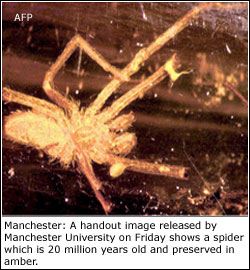 LONDON, Sept 30: A British scientist revealed on Friday he has discovered a prehistoric spider preserved in amber, possibly meaning its DNA could be extracted — just as in the blockbuster film, ‘Jurassic Park’.
The spider, four centimetres long by two centimetres wide, was trapped in resin 20 million years ago, but has been perfectly preserved, said palaeontologist Dr David Penney.
The scientist, from the University of Manchester in northern England, extracted blood droplets to determine its age.
It is believed to be the first time spider blood has been discovered in amber and could lead to its DNA being extracted — which some scientists say is impossible.
In the 1993 Steven Spielberg film, based on the novel “Jurassic Park” by Michael Crichton, scientists recreated prehistoric dinosaurs in a theme park by finding the creatures’ DNA inside insects preserved in amber.
Mr Penney said he used the blood to fathom when, where and how the spider died.
“It’s amazing to think that a single piece of amber with a single spider in it can open up a window into what was going on 20 million years ago,” he said.
Mr Penney reckons the spider was climbing a tree when
it was hit by fast-flowing resin, dying as it became engulfed.
He saw the fossil during a visit to a museum in the Dominican Republic two years ago. It is a new species from the filistatidae family commonly found in the Caribbean and South America. —AFP