0
0

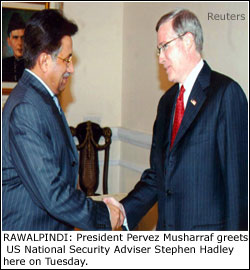 RAWALPINDI, Sept 27: President Gen Pervez Musharraf on Tuesday urged the United States to support efforts aimed at resolving the Jammu and Kashmir dispute. During a meeting with visiting US National Security Adviser Stephen Hadley, the president underscored the importance of moving towards a settlement of the Kashmir dispute in the interest of durable peace and stability in the region.
Mr Hadley praised the president for his initiatives, particularly the Pakistan-India peace process, to promote peace and stability in South Asia.
He conveyed to the president greetings of President George W. Bush and reaffirmed the commitment of the United States “to broadening and deepening its strategic relationship with Pakistan over the long term”.
Gen Musharraf recalled his meeting with President Bush in New York during his recent visit to the US for the UN summit. He expressed satisfaction at the excellent multi-faceted cooperation between Pakistan and the United States.
Mr Hadley, accompanied by US Ambassador to Pakistan Ryan C. Crocker, expressed appreciation for Pakistan’s contribution in countering terrorism and taking measures to curb extremism.
The president reiterated that Pakistan was committed to rooting out terrorism.
Mr Hadley underlined Pakistan’s role in promoting regional peace and stability. He said the US appreciated the support extended by Pakistan to efforts by President Hamid Karzai’s government for promoting peace and stability in Afghanistan.
He particularly mentioned the constructive role played by Pakistan in the context of holding parliamentary elections in Afghanistan recently.—APP
Qudssia Akhlaque and Raja Asghar add from Islamabad: Meanwhile, it is learnt that Pakistan’s quest for civilian nuclear technology and its legitimate defence needs, including F-16s, also figured in discussions.
Earlier, Mr Hadley had a comprehensive exchange of views with Foreign Minister Khurshid Mehmood Kasuri on issues of bilateral, regional and international interests during delegation-level talks.
The developments in Afghanistan and progress in the Indo-Pakistan composite dialogue also came under discussion.
The foreign minister expressed the hope that the ongoing dialogue process would lead to a solution of the Jammu and Kashmir issue that was acceptable to the people of J&K and to Pakistan and India.
Mr Hadley, who paid his first visit to Pakistan after replacing Dr Condoleezza Rice as the National Security Adviser, expressed satisfaction at the level of cooperation achieved in various fields between the two countries, a foreign office statement said.
He expressed appreciation for the arrangements made by Pakistan to help maintain peace and security during the Sept 18 Afghan polls. Mr Kasuri referred to the massive and unprecedented deployment of troops on the Pak-Afghan border for that purpose. He underlined that a stable Afghanistan was in Pakistan’s own interest and that improved security conditions in Afghanistan would encourage more than three million Afghan refugees still in Pakistan to return home.
Mr Hadley also held talks with National Security Council secretary Tariq Aziz.
Addressing a news conference later, Mr Hadley said: “The conversations... reflected the long-standing and close relationship between our two countries.”
“One of the topics was how to broaden and deepen the strategic relationship that already exists between our two countries (and) to develop a long-term agenda that will be tailored to the needs and plans of Pakistan.” Mr Hadley also travelled to Peshawar to visit the army’s Eleventh Corps engaged in fighting militants along the Afghan border and meet NWFP Governor Khalilur Rehman.
He said he and Pakistani authorities had also talked about the global war against terrorism and that he had expressed appreciation to President Musharraf for Pakistan’s contribution in the effort.
“These have been bold steps — not without risk — and they have made progress against Al Qaeda and also increasingly against the Taliban.
“There is obviously more for both of our countries to do... and we talked a little bit about what we can do together to enhance our progress on the war on terror. In that connection we also talked about the issue of democracy and the (US) president’s freedom agenda,” he said.
Asked about the mode of increased coordination in the anti-terror fight, Mr Hadley made it clear he did not mean any joint operations across the Pakistan-Afghan border.
“Afghanistan, Pakistan and US forces need to work together to do more, to address the security situation,” he said.
“This involves greater information-sharing, greater intelligence-sharing, coordination of activities on both sides of the (Pakistan-Afghanistan) border and a better dialogue to ensure we have a common understanding of the problem. That’s what I think is required.”
He said Taliban activities on the border “threaten all of us.”
He said President Musharraf had laid out “a bold agenda for the future of Pakistan” that Washington wanted to support and assist.
INVESTMENT TREATY: Mr Hadley told a questioner that Pakistan’s internal issues such as whether the country should have a parliamentary or presidential system of government was for the Pakistani people to decide, and the US could support ‘in a general way’ efforts to expand their participation in governance and support economic progress.
He said the two sides were in the process of concluding a bilateral investment treaty that would enhance foreign investment in Pakistan and contribute to the country’s growth and added: “The challenge for us is to turn these areas of potential cooperation into concrete projects.”
The US official said his talks also covered regional issues and mentioned the ‘agenda’ being pursued by President Musharraf and Indian Prime Minister Manmohan Singh for solving problems between their countries.
He sidestepped a question about whether Washington could extend similar concessions to Pakistan as promised to India for civilian use of nuclear technology.
“Our overall goal with respect to each of these relationships is to develop things that we can do with India on the one hand and the things we can do with Pakistan on the other,” he said.
“That will strengthen our respective relationships and... enhance the plans of each country for their own future.”
He said India’s plan involved a potentially heavy investment in civil nuclear power and that “in our discussions with India we have ensured that any cooperation is focused strictly on a peaceful nuclear power programme.”
He said India, in turn, had undertaken to take steps that “will ensure that any such cooperation does not contribute to the proliferation of nuclear weapons or other ones of mass destruction”.
Mr Hadley said the US needed to have “its own programme with Pakistan that is tailored to the needs of Pakistan and most of all tailored to President Musharraf’s and his government’s vision for the way forward for Pakistan.”
“The president is very anxious to come to South Asia. He would be very anxious to meet with President Musharraf here in Pakistan,” Mr Hadley said.
“It is time for the president (Bush) obviously to have that opportunity to do that here and president would like to try and do that sometime next year.”