Madressah registration
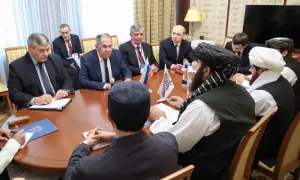
IT remains to be seen whether the understanding reached between the government and madressah managements will work and last. Prime Minister Shaukat Aziz sounded quite hopeful after his meeting with leaders of the Ittehad-i-Tanzeemat-i-Madaris-i-Deeniya (ITMD) in Islamabad on Friday. According to the prime minister, the ITMD has agreed to the registration of 9,000 seminaries. On its part the government has expressed its willingness to make changes in the Registration of Societies’ Act. If the process goes well, the madressahs operated by the ITMD should stand registered by December 31. That this legal requirement should have taken so long to be agreed upon shows the difficulties in the way. Registration had been talked about for a long time now, but little progress was made because of the government’s diffidence on the issue.
The views expressed by madressah officials seem to betray a lack of full understanding with the government. Mufti Munibur Rahman, head of the Tanzeemat-i-Madaris Ahl-i-Sunnat, sounded satisfied with the outcome of the meeting with the prime minister but hoped that the ulema’s reservations would be taken into account. Equally emphatic on the issue was Maulana Mufti Abdur Rashid, the ITMD general secretary. He said the ITMD would not cooperate with the government until its reservations were incorporated into the proposed legislation. He also made it clear that the ITMD would not disclose its sources of funding. Besides, madressahs without hostels would not be registered, nor would every campus of a given madressah. Both he and Mufti Munib also insisted that the doors of the madressahs should not be shut on foreign students, insisting that those with valid documents should be allowed to stay on. The prime minister reportedly agreed to “look into it”.
Apparently, a lot of ground remains yet to be covered before the registration process can make progress. The ulema’s main reservations concern the comparative study of other religions and sects. Comparative religion is a standard discipline throughout the world, but it is taught to impart knowledge and not to foster prejudice and hatred. The truth is that some seminaries using the study of other sects and religions brainwash their students into hating other faiths. This is counter-productive and can hardly be called the function of an institution devoted to Islamic studies. Reputed institutions of Islamic learning such as al-Azhar in Cairo and Darul Uloom-i-Deoband in India never conveyed a hate message to their pupils. That some madressahs here should indulge in this kind of parochialism is indeed deplorable.
Madressahs have been in existence in South Asia for centuries as a source of knowledge and enlightenment. They have produced outstanding scholars and had nothing to do with any sort of militancy. The US-led ‘jihad’ against the Soviet Union in Afghanistan turned some Pakistani madressahs into recruitment centres and schools for political brainwashing. This has had disastrous consequences not only for Pakistan’s political culture but also for the very fabric of society. To rediscover the madressahs’ traditional role, the government and the ulema must cooperate on solving the issue amicably. The curricula in many madressahs, including Binnori Town, already include modern subjects; other seminaries, too, should be required to give their students a modern education so that on completion they can compete with others for employment. The registration issue must be solved to the satisfaction of both sides, and the government should not hesitate to take action against those resisting registration or disclosure of foreign funding.
New line-up in the making?
THE ongoing drama in Vienna has far-reaching implications for international politics of the post-Cold War era. On Friday the EU-3 presented the IAEA’s governing board with a resolution calling on the agency to report Iran to the UN Security Council for non-compliance with nuclear safeguards regulations. This is a modified version of an earlier draft which had called for “immediate referral”. The new draft is expected to be passed by a majority of the 35-member board. The significance of the developments of the past few weeks lies in the line-up of countries for and against the resolution. Since 2003 when the Iran nuclear crisis came into the open, the United States has adopted an unequivocally hardline stance against Iran. The EU, which was at that time resisting the American position on Iraq, chose to be conciliatory. Now that Iran’s new government has revoked the freeze President Khatami had agreed to on uranium processing, the EU has reacted strongly. It is now closer to the US position. But Russia and China have made it clear that they will not agree to penalize Iran. In fact, Russia is even helping set up a nuclear plant at Bushehr and will be supplying fuel for its operation.
It is not so much whether Iran is voted guilty or not that is the key issue at the moment. It is the new alignment that is emerging in international relations that is significant. China, which has the fastest growing economy in the world today, and Russia, which still has a large arsenal of nuclear weapons, are now challenging American hegemony. India has voiced its opposition to the EU-3 draft but has also appealed to Iran to be reasonable. There is an air of déjà vu in this scenario. In the early fifties the USSR and China had joined hands to act as a countervailing force in international politics. Although the Cold War kept the world on tenterhooks for four decades, it enabled the developing countries to protect themselves from the domination of one superpower or the other. If the same pattern is emerging today, it would be a blessing for the security of the Afro-Asian countries.
Setting a good example
THE restoration of Tollinton Market, a colonial-time landmark on The Mall in Lahore, comes as a welcome move. The Punjab government has decided to hand over the refurbished hall to the Lahore Museum, directing it to set up a city museum there. This is encouraging at a time when rampant commercialization has become a fetish with most city governments. Tollinton Market was set up way back in 1864 on a temporary basis to house the first-ever Punjab industrial and agricultural exhibition, which later became a permanent feature because of its popularity. The then colonial rulers decided to keep the hall for the purpose. In the post-independence years, however, Tollinton Market degenerated into a fruit, vegetable and meat market, which caused immense damage to its elegant structure. The government evicted the vendors from the premises when Tollinton Market faced the threat of collapse .
The restoration of this city landmark and its intended use as a museum should be taken as an example for other buildings in the country. Karachi’s Empress Market in the Saddar area is one such landmark that readily comes to mind. Similar restoration work there will be of immense cultural importance. It is a shame that the government could not save the old Dean’s and Faletti’s hotels in Peshawar and Lahore, respectively, when they became victims of dilapidation. Similarly, Lahore’s sprawling Mayo Gardens and Karachi’s Parsi Colony are but two historical quarters which are in need of conservation. The spacious bungalows there should be saved from demolition by declaring them part of the national heritage. That is the only way to save these neighbourhoods from greedy developers out to commercialize residential areas.
German elections’ impact on the EU
 EUROPEAN Commission chief Jose Manuel Barroso is a cautious man, reluctant to get entangled in the complex domestic politics of the European Union’s 25 member-states. But only a few days after Germany voted inconclusively for a new chancellor, the chronically prudent Commission chief admitted to reporters in Brussels that he was hoping for a quick return to political stability in the bloc’s largest, richest and traditionally most economically powerful country.
It would be “useful if there were a rapid outcome” to German politicians’ current search for a coalition to provide Germany with a new government, the former Portuguese premier said at a news conference. “We have to respect democracy which goes at its own pace,” Barroso said. But it would be so good for the stability of the rest of Europe, if German politicians could swiftly get their act together and agree on a new government to deal with the many economic woes facing the trouble country.
The Commission chief is not alone in hoping German Chancellor Gerhard Schroeder and conservative challenger Angela Merkel can stop squabbling over the election results and whip up support for a coalition government that can govern Germany for the next five years.
Fears that the unprecedented current political deadlock in Germany will impact on the rest of the EU have also come in recent days from a host of politicians and experts, including European Central Bank president Jean-Claude Trichet.
Whoever ends up in charge of the next government must give priority to job creation and growth, Trichet insisted recently. The ECB chief said continued commitment to economic reform in Germany was essential if the euro zone was to increase its poor growth rates, forecast at below two per cent in 2005.
Separately, the head of the International Monetary Fund (IMF), Rodrigo Rato, expressed optimism that Germany’s next government will address the problems facing Europe’s largest economy. “I wouldn’t be pessimistic,” Rato said in a newspaper interview, adding: “There was a consensus, at least among the two big parties, that reforms were crucial.”
Rato has a point. While media focus has so far been on the unprecedented political chaos in Germany following the Sept 18 polls — and the rival claims to be chancellor being put in by Schroeder and Merkel — there is growing recognition across Europe that contrary to conventional wisdom, German voters did not turn their back on reform.
Both Schroeder and opposition leader Merkel have, in fact, put economic reform of the sluggish German economy high on their agenda, with a special focus on changing the rigid rules which currently govern the highly-regulated German labour market. And a majority of Germany’s 62 million voters cast their ballots in favour of change.
What Germans did disagree on, however was the pace of reform. Those voting for Merkel’s Christian Democratic alliance (CDU/CSU) and the liberal Free Democrats (FDP) demonstrated a willingness to accept reform shock therapy, including an immediate rise in taxes and more flexible hire and fire rules for German companies. Those in favour of Schroeder’s Social Democrats (SDP), in contrast, illustrated a preference for a softer and longer route to change, while admitting that reform was inevitable.
The courage and acceptance for reform shown by the German electorate is, in fact, an example for other EU governments, especially in France and Italy, which must also inevitably take up the challenge.
French politicians, preparing for presidential polls in 2007, are watching events in Germany particularly closely. Merkel went out of her way in the run-up to the elections to build up a common modernizing pro-reform platform with French Interior Minister Nicolas Sarkozy who has gone public with his ambitions to replace President Jacques Chirac at the Elysee Palace in two years. “Iron lady” Merkel’s poorer-than-expected showing at the polls is certainly causing some concern in the Sarkozy camp.
Another uneasy bystander is British Prime Minister Tony Blair who had been banking on a clear-cut Merkel victory — to be followed by Sarkozy’s poll success — to construct a new alliance of EU leaders ready to embrace change and shake up the continent’s economic structures.
While Merkel may still get a chance to become Germany’s first female chancellor, her mandate for change has been weakened by the results of the polls which give her party only a three-seat majority in the Bundestag.
It is an open secret in Brussels that Barroso and other commissioners, tired of dealing with an increasingly assertive — and tight-fisted — Schroeder, were also looking forward to the victory of the pro-business and pro-reform Merkel.
While coalition talks have opened among the major parties, agreement on forming a new governing alliance will require much effort and patience. Most analysts concur that the emergence of a “grand coalition” bringing together the rival SPD and the CDU/CSU is still the best option for a country which needs a national consensus to kick-start the faltering economy. The problem is, however, that both Schroeder and Merkel want to head such an alliance. Some in Berlin are betting on a so-called “traffic light coalition” which would include the current SPD (with red as the trademark colour) and Greens alliance joined by the Free Democrats (with yellow as their campaign colour). A so-called “Jamaica coalition,” including the CDU/CSU with the FDP and the Greens — named as such because the black-green-yellow official party colours match the Jamaican flag — is another possibility.
Merkel, however, recently dampened prospects of a conservative coalition with the Greens by saying there were huge policy differences between the two parties. Senior Greens members have also expressed deep scepticism over setting up the “Jamaica coalition.”
Even more significantly perhaps, Schroeder and Merkel are standing firm on their respective demands to be the next German leader after a first round of talks held in Berlin on September 22. Both have, however, agreed to meet again in Berlin soon.
While politicians in Berlin engage in power struggles, the focus in Brussels is on ensuring that Germany — whatever its government colours — stays in the forefront of EU efforts at further political and economic integration.
As European commissioner for industry Gunter Verheugen, a German social democrat, warned recently, “When Germany is not capable of decision-making, the whole EU stagnates.”
The need for decisive action and an end to the current paralysis is especially necessary given the EU’s recent troubled history, including the rejection this summer of a new EU constitution by German and Dutch voters.
There is no denying that although it has not played as active a leadership role as in the past, Germany has a pivotal role to play in EU policymaking. Europe, struggling to rev up its economy and meet global competitive challenges, clearly needs a Germany in full gear, ready to undertake bolder and more rapid reform.
Berlin’s influence in the 25-nation bloc cannot be underestimated. Germany is the largest contributor to the bloc’s joint 100 billion euro annual budget and, with a massive number of votes in the Council of Ministers, has a crucial input in all EU decisions.
Often with France at its side, Germany has long been the “locomotive” for further EU integration, including the creation of a frontier-free single market and the introduction of the euro. Last year’s EU enlargement into eastern Europe and the scheduled start on October 3 of negotiations on Turkey’s membership of the bloc were also the result of strong German campaigning.
Crucial decisions are now needed to revitalize the EU economy and set it on a new path of rapid development. EU leaders meeting for an informal summit end-October have to debate an appropriate “social and economic model” for the bloc. Commission chief Barroso, meanwhile, is urging governments to speed up work on market deregulation as part of a so-called Lisbon agenda on boosting EU competitiveness.
Most importantly, the EU needs accord on a new six-year budget to ensure the bloc’s economic vitality and global standing in the coming years.
The weeks ahead promise to be difficult for both Germany and the EU. What German newspapers describe as an election without victors is being followed by tough political horse-trading, with Schroeder and Merkel — who hurled insults at each other during an unusually fierce election campaign — in no mood to compromise.
Although the “war of the chancellors” — as German news reports describe the current battle for power in Berlin — is expected to be long and hard, many commentators believe that a “grand coalition” between Merkel’s conservatives and Schroeder’s social democrats is likely to emerge at the end of the political wrangling.
Some analysts warn that a “grand coalition” of conservatives and social democrats will mean decision-making gridlock in Berlin. Cooperation among “strange bedfellows” championing different and often conflicting political and economic agendas is unlikely to lead to strong policies or decisive action on either the domestic or European fronts, say EU diplomats in Brussels. Many German industrialists, favouring a conservative alliance with the pro-business liberal FDP, have also warned that a government run by the rival parties will make their country harder to govern.
| © DAWN Group of Newspapers, 2005 |