0
0

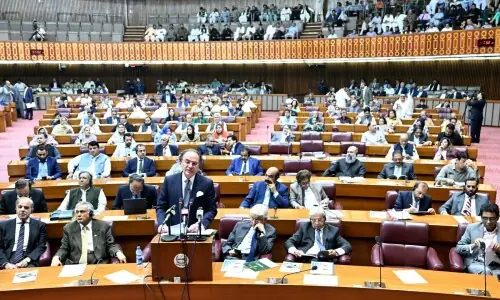
ISLAMABAD, Sept 23: The Senate on Friday disposed of a heavy agenda after the opposition ‘generously’ agreed to defer the question hour allowing the government to pass a bill and table various motions and ordinances.
The house disposed of an opposition’s resolution seeking to disapprove the Federal Public Service Commission (Amendment) Ordinance 2005. The ordinance aims to reduce the tenure of the commission’s members to three years from five years.
Farhatullah Babar and Mian Raza Rabbani of the Pakistan People’s Parliamentarians did not press on the resolution on the request of the leader of house Wasim Sajjad after both sides debated the rationale of the ordinance.
Mr Babar said it was regrettable that the ordinance had been given retrospective effect to get rid of four FPSC members. He said the action was based on mala fide intentions and was aimed at suppressing the annual report submitted by the FPSC chairman in which he had pointed out certain out-of-turn extensions.
He pointed out that the annual report was to be presented before both houses of parliament but it was not done despite two reminders having been sent to presidency.
He described the step as unconstitutional and as a means to discourage honest and competent persons in the country’s most prestigious institution.
The house took serious notice of the reported murderous attack on the son of the leader of opposition in the National Assembly Maulana Fazlur Rehman and Senator Abdullah and attributed it to the government’s failure in providing security to people.
Condemning the attack, leader of the house Wasim Sajjad said terrorism was an international problem that needed to be combated by every nation.
Raza Mohammed Raza of the Pukhtunkhwa Milli Awami Party raised the issue of firing in his area in Balochistan. Calling it a serious matter, he said the ammunition seized from the area was never seen before. He regretted that while killings were rampant in the area the government instead of paying attention to such issues was busy manipulating results of the local government polls.
Mr Raza said it was pity that while Afghanistan had entered the democratic era by holding polls “we are still struggling to gain our democratic rights”.
Addressing the chair, he said: “Mr chairman, in your absence from the house a number of illegal actions were taken as a result of which the entire opposition boycotted the proceedings.”
He rejected Mushahid Committee’s report on the Balochistan problem, saying it had ignored real problems of the province.
The opposition and treasury benches agreed on setting up of a joint mediation committee of the two houses of parliament to propose certain changes in the Pakistan Electronic Media Regulatory Authority (Amendment) Bill 2005. The Pemra Bill was passed by the National Assembly on June 22.
On a motion by Parliamentary Affairs Minister Dr Sher Afgan Niazi, the house approved names of Abdur Razzaq Thahim, Shahzad Wasim, Tanveer Khalid, Tahira Latif, Mohammad Amjad Abbasi, Shujaul Mulk, Abdullah and Kamran Mujtaba for the committee. The National Assembly had already nominated eight members for the committee to be chaired by Dr Niazi.
At the outset, leader of opposition Mian Raza Rabbani proposed that since it was the last day of the session the question hour might be deferred to enable the government to dispose of the heavy agenda for the day.
Senator Safdar Abbasi of the PPP, referring to the Hydrocarbon Development Institute of Pakistan Bill, 2004, criticized the government for running its affairs through ordinances.
Senator Mushahid Hussain Syed presented the report of the standing committee’s meeting with the delegation of the All Parties Hurriyat Conference which visited Pakistan in June.
Senator S.M. Zafar, chairman of the functional committee on human rights, presented a report of the committee for the period from Jan 1 to July 1, 2005.
Senator Khalid Ranjha, chairman of the standing committee on law and justice and human rights and parliamentary affairs, presented the committee’s report on the Contempt of Court Bill 2005.
He introduced two ordinance — The Pakistan Telecommunication (Re-organization - Amendment) Ordinance, 2005, and The Alternative Energy Development Board Ordinance, 2005.