



 0
0

The storm that wasn’t
 Was it the Met people or the eveningers that kept us on tenterhooks all week about an expected sea storm threatening Karachi and other coastal areas? Maybe there actually was a storm building up and then it dissipated. Whatever the truth, there was some anxiety among the citizens, and fishermen were told to tie up their boats and not venture into the sea.
Strong winds blew on Tuesday and Wednesday, deepening the fears, but eventually it all passed off fairly uneventfully. The winds were hot, not totally unusual for Karachi during this change of season but nevertheless catching people on the wrong foot. The city and its denizens are not much used to sudden changes in the weather; they have got accustomed to a muggy monotony throughout the year, enlivened most evenings by a pleasant breeze from the sea. Winter reveals itself only in flashes and the rains are usually now conspicuous by their absence.
In Punjab and the northern subcontinent, the hot summer wind known as the “loo” was a regular feature of the pre-monsoon months of May and June, but there too the weather pattern has been thrown into disarray by environmental pollution and degradation. People were warned against going out bareheaded in the sun, and children were told that slices of raw mango could protect them against the ill effects of the “loo”. “Loo lagna”, stricken by the hot wind, was a common diagnosis for summer fevers.
There was something or the other associated with each season. That lore too, like much else of our popular heritage, is fading out.
Continuing ding-dong
The MQM and the Jamaat-i-Islami continue their ding-dong because the city nazim and naib nazim slots have still to be contested. The MQM is sure to bag both posts, although JI’s former nazim, Naimatullah Khan, is putting a brave face to the coming contest.
He’s been seeking to remind people of the development work undertaken during his nazimship. Unfortunately, he was a little too zealous in ordering new schemes during his last days in office, and residents now chiefly remember him by the mess he has left on the roads. Many areas are dug up, leading to immense traffic problems. Mr Naimatullah Khan knew his term was ending and he knew that the new road and park projects he was initiating would not be completed in time, and yet he went ahead in a kind of a last fling. Now the incumbent city leadership will be able to lay claim to the projects.
But Karachians hope that the projects will not be left incomplete just because someone else had thought of them. The incoming city government will be on test both with regard to efficiency and transparency.
Paisa in the singular
A reader from the PECHS, M.S. Ali Hyder, has written to point out that the word “paisas” used in the plural in an item in this column on Aug 16 (and also in an internet advertisement) is wrong. Paisa he says is an Urdu word and just by adding ‘s’ it cannot be baptized as paisas.
Mr Hyder says when, under the decimal system, paisa coins were minted, the government had widely publicized the fact that the word “paisa” would be used for both singular and plural forms. This was done to distinguish our coin from its Indian counterpart. The Indians use paisa for one paisa and paise for the two, five, 10, 25 and 50 denomination coins.
Those, Mr Hyder adds with tongue in cheek, who are using paisas in the plural are stretching the paisa a little too much since it has no monetary value left except for accounting purposes.
Landmark gone
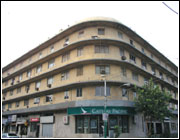 With the Metropole coming down, to be replaced perhaps by a residential-cum-commercial centre, many memories have been revived about the hotel. A colleague remembers when it had become a rendezvous for senior journalists who would gather there almost every evening for a cup of tea, which was only Rs2 at the time, the 50s. It was conveniently reached from almost all newspaper offices and while Rs2 at that time was not a small sum, many junior reporters too used to go there to listen to their seniors talk on politics and journalism.
The Palace Hotel too had begun to attract quite a regular crowd of journalists and intellectuals, with Faiz Ahmad Faiz prominent among them during his Karachi sojourn. That too is gone. Both the Palace and Metropole hotels had great floor shows. Ah, those were the days, you can hear many say.
There was Café Grand, a little more expensive and exclusive, but nevertheless good for a splurge on payday. They served tea with proper pastry stands, patties on the lowest platter. That’s boarded up.
— By Karachian
email: karachi_notebook@hotmail.com
Friends can go to hell

WHEN Atal Bihari Vajpayee prescribed a new approach in India’s foreign policy in 1977, which included the intriguing sobriquet of ‘genuine non-alignment’, he was branded by the Congress party as an American stooge for seeking to recast New Delhi’s traditional ties with the Soviet bloc.
Now the boot is on the other foot. In the absence of the Soviet Union today, the Congress party has pursued Mr Vajpayee’s prescription of leaning heavily on the United States, even though there has never been any electoral mandate for either Mr Vajpayee or to the Congress to pursue this approach.
In following a policy that leans on this or that bloc India has callously picked up friends and betrayed them at will. Perhaps this has happened with every country that was caught in the vortex of Cold War rivalries. But India or at least Nehruvian India did once take pride in being a friend and representative of the Third World countries. All this does not seem to go well with our new-found zeal to become some kind of a superpower ourselves.
Prime Minister Manmohan Singh is himself a prime example of an ideological turncoat. Having been an advocate of South-South cooperation, he is today a champion of North-South dialogue.
Majaz Lucknavi, the renowned wit and poet from Lucknow, used to tease Salaam Machhlishehri, a lesser known versifier from the qasbah of Machhlishehr, thus: “Meet Salaam Sahib. He is the biggest poet in all of Machhlishehr.” Likewise, India with its rampant poverty, fractious polity and galloping corruption may be heading to become a major superpower of a Machhlishehr or some such, but little more. As the eminent historian Sarvepalli Gopal would say, we are building an imposing structure on crumbling grounds.
What we have already lost on the route to our upward mobility is the trust of friends who would once look up to India in times of need.
Some of these former friends include Iraq, Palestine and Afghanistan.
Iraq was India’s pillar of support on Kashmir in the entire Middle East, in fact in the entire Muslim world. You might disagree with Iraqi and Indian positions on Kashmir, but we are not discussing that. We are discussing friendships.
Right up to the Kuwait war, India appeared to stand together with Iraq. At that time foreign minister Gujral, on most occasions a non-descript politician, established himself as a man with a mind of his own by flying to Iraq and embracing Saddam Hussein, to the chagrin of the Allied forces.
India’s betrayal of Iraq is not a unique event. Prof Perry Anderson noted with cold reasoning that the phenomenon was more widespread.
Remember the massive anti-war rallies in Europe, most notably in Britain. Remember that the course of the Spanish elections was changed when the party opposed to the war effort in Iraq pulled off a shock victory.
There were protests in Latin America, notably in Brazil. In Asia, notably in Pakistan, people were out in the streets. Even in India protesters came out, very few of them, but they were there, against the war. But when it came to a vote in the Security Council to seek the reconstruction of the militarily occupied country, all 15 members, including Pakistan and Brazil and Spain, endorsed the American-led move.
“Suppose India was present and voting in the Security Council, would it have done anything different?” Perry Anderson asked rhetorically.
“India would be doing precisely what it has been doing on behalf of the United States in Nepal,” he replied amid applause from a largely anti-war meeting of students at Delhi University.
This was some moons ago.
As far as establishing ties with Israel was concerned, there was nothing that happened in 1992 for India which had not happened in all of 50 years preceding it. Crown Prince Fahd was piloting an Arab League initiative to recognize Israel in 1981. But India kept aloof, in Iraq’s company, of course. Why?
It claimed to be ideologically and morally bound to back Yasser Arafat. But suddenly the cogent logic of this stand vanished in 1992, and for the worst possible reason. The policy had no leg to stand on after the Soviet Union disappeared. There was no need to give excuses, blaming the poor Indian Muslims for stalling the ties with the Jewish state all these years. Why are we sheepish about something we claim to believe in?
One of the reasons that eventually came to be cited was the need for a military cooperation if not an alliance with Israel to deal with the Kashmir uprising and with Pakistan. What has become of that notion today, now that Pakistan has limbed the gravy train? Indian diplomacy can go on a high protein diet with so much egg to lick off their faces.
India’s forays into Afghanistan were equally dreadfully ill-conceived.
From becoming a lackey of the Soviet establishment in Kabul, to seeking allies among the former rebels to switching loyalties to an American installed, insecure and frightened regime, India has lurched from one betrayal to another. All that seems to matter to the policy makers is building cooperation with Kabul for reconstruction, euphemism for a slice of business, some crumbs from the likes of Halliburton.
It is in this context that reports are coming in of yet another betrayal about to happen. “India will vote with the United States, France, Britain and Germany in the International Atomic Energy Agency’s (IAEA) board of governors if forced to make a choice on referring the question of Iran’s nuclear intentions to the United Nations’ Security Council,” the Hindu reported on Friday.
It quoted ‘highly-placed’ sources in the Indian foreign ministry as saying that the decision to vote with the US in a crunch situation was taken even before Prime Minister Manmohan Singh went into a meeting with US President George W. Bush in New York.
“At this bilateral meeting Iran is said to have come up for discussion,” the Hindu said. India’s reported stand looks even more untenable in view of reports from New York to the effect that the United States and the European Union ‘three’ are backing off from asking the IAEA’s board to refer Iran to the Security Council on September 19 itself.
The board is meeting in Vienna on Monday. “In such a scenario, where the EU ‘three’ foreign ministers have had diplomatic contacts with the new Iranian leadership in New York, it appears that India will not immediately be called upon to vote one way or another in the IAEA board,” the newspaper reported. In other words if Iran does get a reprieve from hell, since another war would be nothing short of hell, it would be despite India’s readiness to play Judas.
Tibbe Nabawi or ‘Prophet’s medicine’ is striking root in Hyderabad and its vicinity as an alternative system of curative and preventive medicine. The system is said to be based on Sunnah, the life and tradition of the Holy Prophet (peace be upon him) and the Hadith.
“Tibbe Nabawi is free of chemicals and based on natural herbs and food products,” says a report in the Asian Age. At least a dozen Tibbe Nabawi clinics have opened in Hyderabad and other parts of Andhra Pradesh.
jawednaqvi@gmail.com
| © DAWN Group of Newspapers, 2005 |


























