0
0

UN and terrorism
AS the UN’s General Assembly dithered on the issue of terrorism — the number one problem facing the world today — the Security Council proceeded to unanimously adopt resolution 1624 last week. This calls on all 191 members of the UN to “prohibit by law incitement to commit a terrorist act” and to deny “safe haven” to anyone suspected of incitement. The driving force behind the resolution was the British prime minister who had been promoting this concept ever since Britain suffered its worst terrorist attacks in July. This resolution will be accepted in principle and will not be questioned by any government, mainly because it is more a declaration of intent and provides no clear-cut framework of action. As such, it is left to every government to find its own definition for “terrorism” and “incitement”. One only hopes that all governments will adopt uniform criteria when they talk of incitement to terrorism. For instance, in Britain itself there have been political leaders, committed to an extreme nationalist agenda, who have lashed out at immigrants in a virulent manner so that cases of racist violence against Asians continue to occur even today.
Since each country will have to determine its own parameters of what constitutes terrorism and find ways and means to tackle it, Pakistan will have to focus on this issue in a more concentrated way. In our context it is very clear that anything which leads to violence, assault and murder — be it in the name of any cause — amounts to terrorism. It should not under any circumstances be condoned. Nor should anyone be allowed to preach such violence within the country or abroad. It is therefore important to identify the sectors where hatred against a group, class, sect, or government is promoted in such a way as to incite some people’s passions and anger and drive them to committing acts of terror. Purveyors of hatred and violence should be nabbed before they carry out their designs. Prevention is always a better strategy in such cases but it may already be too late for that, given the fact that the poison of hatred and terror has already spread far and wide in our society.
Two areas where violence and hatred are freely preached are the mosques and the madressahs, many of which exhort people to wage jihad against non-Muslims. Although all of them do not direct people to actually go and attack the so-called enemy, they do propagate intolerance and hatred. In this respect the officially prescribed curricula of schools and colleges as well as some television channels are also spreading a similar message. While guidelines will have to be drawn up as to what is acceptable and what is not for those operating in the grey areas, the madressahs will have to submit to the law of the land which requires them to register with the authorities. It is surprising why the madressahs which have now joined hands under the Ittehad Tanzeemat Madaris Deenia have reneged on their earlier decision to register. They are now demanding changes in the law. Under no circumstances should the madressahs be allowed to decide what they wish to teach, especially if it incites violence. By the same token, institutions which impart military training to their students in the name of jihad should be closed down, for violence and terror should not be tolerated under any circumstances.
Need for mass transit system
KARACHI is perhaps the world’s only mega city without a mass transit system. For the future, too, there is no hope because no plans exist for giving this city of twelve-million plus a mass transit system that would be cheap, fast and comfortable. These thoughts have been occasioned by Sindh Governor Ishratul Ibad’s directive the other day to officials concerned to expedite work on the Karachi Circular Railway. The KCR must of course be “revived”, unless the bit of run from the City Railway Station to Landhi is supposed to have already done this. But the point to note is that the KCR is no substitute for a rapid transit system. Its very alignment is odd. It is of no use to a person who wants to commute, say, from the University of Karachi to Defence or from Sohrab Goth to Saddar. The new emphasis on the KCR merely confirms the unannounced death of the elevated light railway plan on which millions had been spent on planning alone. Even an Indus Mass Transit Company, with funding coming from Japanese, Canadian and Saudi Arabian sources, had been set up, and a prime minister had even laid the foundation stone for it. But the end result has been zero.
The future is dark. The way the number of cars is increasing in Karachi, the day is not far off when owning a car will be counter-productive. Already, traffic jams have doubled driving time and considerably increased petrol consumption. But the tragedy is that one cannot give up the car option because there is no sign of a mass transit system in the foreseeable future. The so-called car-driven VVIPs, for whom security forces clear the way, have no idea of the traffic situation in Karachi. Notwithstanding the need for the KCR to become functional, a rapid transit system is overdue for our major cities, especially Karachi and Lahore. Mass transit systems do not exist only in the developed world. Even such Third World cities as Kuala Lumpur, Kolkata, New Delhi, Tehran, Cairo and Ankara have them.
Regulating billboards
STRONG winds in Karachi the other day caused a massive billboard on one of the city’s busiest roads to topple and fall on a parked car and several motorcycles. Mercifully, the car was empty or the consequences could have been more damaging. The incident however underlines the mushrooming billboard industry in the country’s largest city and is a strong case for greater regulation of this thriving sector of Karachi’s economy. According to a former city nazim, out of the 17,000 plus billboards, a mere 6,000 are legal while the rest are actually unauthorized. Considering that Karachi is Pakistan’s economic and commercial capital, the trade of buying and renting of billboards is big business. That perhaps explains why so many billboards are in fact illegal. A well-known local NGO involved in fighting the land mafia and those who illegally occupy public space and property has made the claim that these unauthorized billboards are protected by those who install them and that such elements are often working hand in glove with officials of the various town administrations.
So, one of the tasks for the new nazim of Karachi will be to ensure that all unauthorized billboards are removed. Second, all authorized signs should be properly secured by those who construct them and that in case of an accident, the proprietor should pay for any damage done. Those allegedly involved in facilitating illegal billboards — there cannot be so many without official connivance — should also be taken to task. In addition, the city administration and the cantonment boards under whose jurisdictions the billboards are located should also see to it that the interests of the motoring public and residents are fully protected by restricting the number of billboards at any major traffic intersection.
A premature initiative
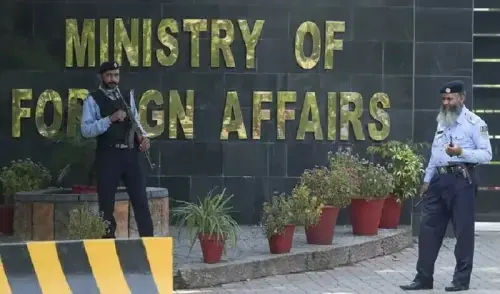
THE meeting of the foreign ministers of Pakistan and Israel at Istanbul on September 1 is believed to be the first formal contact between the two governments. While the previous governments have been secretly in contact at a lower level for more than a decade, the Musharraf government, throwing all cautions overboard, chose to negotiate with the hard-line Likud regime headed by Ariel Sharon. The circumstances under which the meeting was held were somewhat intriguing.
The Pakistan side gave the impression that the initiative was taken on urgings of the Muqtadara chief, Mahmoud Abbas, who during a visit to Islamabad in May, requested Gen Musharraf to send a high-powered delegation to Gaza and the holy city. The Palestinian leader had also requested the Pakistan president to use his influence with the international community to get the West Bank vacated so an independent Palestinian state could come into being.
It would indeed be very naive if Islamabad understood it as a request by the Palestinian leader to use its good offices with the Jewish state to oversee the vacation of the occupied West Bank including Jerusalem. For neither Pakistan enjoyed friendly relations with Israel nor is it a formidable military power that could exert any influence on Israel. It would have made some sense if Mahmoud Abbas had approached India in this regard.
All that the Palestinian leader would have meant was that Gen. Musharraf may persuade George Bush to press Sharon to withdraw from the remaining occupied Palestinian territory. And this is borne out by the reaction of the Palestinian deputy prime minister and information minister, Nabil Shath, who denied that any such request was made by the Palestinians that Islamabad establish any relations with Israel before the withdrawal of its forces from the West Bank. He regarded such a move as being tantamount to rewarding Israel before evacuation of those areas and the establishment of Palestinian state.
Later, Mahmoud Abbas confirmed it in an interview to a private television channel by stating that Pakistan’s move to establish diplomatic relations with Israel before the establishment of an independent Palestinian state was premature.
However, the Palestinian president was satisfied with the assurance of Gen. Musharraf that negotiations between Pakistan and Israel did not imply recognition of the Jewish state and that Islamabad would not recognize it until the establishment of an independent Palestinian state.
Again, the official and non-official media gave the impression that the Kasuri-Shalon meeting took place on the initiative of Israel, which was keen to establish diplomatic ties with the leader of Islamic bloc of nations. This is not true. According to a spokesman of the Israeli foreign ministry, the meeting was arranged at the request of Pakistan by the Turkish government.
Among reasons given by Gen Musharraf for open diplomatic contacts with Israel are: (1) Pakistan decided to engage with Tel Aviv in response to its evacuation of Gaza in order to persuade it to continue this process in the West Bank as well; (2) Pakistan would neutralize the Zionist lobby, which has been backing India’s case on Kashmir.
It is a wishful thinking on the part of Pakistan to entertain such hopes since neither Sharon nor the Labour leader, Shimon Peres, is prepared to dismantle the West Bank settlements. In fact, the settlement building activities had intensified during the tenure of the Labour government. And over and above, George Bush has publicly declared that Israel could keep some of the Jewish settlements.
If Israel does not withdraw from the West Bank and the holy city as is generally expected, then Gen Musharraf will have either to persuade the Palestinians to be content with the Bantustan-like status of the West Bank — an inevitable result of partial Israeli evacuation — or break off (diplomatic) ties with Israel. In the ultimate analysis, Pakistan would be estranged from both Palestinians and Israel. Therefore, the very purpose of Gen. Musharraf’s diplomatic overtures towards Israel will be defeated.
Again, assuming that Israel withdraws from the whole of the West Bank and agrees to the establishment of an independent sovereign Palestinian state, and then Pakistan recognizes Israel, would that be the end of Israeli occupation? No, because Israel still occupies a large tract of Syrian territory, the Golan Heights, annexed in 1981. The 1967 Security Council resolution 242 denounced the acquisition of territory by force as illegal and ordered the belligerents to withdraw their troops to their pre-June 6, 1967 position while in 1981 the Council rejected the Israeli annexation of Golan Heights and directed it to return it to Syria.
Not only that Israel has not complied with this resolutions, it has evicted half a million inhabitants of the Golan Heights from their hearth and home and settled Jews in that area. If Islamabad recognizes Israel while it continues to occupy the Golan Heights in Syria and Sheba farms in Lebanon, would it not tantamount to acquiescing in to annexation by conquest? Apart from its repercussions in Syria, Lebanon and the Arab countries generally, it will have serious implications for Pakistan in respect of Kashmir. India has annexed Kashmir in the same way as Israel has annexed Jerusalem, West Bank, the Golan Heights and Sheba farms. If Pakistan acquiesces in to Israeli occupation of some Arab territories, it loses the moral — if not legal — right to demand the termination of Indian occupation of Kashmir.
The protagonists of Islamabad-Tel Aviv ties argue that the country’s overriding considerations of national interest dictate Pakistan to establish relations with Israel. They believe that no sooner than Pakistan recognizes Israel, trade, technology and investment would flow into Pakistan and the Zionist lobby would stop demonizing this country and Islam.
There may be some relaxation in Israel’s anti-Pakistan lobbying in the US and western capitals, but it is doubtful that it will mediate in the Kashmir dispute or sell sophisticated military technology to Pakistan. Of course, the Jewish state would be interested in moving into Pakistan market which will be thrown open to it after the normalization of ties which may be already in progress. But for these peanuts, Islamabad could wait for some more time — until Israel’s evacuation of all the occupied Arab territories.
There is no doubt that Gen Musharraf made unnecessary haste in establishing official contacts with Israel before latter’s compliance with the UN resolution for withdrawal from all the Arab territories. The right thing to do would have been to let the Arab League decide about the recognition of Israel since it is primarily an Arab-Israel affair. The Pakistan government should have pondered as to why Mahmoud Abbas did not use any leader of the Arab League to pull the chestnuts out of the fire and instead chose a non-Arab for that purpose. Or it was just a ruse and George Bush was behind the scene.
Rhetoric of workers’ rights
EVER since Ernest Bevin led his Transport and General Workers’ union against the first Labour administration in 1924 — provoking a nervous premier to declare a state of emergency — there has been argument about the proper relationship between a Labour government and the trade unions who created and funded the party. On Thursday, as delegates went home from the 137th Trades Union Congress, the conundrum seemed closer to resolution than ever before.
There are still-powerful trade union leaders who believe Labour’s foremost concern should be to govern in the interests of the unionised workforce; but their hopes that a Gordon Brown premiership would somehow reverse the Blairite “fairness not favours” rule were scuppered by the chancellor’s tepidly received speech on Tuesday.
Beneath the rhetoric of workers’ rights, Mr Brown is as convinced as Mr Blair that the proper response to globalization is stability and efficiency rather than “the old conflicts and disorder” that destroyed earlier Labour governments. There would be no restoration of old trade union rights in a Brown administration.
As government spokespeople never tire of pointing out, there are other ways of fighting poverty, unemployment and low wages. In the past eight years there have been huge advances - most famously, the minimum wage but also, for example, on family friendly working and childcare costs — that would be inconceivable under any other government.
But the trade unions are also right to argue that these are nowhere near enough. The minimum wage is still too low. Women are barely nearer equal pay now than 30 years ago. And the Gate Gourmet dispute - on which government speakers were notably silent - illustrates the difficulties of mounting an effective campaign against an unscrupulous employer.
However, as the TUC general secretary Brendan Barber reminded delegates, trade unions, struggling to recruit, are at a critical moment. They are thinking hard about how to respond. The “one big union” that so attracted trade unionists in the early 20th century will come a step closer if the proposed merger between the three largest unions goes ahead. Whether it will produce more recruits is another question.
But it will not turn the clock back on relations between Labour and the trade union movement.
— The Guardian, London
| © DAWN Group of Newspapers, 2005 |