0
0

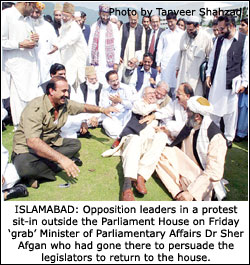 ISLAMABAD, Sept 9: Opposition parties walked out of the National Assembly on Friday as part of a nationwide protest general strike called by them, allowing the government to rush business through the house, including a controversial bill passed without any debate. The walkout after a few opposition speeches at the start of the Friday morning sitting triggered half an hour’s suspension of proceedings during the question hour for lack of quorum, which was later managed while Prime Minister Shaukat Aziz sat through the remaining half an hour’s business before speaker Chaudhry Amir Hussain adjourned the house till 9.30am on Saturday.
While opposition members staged a brief sit-in outside parliament house in scorching heat, the ruling coalition quickly finished the entire agenda for the day and passed the Legal Practitioners and Bar Councils (Amendment) Bill, which empowers the high courts and the Supreme Court to take disciplinary action against advocates for misconduct and reduces the strength of provincial bar councils.
Lawyers’ organisations have opposed the legislation, which amends Act and has already been passed by the Senate.
Before walking out, opposition leaders said in brief speeches that their parties were protesting against the latest rise in domestic petroleum prices, general inflation, alleged rigging of the two phases of local body elections held last month and continued military rule.
After the issue of the opposition-called strike was raised by Muttahida Majlis-i-Amal (MMA) member Liaqaut Baloch, MMA president Qazi Hussain Ahmed said parliament was being passed on important issues like Kashmir and recent contacts with Israel and called both the present government and President Pervez Musharraf unconstitutional.
Raja Pervez Ashraf, secretary-general of the People’s Party Parliamentarians (PPP), said the opposition would raise its voice against what he called repression let loose in the country.
Law and Justice Minister Mohammad Wasi Zafar only had taunts for the opposition parties, saying their strike call had been a failure and they had suffered a disgrace.
While the opposition members walked out of the house, some of them chanted “go Musharraf go”, although anti-government chants grew louder when they squatted outside the parliament building.
Muttahida Qaumi Movement member Kunwar Khalid Yunus questioned Jamaat-i-Islami’s democratic credentials, pointing to the choice of a daughter of party chief Qazi Hussain Ahmed, Samia Raheel Qazi, as a National Assembly member and the reported choice of a son of the Jamaat chief for the office of Nowshera district nazim.
Ms Raheel returned to the house on hearing her name and said she had been elected to the house on merit as a party worker and not as a daughter of the party chief, but she made no mention of her brother.
While the question hour was in progress, PPP member Shagufta Jumani from Sindh came back to the house to point out that the 342-seat assembly lacked the quorum of at least 86 members, or one-fourth of the total, forcing the speaker to suspend the proceedings after a count ordered showed that only 76 members were present at the time.
The house resumed after half an hour when the ruling coalition had managed an attendance of 92 members moments before the prime minister also arrived to cheers from the treasury benches.
Parliamentary Affairs Minister Sher Afgan Khan Niazi informed the chair that efforts by him and two other members, Health Minister Mohammad Naseer Khan and chief whip Nasrullah Khan Dareshak, failed to bring the opposition members back into the house although, he said, some of them did really wanted to return.
While taking up the 30-clause Legal Practitioners and Bar Councils (Amendment) Bill, the speaker dropped two opposition amendment because of the absence of their movers.
A statement of objects and reasons accompanying the bill said experience of elections held under the original act had shown “several inconsistencies and contradictions” in the law and that certain provisions negated the very objective of its enactment. “In order to maintain discipline in the profession, besides the bar councils, the high courts and the Supreme Court, also being empowered to take disciplinary action against advocates guilty of misconduct,” it said.
The statement said the number of seats of members of provincial bar councils had increased over the years to “unmanageable extent” on account of the existing provisions of the original act’s section 5, resulting in functional problems and difficulties and causing an extra financial burden. Some amendments had also become necessary after the abolition of administrative divisions, now to be called groups of districts under the new law.
Other business conducted by the opposition-less house included condonation of a delay by the house Standing Committee on Finance in presenting its report on a bill seeking to repeal the National Development Finance Corporation Act 1973, over which the government had suffered a humiliating defeat last week when the house had rejected a similar motion.
Similar condonations were granted for delayed reports on three other bills but the speaker advised the standing committees to present their reports in time after ruling party member M.P. Bhandara suggested that the committees give reasons for the delay while seeking condonations.
DESECRATION CHARGE: Parliamentary secretary for minorities affairs Mushtaq Victor told the house that an inquiry report about the arrest of a Hindu couple accused by some locals of desecration of the Holy Quran would be available by Sept 15 and that justice would be done in the matter.
He was responding to a call-attention notice from PML member Gayanchand Singh who said the family was falsely accused of desecration and being harassed. Mr Victor, quoting information from the local authorities, said only the accused couple were arrested while other members of the minority community there had shifted to a safer place.