



 0
0

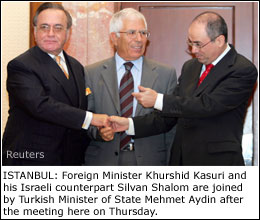 ISTANBUL, Sept 1: Israel and Pakistan held their first-ever high-level talks here on Thursday in a bid to normalize ties. Buoyed by Israel’s pullout from the Gaza Strip and its desire to better its ties with Arab and Muslim states in general, Isreali Foreign Minister Silvan Shalom and his Pakistani counterpart Khurshid Kasuri met in Istanbul for what they called ‘historic’ talks.
The two ministers emerged upbeat from the meeting which was arranged after Turkey played a mediating role to bring them together.
At a joint press conference with Mr Shalom, Mr Kasuri hailed the withdrawal of Israeli troops and settlers from the Gaza Strip, which he said constituted a turning point for the establishment of a Palestinian state.
“Pakistan has therefore decided to engage with Israel,” he told reporters at a top hotel where the talks were held. He did not elaborate on what sort of an engagement Pakistan was planning.
Mr Shalom, for his part, said the meeting heralded a new era in bilateral ties. “This is a historic meeting,” the Israeli minister said. “We see this meeting as the beginning of a new period, the beginning of open and useful mutual relations.”
Israel was hoping to establish diplomatic relations with Pakistan, Mr Shalom told a separate news conference later in the day, but acknowledged that they were not in the making soon.
“I believe positive and full diplomatic ties will be established, but this will take time,” he said.
However, Pakistan said its position on the Middle East crisis remained unchanged that calls for an independent Palestinian state with Al Quds as its capital.
“Our gesture should demonstrate to Israel that the Islamic world will respond positively if it is ready to accept the imperatives of peace by respecting the fundamental right of the Palestinians to live in freedom and peace in their own homeland,” Mr Kasuri said in a statement made to the press after the meeting.
“Pakistan would like to see that the process started with the withdrawal from Gaza is now continued in the West Bank for the establishment of the Palestinian state.
“The meeting today does not mean recognition. That stage will come following progress towards the solution of the Palestinian problem. Our position on Palestine issue remains unchanged,” Mr Kasuri said in the statement.
He also referred to the visit by President Mahmoud Abbas to Pakistan early this year in which the latter had said he would like President Musharraf to use his good offices with the international community for a just and peaceful resolution of the Palestine dispute.
Israeli diplomatic sources in Turkey said a formal agreement could be announced at the UN General Assembly later this month.
Israel has full diplomatic relations with three Arab states — Mauritania, Egypt and Jordan — and a handful of Muslim majority states, including Turkey.
Israel has been hoping that its pullout from the Gaza Strip would help bridge the gap with the Arab and Muslim world.
WORRYING MOVE: Meanwhile, the Palestinian Authority on Thursday said it was ‘worried’ about Pakistan’s first diplomatic contact with Israel as the Jewish state continues to occupy east Jerusalem and the West Bank.
“It is not good to give Israel gifts before it really implements the peace process, not only in Gaza, but in Gaza, the West Bank and Jerusalem,” deputy prime minister Nabil Shaath told reporters.
“We are worried about this because it’s not a good time to start relations with Israel,” he said.
“The right time for this relationship with Israel is after Israel withdraws from... all land occupied in 1967 and solves the refugee issue,” Mr Shaath said, adding that he thought Palestinian leader Mahmoud Abbas was of the same opinion.
The West Bank leader of Hamas denounced the meeting and urged Muslim states not to fall into the trap of seeing the Gaza pullout as synonymous with the end of occupation.
“We condemn any relationship between an Islamic state and the Israelis and we ask Pakistan to go back on this agreement, especially as the Palestinian people have not yet been given their rights,” said Hassan Yussef.—Agencies





























