0
0

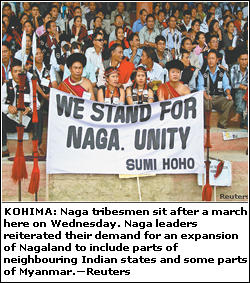 KHONOMA (India): The tiny village of Khonoma in the thickly forested hills of remote northeastern India is littered with war memorials. A memorial to British officers who lost their lives when Naga tribesmen ambushed them in 1879. Memorials to scores of villagers killed in five decades of resistance to Indian rule.
Today, there is peace in Khonoma, but there is growing concern that it might not last. Eight years of ceasefire between Christian Naga rebels and the Indian government have brought little sign of a solution.
“We had high expectations when the ceasefire started, that there was going to be a solution after long years,” said village council chief Vishulie Mor. “But people are not very confident now. And if the ceasefire breaks we are back to square one.”
Outside, children in grey uniforms come home from school, umbrellas up against the drizzle. A massive concrete Baptist church dominates the highest point on the ridge.
In the valley below, farmers tend their rice paddies, the bright green terraces contrasting with the dark green of the steeply forested slopes above them.
For half a century, Naga tribesmen fought the army in these mountains, before agreeing to the ceasefire in 1997. India’s oldest insurgency had cost more than 20,000 lives.
Few places symbolize the Naga independence fight like Khonoma. The village was burned down by the British in 1850, resisted a fierce British assault after the 1879 ambush and was home to the first leader of Naga resistance to Indian rule.
Farmer Lhulie Mayse does not know his birthday. Records, he says, were lost when the Indians burned down Khonoma when he was seven, in 1956. Today, the army is trying to win the hearts and minds of villagers by distributing medicines.
“In our childhood, we used to hear the sound of the Indian army vehicles and we would run and hide. But we would welcome the undergrounds,” he said. “Now it is the other way round.”
But Mayse is not quite sure he believes the Indian army’s claim, written beside every camp of the Assam Rifles, that they are the ‘Friends of the Hill People’.—Reuters