0
0

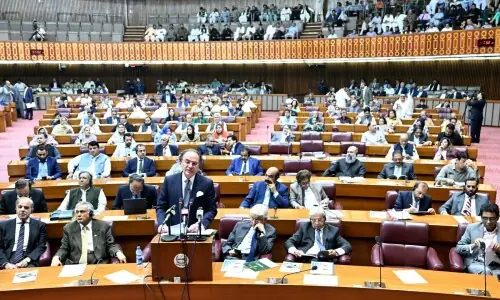
ISLAMABAD, Aug 29: President General Pervez Musharraf on Monday announced that an organization would be set up to work for Muslim renaissance. Addressing a seminar on ‘Global terrorism’ organized by the Institute of Regional Studies in collaboration with the Hanns Siedel Foundation of Germany, the president said that in the battle for hearts and minds a national discourse was the need of the hour.
He said there should be an organization to carry out that discourse on the real values of Islam and work for Muslim renaissance.
“Let Pakistan be the source of light. Let Pakistan be the centre of Muslim renaissance,” he stressed.
Gen Musharraf said the concept might seem a tall order, but the government was committed to bringing about a change and added that about 40 scholars had been invited from around the world to be part of a guiding force to achieve the goal.
Referring to steps taken for combating terrorism, he said terrorists had been picked up from seminaries in tribal areas and added that action would be taken against seminaries which ‘might be’ harbouring terrorists in cities.
He said seminaries admittedly were the largest NGOs hosting some 1 million students and providing them free boarding and lodging, but some of them were also involved in spreading hatred and militancy. The Wafaqul Madaris, he pointed out, supported the government’s decision to reform the curriculum and expel foreign students from seminaries. “We will not allow the Madressahs to be used for spreading extremism.”
He said banned organizations must not be allowed to re-emerge under different names or to collect donations. Rejecting perceptions that steps against the outlawed groups were initiated under pressure from western governments, he pointed out that he had announced those steps six months before 9/11.
The president said that 22 publications had been banned for spreading hate and militancy and added that those magazines had misconstrued jihad and encouraged people to go all over the world and fight. Jihad, he said, was not offensive in connotation.
The government, he said, had initiated action against obscurantists who had been using mosques for spreading extremism. He said the government wanted a change in the seminary curriculum to shift focus from rituals to the real values of religion.
He said the Organization of Islamic Conference should be re-organized to address socio-economic developments, adding that proposals for its restructuring had been given to foreign ministers of the Muslim countries. A special OIC summit would adopt those proposals.
He said London bombings had added a new dimension to understanding terrorism as those involved were neither poor nor politically deprived. Terrorists had not integrated into the British society and they were perhaps getting unequal treatment, he observed.
The president said that the root-causes of the problem had to be tackled in a holistic manner with both long- and short-term strategies at the global and domestic levels. He said all countries must share intelligence and stop free flow of funds which might be used for terrorism.
He asked the world community to take actions to resolve the festering political disputes, including Kashmir and Palestine. “I see a beginning on Kashmir and Palestine. Resolution of the problems will pull the rug from under the feet of the terrorists.”
Pakistan, he said, welcomed the Israeli pullout from Gaza. Pakistan and India were moving ahead on Kashmir, he said, adding that all stakeholders and the leadership in India and Pakistan and in Israel and Palestine must address the ‘core of the core problem’.
He said the unresolved problems in Afghanistan, Iraq, Bosnia, Kosovo and Chechnya had created an impression that Muslims were politically deprived and alienated while the West moved quickly to solve the problem in East Timor, which primarily was a Christian issue. He said justice must be done in all the cases to root out terrorism.
Unless these political problems were resolved, he said, military action could provide only a temporary breathing space. The military action would only buy time while concrete long-term actions were required to get to hearts and minds.