0
0

KARACHI, Aug 29: Shops are being built on the premises of the Sindh High Court, which is protected under the Sindh Cultural Heritage Protection Act, without the permission of the relevant government departments, it is learnt.
Nobody, including the owners, can carry out any construction in a site that is protected under the act, which prescribes long prison terms and heavy fines for violators. An NOC is required from the advisory committee on cultural affairs, headed by the provincial chief secretary, before carrying out any construction at a protected site.
Dawn visited the site on Monday and saw walls being built. The proposed shops are located next to the annexe building and by the side of a bank branch and a canteen. Construction material was also present.
Additional Secretary Culture Rabiya Javeri Agha said the Sindh High Court building is protected under the Sindh Cultural Heritage Protection Act, and nobody can carry out any construction activities at a protected site without the NOC.
Responding to Dawn queries, Brig (retd) A S Nasir, Chief Controller of Building Control Authority, said a permission is required before carrying out any normal construction activities in the city, but when the construction involves a building protected under the Cultural Heritage Act, additionally an NOC is required from the culture department, which is submitted to the KBCA with construction plans.
The plans are reviewed by the KBCA and if found correct, permission is granted for construction. He said in this case, neither the culture department, nor the KBCA have issues any permission.
Dawn approached the SHC Registrar Shaukat Ali Memon on Monday, but he was not available.
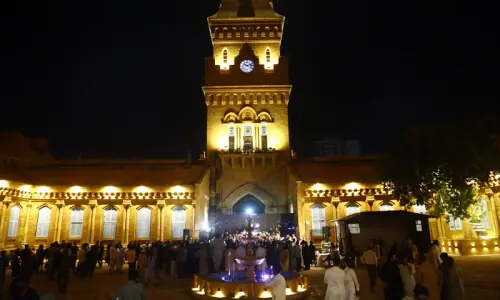
Originally known as the Judicial Commissioner’s Court, the Sindh High Court building was designed in 1923, and was built on 200 acres near Artillery Maidan Quarters after the removal of an arsenal, the Horse Keeper’s Lines and the gun-shed from the site.
Placed on the axis of a new road, then known as King’s Way (now Shahrah Kamal Ataturk), the design was prepared in the offices of Consulting Architect to the Government of Bombay, from where Sindh was controlled at that time, and the construction was carried out by the Karachi Building Division of the Public Works Department.
Work on the building commenced in September 1923 and completed in six years at a cost of Rs 3 million. It was finally declared open on Nov 22, 1929, by the Bombay’s Governor Frederick Hugh Sykes.
When completed, the Judicial Commissioner’s Court was considered to be the most impressive building of the city.
While the part of the facade is simply treated, elsewhere neoclassical features are liberally applied. Thus, a high podium and classical portico with ionic columns and triangular pediments are combined with simple fenestration. The court is one of the earliest buildings of the Karachi in which Jodhpur’s Chhatar sandstone is used liberally.