0
0

‘No’ to pullout from Iraq
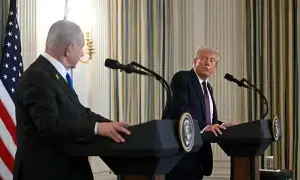
ONCE again, the US has ruled out giving a withdrawal timetable for American troops in Iraq. The reiteration of the American position came last week in response to Russian President Vladimir Putin’s call a day earlier for a definite schedule. Even though Mr Putin called for a pullout timetable for “foreign troops”, it is obvious that he meant US forces, because the largest number of soldiers — 138,000 — are from America. Besides, a decision to withdraw rests primarily with Washington and not with the other countries with token contributions to the occupying forces. The emphasis in the state department’s reaction to Mr Putin’s call was on the training of the new Iraqi security forces. It said that as the new Iraqi security forces “stand up”, American and other troops will “stand down”. One wishes it were that simple, for the issues in Iraq are complex and pose a challenge to the unity and integrity of the country.
A draft constitution is not ready yet. Because of the sharp differences among the deputies, the Aug 15 deadline could not be met and was extended. While a section of the Shia community, led by Abdel Aziz al-Hakim, is demanding a separate province, firebrand cleric Moqtada al Sadr has opposed a constitution based on federalism. The Sunni opposition to a federal Iraq revolves round oil, for the huge deposits of black gold are either in the Shia south or the Kurdish north. The “Sunni triangle” thus fears it may get a raw deal in the sharing of oil revenues if there is a federal Iraq. Given this opposition, one should keep one’s fingers crossed about the constitution when it is put to vote in December. If the draft is rejected, one can well imagine what the situation would be like. Already, the insurgency continues unabated with its daily toll of foreign troops and Iraqi civilians. A collapse of the constitutional process will accentuate violence and lead to unpredictable consequences for the country’s future.
The state department did not react to that part of the Putin statement which called for an international conference on Iraq. Moscow had enjoyed good relations with Baathist Iraq and resents that America should now monopolize the resources of that country. As British MP Michael Meacher points out, US Proconsul Paul Bremer, before leaving Baghdad, signed no less than 100 decrees which virtually placed the entire Iraqi economy under American control. These laws privatized all sectors of Iraq’s economy and extended American control from Iraqi oil and heavy industry to agriculture. According to Mr Meacher, “these laws will not be reversed” while American troops stay in Iraq.
There is no doubt that a hurried US withdrawal could be disastrous and lead to chaos. The only choice before Washington is to induct a UN peacekeeping force which should organize a general election. A government that comes into being through such a process will stand a better chance of commanding the respect of the Iraqi people and undertaking the task of Iraq’s reconstruction. The present uncertainty suits no one, most certainly not America, which has suffered more than 1,800 fatalities. No wonder, public opinion in America too increasingly favours a withdrawal. The resistance will remain strong as long as the US refuses to come out with a withdrawal schedule. Since at present the occupation looks open-ended, it provides the resistance with a cause.
Poor education standards
HAD the NWFP government not been so preoccupied with its efforts to upgrade moral values in the Frontier, it would by now have gone a little beyond making frequent pledges to improve educational standards in the province. Indeed, the abysmal education statistics for the province belie the latest assurance held out by the government that it is committed to improving literacy rates — currently 43 per cent — in the province. But, then, it is not fair to blame the conservative NWFP government alone when the state of education elsewhere in the country is not much better either — in fact, worse in Balochistan, where the literacy rate is merely 36 per cent. Besides, the gender gap is startling, and in no province does the female literacy rate exceed 43 per cent. It is highest in Punjab (42.9 per cent) where the male literacy rate is 63.6 per cent, but well below the national statistic of 53 per cent.
This sorry state of affairs calls into question the implementation of the government’s Education For All campaign that aims at promoting free and compulsory primary education, 50 per cent improvement in the adult literacy rate and gender equality in education — all by 2015. The fact that educational efforts have not kept pace with the high population growth rate and that the number of primary school dropouts continues to be one of the highest in the world has not only meant a poor response to government efforts but also an increasing number of illiterates. Several factors can be cited for this, including the perennial shortage of funds for education, inadequate schooling facilities, and ill-qualified teachers. But perhaps, it is the lack of political will that probably explains the fact that Pakistan’s commitment to basic education ranks the lowest among that of 14 Asian countries. No matter how many plans and policies the government comes up with to halt the educational decline, its efforts will come to nought unless it sets about seriously rectifying the shortcomings. In this, it may be worthwhile to study Punjab’s educational reforms.
Erring blood banks
THE Sindh governor Ishratul Ibad’s displeasure at the slow process of registration of blood banks in the province and his instructions for the formation of a high-level task force to keep a strict eye on erring units should hopefully shake the Sindh Blood Transfusion Authority out of its stupor. Although the SBTA has shown itself capable of action — its crackdown on blood banks indulging in unhealthy practices last year is a case in point — it appears that of late the authority has not been wielding the stick against illegal units as often as it should. To be sure, its task of keeping a strict check on the over 400 blood banks in Sindh is a difficult one. But without regular inspection, these units tend to become lax in their approach to patient safety and care little that they may be storing contaminated and expired blood that poses a serious health risk for the recipients. Currently, only 20 per cent of the units screen blood, with many citing expensive procedures involved as the main reason for not ensuring that the stored blood is free from germs.
The SBTA will have to rev up its efforts and impel units to register themselves and comply with the rules in order to avoid closure. But more than that, it should also support a public awareness campaign so that people learn of the dangers of blood transfusion and insist on proper certification and the supply of screened products at blood banks. Moreover, a culture of voluntary donation should also be encouraged to avoid blood supplies from professional donors like drug addicts who, through their use of shared intravenous needles, are potential carriers of dangerous organisms, such as the hepatitis ‘B’ virus. The mobilization of public opinion is important for the success of any campaign against faulty blood units.