0
0

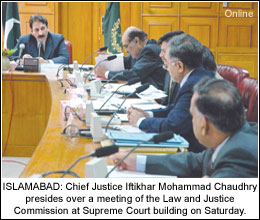 ISLAMABAD, Aug 20: A meeting of the Law and Justice Commission of Pakistan on Saturday proposed substitution of punishment in the Zina (Enforcement of Hudood Ordinance) and sought a report from the State Bank of Pakistan (SBP) on service charges being deducted by banks from small deposit holders.
Chief Justice of Pakistan Justice Iftikhar Mohammad Chaudhry, while presiding over three meetings, also stressed the need for eliminating corruption from the judiciary and hinted at conducting a major surgery to cleanse it of the evil of corruption.
All the chief justices should have a zero tolerance for corruption, the chief justice observed while presiding over meetings in the Supreme Court Building to review Access to Justice Development Fund (AJDF), discuss national judicial (policy making) committee and consider amendments in certain laws.
While considering Sections 11, 13 and 14 of the Offences of Zina (Enforcement of Hudood) Ordinance 1979, the Law and Justice Commission of Pakistan recommended substitution of the punishment of imprisonment for life with 25 years imprisonment.
The recommendation was made after it was found that single punishment of life imprisonment left no discretion with courts to award a lesser punishment where the circumstances of the case so warranted.
This necessarily resulted in giving benefit to the accused to secure acquittal. Therefore, the commission stressed the need of some alternative punishments so that in an appropriate case punishment could be awarded as per facts of the case and the degree of involvement of the accused in the crime.
It also took notice of violation of Section 7 of the Muslim Family Laws Ordinance 1961 by not forwarding notice of “Talaq” (divorce) to chairman of the union council by husband which puts wife in difficulty if she contracts marriage on the expiry of period of “iddat.”
To avoid such eventuality, the commission recommended that in case husband fails to send notice to the chairman, wife could give such notice and send a copy thereof to husband. In response the chairman would initiate conciliation proceedings.
In case a woman exercises “Talaq Tafveez” (delegated divorce), she would need to send a notice to the chairman and a copy of it to the husband and in case of failure, the husband could send such a notice to the chairman of the union council.
Therefore, the commission recommended amending the law accordingly.
It also considered that the punishment of Rs1,000 fine on non-registration of Nikkah under Section 5 of the Muslim Family Ordinance has lost its deterrent effect as a result of devaluation of rupee. Therefore, by amending the law, the amount of fine be increased to Rs10,000.
It also recommended a suitable amendment to Section 10 of the Family Court Act 1965, concerning the Khula cases. The court should issue decree of the dissolution of marriage subject to return of “mehr” by wife to husband.
The commission also took notice of service charges being deducted by banks from small deposit holders whose balance in the account falls below Rs5000.
The banks arbitrarily deduct amount from the account-holders who close their accounts and arbitrarily fix rates of profits after deduction of administrative and other charges and thereby pass on a very small profit to account-holders.
The commission noted that such practice was arbitrary and unfair to the general public and in particular the low-income groups and poor sections of society.
It, therefore, asked for a report on the issue from the SBP for consideration in the next meeting.
Meanwhile another meeting of the National Judicial (Policy Making) Committee constituted a committee headed by Justice Tassadiq Hussain Jillani, Judge Supreme Court, and a judge each from provincial high courts to propose guidelines for imparting training of alternative resolution of disputes.
The committee resolved that all the high courts should direct the lower courts to hear cases of imprisoned women and children on a priority basis and in case there was any problem of prisoners transport to the courts, their cases be transferred to court where there was no such problem while woman and child prisoners may be released on parole frequently.
It also considered progress in automation of the Supreme Court and the high courts and directed the agencies concerned for standardization of database for all the high courts and a uniform code be prepared for the committee’s consideration.