



 0
0

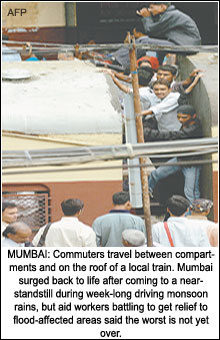 MUMBAI: India’s dream of turning its financial hub, Mumbai, into another Shanghai was washed away by the city’s worst rains on record that left dead bodies and animal carcasses floating on the flooded streets. Home to more than 15 million people and also to Asia’s largest slum, the teeming metropolis came to a near standstill last week after the deluge caused floods and landslides that killed nearly 500 people.
As the city struggled to deal with its submerged streets, power and phone outages, floating garbage, lack of clean drinking water and transport disruptions, residents of India’s Bollywood film capital asked: Was this disaster natural or man-made?
Environmentalists blamed the city’s unplanned urban growth, while citizens’ groups said the state didn’t react quickly enough to warn people of one of the worst disasters in the long history of Mumbai, a group of seven islands stitched together by reclaimed land.
“This was a disaster waiting to happen,” said Shyam Chainani, secretary of the Mumbai Environmental Action Group. “The city has been expanding willy-nilly, with no concept of development. We should be surprised it didn’t happen before.”
“And when everything was collapsing, there was no information being given, which caused needless suffering.”
The plan to turn Mumbai into another Shanghai was first enunciated by a former chief minister of Maharashtra, of which Mumbai is the capital, and then repeated by Prime Minister Manmohan Singh.
Consulting firm McKinsey & Co. which did a report in 2003 on how Mumbai could be turned into a first-world city, said the transformation would require radical changes to transport, housing and sanitation, besides a reduction in slum population.
But last week thousands of people walked for hours to get home, some in chest-high water, after train tracks were flooded. Others spent the night in train stations or on stalled buses.
Then on Thursday, as rumours of a dam collapse swept through a suburb, a stampede killed 18 people, many of them children.
Bittu Sahgal, a leading environmentalist, said the flooding was inevitable after the government reclaimed land and destroyed mangroves to make way for roads and buildings.
“The bottom line is urban planning decisions are driven by builders and developers for profits, not by city planners. The civic authorities are responsible for these deaths,” he said.
ILLEGAL SLUMS: Reclaimed land along the coastline led to water-logging, and the destruction of mangroves and wetlands caused more damage, as they would have otherwise provided natural barriers against flooding and dissipated the strength of the waves, he said.
Much of Mumbai is dotted with illegal slums and real estate projects, most of which provide no drainage. Rubble from construction projects dumped in wetlands has clogged drains, forcing water to the streets and drowning cars and buses.
Maharashtra Chief Minister Vilasrao Deshmukh blamed the rain. “It was unprecedented.” he said. “What could any government do?
“People panicked on Tuesday ... they did not follow instructions, and the police were helpless.
“We will look into the urban development issue, but this is not the time to do it. Our priority now is rescue, relief and rehabilitation,” said Deshmukh. It is estimated that losses from the flooding in Maharashtra could reach half-a-billion dollars.
Over the weekend, angry citizens stoned buses and dumped piles of rotting garbage in the offices of civic authorities and politicians to protest against the breakdown of services.
In one suburb, citizens hung posters promising a reward for information on the whereabouts of their elected representative.
“The irony is that the Infrastructure Leasing and Finance Co. and the Bombay Metropolitan Development Agency are both on reclaimed land — the very bodies that are planning development,” said environmentalist Darryl D’Monte. “We are living in a fool’s paradise.”—Reuters




























