



 0
0

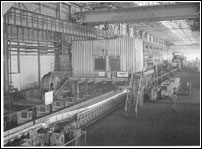 CAN Pakistan Steel, dubbed by many as a white elephant, which could not expand its productive capacity beyond 1.1 million tonnes in 25 years, raise its output by 10 to 15 times in ten years.
That may seem to many as vaulting in the void; but that is what Jehangir Khan Tarin, minister for industries, production and special initiatives, wants to meet the rapidly rising demand for steel in the country. He is eying for a steel output of 15 million tonnes by 2015.
The domestic demand for steel is 4.5 million tonnes, while the total output of all steel enterprises together is 3.1 million tonnes. Among them the Pakistan Steel is a minority producer with 1.1 million tonnes. Hence prices of steel products are invariably been high.
And when that basic material costs more, everything costs far more and the cost of production rises high or is fluctuating violently as in recent times for one reason or another.
The minister says that in view of the fast growing economy, the fast pace of construction and the rapidly expanding automobile sector, steel production has to expand fast and sustain the tempo of growth. Steel for construction is in greater demand as high-rise construction is getting to be common, not only in the cities but also elsewhere.
But the government will not step up production by itself by expanding the capacity of the Pakistan Steel. Instead, the mills will be privatized by December —- five months from now. And the new owners will be encouraged to step up production rapidly while enabling the private sector to set more steel mills.
When the Russian-aided steel mills were set up in the 1970s following the initiative of then Prime Minister Zulfiqar Ali Bhutto, it was argued by many that a very costly enterprise was being set up with a small output, but the Russians argued the facility included the infra-structure for expansion of the mills to three million tonnes, a more viable capacity. Hence it was located in an area of 18,600 acres.
When moves were being made to increase the production capacity of the mills, Pakistan found itself pitted against the Russians in Afghanistan for 10 years, and later Russia ceased to be a super-power.
Among the many countries approached for help in expanding the mills was China but the requisite assistance was not coming forth for a variety of reasons. That included the technical feasibility of the expansion. And Pakistan did not have the money to fund the for a costly project.
The bidding for the mills has not started. Only the preliminary steps are being taken following a meeting presided over by the secretary, Privatization Commission (PC) Tahsin Khan Iqbal.
Who will buy the 51 to 74 per cent shares of Pakistan Steel which are to be offered to the startegtic buyer with management control? One of them can be Lakshami Mithal of India, who is a British citizen now, who has emerged as one of the top steel mill-owners in the world after buying many failing and faltering steel mills around the world, including the US.
But even if he wants to buy Pak Steel, political road-blocks would sand in the way. President Musharraf has said: political settlements or serious movement in that direction first and investment next.
The Steel Mills with its 18,600 acres is to accomodate an industrial park that will use up 2,000 acres. Clearly, it has a big extra asset in the form of real estate of precious value. Some of that, if necessary, could be sold off before bids for the mills are invited so as to reduce its sale price.
One of the major question which arises is: will the new buyer be resourceful enough to invest on expanding the capacity of the mills by two million tonnes more? He will have to undertake to do that before the sale is completed. That may mean, not a single buyer coming forward but a group.
And that group in the next 10 years should be able to expand the capacity of the mills to around ten million tonnes out of the national target of 15 million tonnes by the year 2015. The other five million tonnes should be contributed by other private sector units like the Al-Tuwairqi group of companies of Saudi Arabia which have their productive presence here with global connections.
Prime Minister Shaukat Aziz says that Pakistan’s low level per capita consumption of steel—30 kg per capita per year—- “calls for development of this important sector on a fast-track basis in view of the tremendous growth in steel consumption in construction and automobile sectors”.
An international workshop on “investment opportunities in steel sector of Pakistan” in Islamabad early this month was very well attended. The 175 delegates included those from China, Saudi Arabia, Italy, Australia and India.
Will the official steel policy be as helpful to the new owners as it has been to the public sector project so far? The import duties on steel and steel products had been framed in such a manner that the interests of Pakistan Steel were well protected. The result was high price of steel and steel products in Pakistan which hampered industrial development to some extent.
Cars assembled or made in Pakistan would have been far cheaper if steel within the country was not high priced. Construction, too, would have been cheaper. Let us hope that as steel production rises and crosses the 10 million tonne mark steel will become cheaper and benefit industry as a whole apart from the construction sector.
Luckily, for the new buyers, the number of workers of Pakistan Steel has come down to 13,200 from over 20,000 or even 25,000 at its peak. For long, the enterprises was the dumping ground, along with PIA, for political workers of successive political parties, turn by turn, and their relatives and friends. These employees were paid not for working but for being on the payroll.
The enterprises, according to its chairman, Lt. Gen. Abdul Qayyum, has now a capacity utilization of 89 per cent. He says the mills have turned the financial corner with total sales of Rs31.11 billion against the budgeted Rs26.79 billion and made a net after-tax profit of Rs6 billion. It paid income and sales tax of Rs8.9 billion last year, and wiped out accumulated loss of Rs9 billion of over the years.
The PC has appointed, Citigroup Global Market Ltd as its financial adviser for privatization. Coras Consulting Ltd., Orr Dignam & Co, and Ferguson & Co are the advisers of the PC for other areas of Pak Steel.
After seeing too little activity in the steel sector so far are we going to see too much or a great deal now? India gave a great deal of importance to its steel industry from the early years of independence led by J.R.D. Tata in Jamshedpur, while there was strong opposition to the setting up of a steel mill in Pakistan.
The American lobby, too, was opposed to the Russian- aided steel mill as the Americans argued that we did not need a steel mill, and certainly not a Russian aided one. And yet thanks to the perseverance of Zulfikar Ali Bhutto and others Pakistan Steel came up; but its efficacy was stifled by not expanding its production capacity as was needed to at least three million tonnes within a decade after its production began in 1981.






























