



 0
0

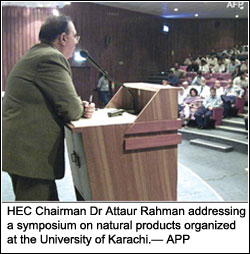 KARACHI, July 25: The chairman of Higher Education Commission, Dr Attaur Rahman has urged the varsities to develop technology incubators so that the culture of research could get a boost in the country.
Speaking as chief guest at the inauguration ceremony of a three-day AFASSA symposium on “Natural Products” at the University of Karachi on Monday, Dr Atta said that the varsities and research and development institutes should run incubators in collaboration with the industries to provide advisory services to industries and transfer of technologies from educational and scientific institutions to industries.
He said that technology incubator areas on the campuses would provide opportunities to academics and industries to work together and at the same time could pave way for foreign investments.
The HEC chief said that the government was already working on national technology incubator areas and technology parks projects in the country, with the objective to promote the much needed culture of innovation and entrepreneurship in a real sense.
Dr Atta, who had also been in-charge minister of science and technology and IT wing of the federal government, apprised the audience about what he claimed revolutionary changes and advancements made in the fields of science and technology, higher education and information technology during the last four to five years.
While discussing about some imperatives for socio-economic development of OIC member states, he said that theses states largely emphasized on buying foreign technology on turn-key basis rather than on creating new knowledge and developing technologies by scientific research.
Dr Atta said that paralytic dependence on foreign masters and very little investment on high quality manpower had left the OIC countries with a negligible creative output at the international level.
The three-day moot would see as many as 25 researchers and practitioner of natural product sciences from 15 countries of Africa, Asia and South America, including Japan, Kenya, Sweden, Mauritius, Norway, Bangladesh, Sudan, Sri Lanka, Malaysia, Zimbabwe and Nepal, in addition to Pakistani scientists and researchers, interacting.
The International Centre for Chemical Sciences, University of Karachi, is organizing the conference with the collaboration of Africa, Asia and South America (AFASSA) Natural Products Network, and enjoyed the support of Unesco as well.
The Vice-Chancellor of the University of Karachi, Dr Pirzada Qasim, stressed the need of enhancing the cooperation in the fields of science and researches, while notwithstanding with any geographical considerations.
Prof M Mosihuzzaman of Dhaka University, Bangladesh, who is the sitting chairman of AFASSA networks, talked about the formation of the association and said that it was aimed at coordinating activities of several groups involved in natural products research in the three continents of Asia, Africa and South America.
The acting director of the HEJ Research Institute of Chemistry, Dr Mohammad Iqbal Choudhary, hoped that the symposium would help promote collaborative multidisciplinary research in natural products in the countries of the South.
Dr Shazia Anjum, the conference organizing secretary, also spoke at the inaugural session of the symposium.
Dr Vijay Kumar of Sri Lanka in his presentation on “pesticides from Sri Lanka” discussed problems faced in developing products for commercializa-tion.
He said that the development of low cost formulations for use by Sir Lankan farmers was identified as priority area for research.
Dr Viqar Uddin Ahmed and Khan Usmanghani of Hamdard University also spoke.




























