0
0

 THE new official policy is not to crack down on profiteers, cartels and monopolists in business dealing in essential goods but to increase their production and distribution quickly and in plenty.
The policy or strategy approved by the Economic Coordination Committee of the Cabinet is not only to import more of such goods in short supply but also make them duty-free and exempt them from the withholding tax of six per cent.
In addition, the policy promotes the ultimate interests of the profiteers and monopolists with their distribution network and extensive political clout as most of the time importers of such goods are the same people or their proxies. And they are richer for that.
The best example is the import of raw sugar by the sugar mill-owners who process and sell it at high prices in the market. So they make good money through the sale of sugar they had manufactured and also the raw sugar which they imported and processed.
Sugar and cement are two items where the mill-owners are having the best of times. Sugar which was selling at Rs22 a kilo sometime ago has hit Rs32 a kilo in many places. Yet, the Trading Corporation of Pakistan which had stock of 0.325 million tones is still supplying the sugar to the utility stores at Rs22 a kilo. It had bought the same much earlier from the sugar mills at Rs16 a kilo.
The government is in a hurry to act for a variety of reasons. The local body elections are on, and the government would not want to annoy the voters by selling sugar to them at very high prices. Ramazan is approaching and that is a period marked for very high prices, particularly of items like sugar.
The international price of sugar has been soaring and has touched $315 a tonne, while the price in July last year was $262 a tonne. That is London overboard and the transportation costs will raise the price to $353 to $363 a tonne. Hence the government is in a hurry to act. And it is only asking the Monopoly Commission to probe the reasons for high prices and suggest the means through which they can be brought down.
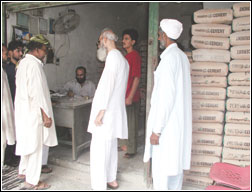
In the area of cement, where the cartel is very successful in operation for long, the heavy export of cement to Afghanistan is stated to be the reason for the prevailing high prices in the Pakistan market. After appeals to cement-makers failed to bring down prices, an export cess was proposed to cut the profit in exports. But the latest reports say that imports of cement is to be allowed. And the importers may be the same cement companies or their proxies. It is a kind of “heads I win and tails you lose” situation.
The Pakistan Sugar Mills Association estimates sugar consumption in the country at 3.9 million tonnes and is exerting pressure on the government to permit the import of raw sugar which they will re-process and sell. They want the raw sugar to be supplied only to the mills, and not to others.
But the government wanting to act quicker, has ordered the import of 100,000 tones of sugar through a UAE party which has to reach Pakistan before the end of August.
According to the sugar mill owners, sugar cane production in the current season was only 45,000.000 tones, while the same was 53,99,999 tonnes last year. As a result, sugar mill-owners claim that they had to pay as much as 58 per cent more for their cane in places and that inflated the cost of production of sugar abnormally.
To make the situation far worse, the mills crushed only 68 per cent of that sugar cane, while 80 per cent of the cane was available for crushing last year. And that reduced the output of sugar by the mills sharply and pushed up prices.
The sugar mill-owners argue that in view of the high prices they had paid for the sugar cane they need not bring down the prices of sugar now. Instead, the government should arrange to import more of raw sugar for them to process and sell and bring down prices.
The official economic policy is liberalization, de-regulation and privatization, says Prime Minister Shaukat Aziz. Any crackdown on the sugar mill owners or cement manufacturers does not fit in with that oft-proclaimed policy.
While the government is being too liberal towards the private sector, it is for the leading lights of this sector to guide their members along the right path. But time and again, the private sector has demonstrated that its sole goal is maximize profit, and other considerations are subservient to that.
Previously, there was an adequate public sector to compete with the private sector and expose the profiteering by the private sector; but that sector is being fast liquidated through privatization. The government is hence finding itself rather helpless.
As a result of reduced output of sugar cane and lower percentage of cane crushed this year, sugar production this season has been only three million tonnes. The raw sugar imported and processed was 159,000 tonnes and the sugar made from beet root was 11,075 tonnes. And the sugar imported was 176,420 tonnes. In addition, there was a carry forward of 800,000 tonnes.
All that should be enough to meet the domestic demand but because of cornering of the stocks here and there and vigorous price manipulation, there has been shortages and high prices.
The sugar cane growers have their political clout. And so have the mill-owners. Together they can create shortages and high prices at any time.
There has now to be a mechanism or compact under which the mills are able to get sugar cane in ample quantity at the right price. Of course, there can be crop failures following shortage of water in some areas. Allowances have to be made for all these factors while fixing the price of sugar cane in each zone.
If instead, the cane prices are too high, that is bound to affect the sugar production cost. There can be some kind of arbitration; but the cane situation varies from area to area.
Between the liberal, free market policies of the government and the feudal mindset of the growers and some mill-owners, there is a large gap. Bridging the gulf is not easy and may take a long time.
If the output of cane per acre is low and the sucrose content of the sugar cane is too poor, the mill-owners will be the losers and the consumers will fare no better. Hence the agricultural side of the sugar industry must receive greater attention than it has been, and productivity in the sugar cane field must improve sharply.
And the mills should opt for manufacturing of the other bi-products which can be plenty instead of focussing on sugar only to increase their profits.
The sugar industry is a major industry of Pakistan and it should be placed on proper foundations. Otherwise, the consumer will be a captive of both— the cane growers and the mills. That situation ought to improve radically, and quick.