0
0

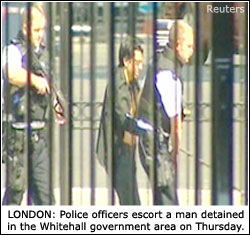 LONDON, July 21: Four small coordinated explosions hit London’s bus and underground train network on Thursday, injuring one person, exactly two weeks after bombers killed 55 people in the British capital.
The attacks took place around 1200 GMT, briefly terrifying passengers fearing a repeat of the carnage of July 7.
But it soon became clear they had either failed altogether or lacked the lethal sophistication of the earlier bombs.
London police chief Ian Blair told reporters: “We know that we’ve had four explosions or attempts at explosions.”
He said it was clear the devices had been intended to kill, but some appeared not to have gone off properly and only one person had been injured.
“Suddenly the door between my carriage and the next one burst open and dozens of people started rushing through and some were falling and there was clearly mass panic,” said a passenger called Ivan at the central Warren Street underground station.
“An Italian young man ... said a man was carrying a rucksack (that) suddenly exploded, a minor explosion but enough to blow open the rucksack, and the man then made an exclamation as if something had gone wrong and ... everyone rushed off the carriage.”
Prime Minister Tony Blair told reporters: “We know why these things are done. They are done to scare people ... We’ve got to react calmly.”
HUNT FOR SUSPECTS: Police sources said they were hunting several fugitives, according to BBC television.
On July 7, four bombs went off in three packed London underground trains and a bus at morning rush hour, killing 55 people and shocking a capital hitherto spared terror attacks on civilians.
Those bombings confronted Britain’s people and politicians with the prospect that the country could be nurturing its own generation of the type of militants who had inflicted carnage in the United States on Sept 11, 2001, in Indonesia and Spain.
Despite their amateurishness, the latest attacks had striking parallels with the July 7 bombs, which also hit three underground trains and a bus in sites located loosely north, south, east and west of the centre. They took place just after a memorial for some of the victims.
“There is a resonance here,” the police chief said. “Whether or not this is ... carried out by the same group of people... it’s going to take a little longer before we can qualify that.”
The attacks have forced the prime minister to defend himself against accusations that Britain’s participation in the invasion of Iraq had made it a target for militants.
A poll published this week indicated that two-thirds of Britons think the July 7 bombings were linked to Iraq.
Tony Blair denied he had put London at risk, saying: “The people who are responsible for terrorist attacks are the terrorists.”
Four bombers died in the attacks two weeks ago, leading most people to assume they had been suicide bombers.
British shares and the pound fell on Thursday, but recovered once it emerged the attacks were not on the scale of the earlier ones. Three of the underground network’s lines were shut, a far cry from the complete standstill of July 7.
IMITATORS AT WORK? The failure of the attack suggested it might not be the work of the organizers of July 7, whose bombs all exploded lethally.
Police chief Ian Blair said unexploded charges might still be left at some of the cordoned off sites: “This may represent a significant breakthrough ... there is obviously forensic material at these scenes which may be very helpful to us.”
Navin Reddy, a risk analyst at Merchant International Group in London, said the attacks were ‘most probably the work of a copycat group of young, disaffected Muslims who were inspired by the events of July 7 to carry out an operation of their own’.
The July 7 bombs, which were claimed on the Internet by a little-known militant group, coincided with a summit of the Group of Eight leading industrialized nations in Scotland.
Although markets again rebounded from the latest shock, nervousness was growing about the prospect of more attacks.
“The security issues have just got 500 per cent greater,” said Jeremy Hodges, head of foreign exchange sales at Lloyds TSB bank. “It will reflect badly on the economy.” —Reuters