0
0

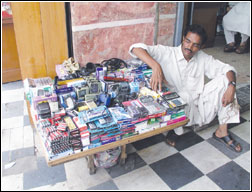 CHINESE products ranging from tooth brushes to air-conditioners and cars have stormed the local markets because of their low cost and easy availability. In fact, they have almost driven away the similar Japanese products which consumers consider to be ‘too costly’.
There was a time when original Japanese products were seen in most Pakistani houses. Then the situation changed. Japanese branded goods assembled in Malaysia Singapore caught the fancy of the buyers because they were cheaper. Now, more and more Chinese products are fast replacing such expensive goods despite their durability and quality. The consumers preferences are changing fast.
The Chinese products quite popular with consumers being sold in markets include: various brands of cells, tooth brushes, torches, stationary items, especially pencils and ball pens, shoes, children’s wear and ladies’ suitings, mechanical and electronic toys, ceramics, plastic goods, furniture, TVs, VCDs and DVDs, mobile phones, air-conditioners, motorcycles and even cars.
Since the rapid entry of the Chinese items into the domestic markets through various legal and illegal channels, the buyers seem to have developed a new attitude. They prefer disposable items, which is in sharp contrast with their past practice of paying high prices for durable Japanese goods.
However that does not mean that all Chinese products are of low quality and lack durability. Chinese products meant for the American and the European markets undoubtedly excel much more in quality compared to those usually available in Pakistani markets. Chinese produce a wide range of goods differing in quality and price to cater and suit various national markets and individual pockets.
Pakistan too could import Chinese quality goods but local traders who import cheap goods maintain that the bulk of local consumers will not be able to buy the costlier Chinese goods. For instance, the local consumers prefer to buy three Chinese brushes for Rs10 and refuse to purchase a single brush for Rs25-35 -a better quality also available in the market.
A China-made cell torch is available for Rs10 and with the same amount one can buy four battery cells made in China. A pair of Chinese shoes can be bought for Rs350-400 as against the price of a locally-made shoe which can be between Rs700-1200.
In electronic goods, a China-made 21-inches TV can be purchased for Rs8,000-9,000 as compared to other brands which cost Rs12,000-22,000. The market is also flooded with Chinese VCDs and DVDs as compared to imported Korean, Malaysian and Singaporean assembled items. Even the local assemblers of the Korean TVs—LG and Samsung-seem to be concerned over the heavy influx of these Chinese items.
In garments, Chinese brand of children’s wear have captured over 90 per cent of market shares and the majority of the units in the organized sector have winded up their business.
Similarly, a number of Pakistani toy-making concerns have been closed after failing to compete with Chinese toys available at much lower prices. Stationary and furniture industries also feel threatened because of the Chinese competition in these fields.
Meanwhile, Chinese mobile phones have also made inroads into the local markets at much lower prices. However, it is not easy to predict at the moment whether these cheaper Chinese brands will pose a real threat to such popular and famous brands as Nokia, Samsung, Ericson, LG, Siemens and Motorola.
Chinese split air-conditioners being distributed and marketed by leading domestic-appliances’ makers have almost heated up the market when people are suffering from a long hot summer. The Japanese- assembled A/Cs used to cost over Rs45,000 as compared to Rs14,000-23,000 for a Chinese brand.
The two Chinese companies have introduced cheap brand cars in the Japanese-dominated car market by using low price as an added attraction. Analysts say that these firms may face problems in carving out a big market share on the basis of low price factor. In this case, they add, buyers are likely to keep in view improved safety and durability.
Chinese assembled motorcycles are running side by side with Japanese-assembled bikes especially in Karachi but Japanese assemblers claim that cheap Chinese bikes have failed to lure buyers in Punjab and other provinces because people living in rural areas, like to rely on powerful and durable Japanese bikes. Nonetheless, the fact remains that Chinese bikes are cheaper by Rs10,000-15,000 as compared to Japanese.
Chinese footwear has already driven many buyers crazy because of low prices ranging from Rs350-450 as compared to Rs900-1,400 for similar local products. Many well-known shops have been forced to display Chinese shoes along with local brands. Some leading shoe stores have also put on display Chinese shoes which are high priced because of high quality leather.
Consumers have given an overwhelming response to many Chinese products just because of the rock bottom prices as compared to local and other imported items. At times when POL products and essential items’ prices have hit the ceiling, the entry of Chinese items have really proved to be a boon for the hard-pressed consumers with poor purchasing power, offering a much wider choice to them. It can be safely said that the prices of our daily essential edible items’ are costlier than Chinese commodities.
However, the dark side of the picture is that, many local industries are facing a collapse or a closure. It is definitely not a good sign for the economy where joblessness level is rising. On the positive side, it can be said that the real beneficiary of the Chinese entry are those consumers who were not in a position to afford high prices for other imported products.
Not only this, now even well-off people do not hesitate in buying Chinese goods since prices of essential items have affected their monthly spending budget.
Market men say that leading world electronic and appliances makers have set up their production facility in China because of cheap labour and low production cost. Even in Pakistan – one cannot be sure whether a Korean company item is actually made in Korea or assembled in China. Dealers in the local markets are charging same rate no matter where the products have been assembled.
One of the survivors from the heavy influx of Chinese goods is a toy unit” Evergreen”. Its manager Imran Iqbal says that China now enjoys a market share of 95 per cent in mechanical, radio control, remote control toys. He says that he has seen closure of well established local toy concerns as they could not compete with the cheap Chinese toys. He said that invasion of Chinese toys started in 1992 and with the passage of time – it destroyed the toy industry.
The former chairman of Site Association of Industry Majyd Aziz says that 21 million metre Chinese polyester fabric landed in Pakistan in January-February 2005 as compared to 807,000 metres in the same period of previous year. He says that gents suiting is also on way.
To protect the local industry, he seeks a ban on free clearance of fabrics from the dry port, and suggests that containers should be weighted. There is a need for cooperation among Pakistan and China customs so that they could tally the figures with each other’s shipments. He says that many people bring left-over fabrics from China at throw-away prices which should be banned.
The Director MHG Group of Companies, Anwar Aziz says that Chinese gents suiting has captured 60-70 per cent market share because of low price factor otherwise the quality is very poor. He says the share of Chinese ladies suiting ranges between 80-85 per cent and adds that the scenario after the budget has changed since the government has abolished sales tax from the textile sector and provided other relief. After the budget, the import of yarn and local sales of yarn have moved forward which means that looms, which have suspended their work, have restarted.
Chairman Writing Instrument Manufacturers Group, Naeem Akhtar Yousuf says that that the share of Chinese pencil and ball pen hovers between 70-80 per cent of the market followed by 50 per cent in fountain pen. Chinese goods are flooding in the market through mis-declaration, under invoicing and smuggling and the government appears not bothered about the plight of stationary industry which is heading towards closure.
“The industry is now burdened with paying 5-15 per cent import duty on raw material besides paying 15 per cent sales tax on the sale of finished products,” he says.
China has almost doubled its share in Pakistan’s total import during a short span of last five years. According to Karachi Chamber of Commerce and Industry, imports from China stood at $1.114 billion in 03-04 while exports from Pakistan recorded a mere $288 million in 03-04, hence the balance of trade is in favour of China.
Rising imports of goods from China may be a welcome relief for the consumers. But these imports are hurting the local industries whose products cannot compete with Chinese goods.