0
0

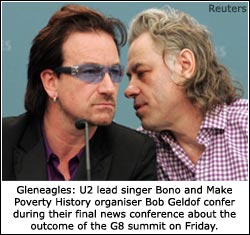 GLENEAGLES (Scotland), July 8: Initial reaction to the Group of Eight summit here on Friday suggested that the leaders of the world’s most powerful nations had failed to meet the hopes of millions who had sought bold action on African poverty and global warming.
International aid activists and environmentalists were quick to pounce on the leaders of the United States and other industrial powers, accusing them of blowing a rare chance to hit the world’s most pressing problems head-on.
On climate change, some green campaigners feared the G8, by producing a watered-down statement, had successfully defused pressure for urgent efforts to cut fossil fuel gases blamed for global warming.
US President George W. Bush was again put on the spot, despite verbal concessions he made about a human role in climate change.
“The search for consensus means that we have ended up with a bland statement without targets and timetables and without recognition of the urgency of the situation,” said Stephanie Tunmore of Greenpeace.
For the past four years, the world’s biggest greenhouse-gas polluter has been in the crosshairs of scientists and greens alike for ditching the UN’s Kyoto Protocol, which requires industrialised countries to trim their emissions of greenhouse gases.
Bush rejects Kyoto as both too costly for America’s oil-dependent economy and unfair, because fast-growing, populous countries like China, which are becoming big carbon polluters, are not required to make emissions cuts.
Kyoto runs out in 2012, but negotiations are due to be launched in Montreal in November on the shape its successor should take. A “dialogue” between the G8 and emerging countries will take place in Britain on November 1.
The G8 leaders said climate change was “a serious and long-term challenge” and acknowledged that fossil fuels “contribute in part” to the phenomenon by emitting greenhouse gases.
The summit’s big emphasis was on introducing cleaner energy technology, much of it in its infancy, and on a “dialogue” to encourage cooperation with big developing countries that are poised to become huge polluters as their economies grow.
“Technology is important but without real targets to reduce greenhouse-gas emissions, it is simply not enough,” said WWF’s Jennifer Morgan.
In February, a pre-summit conference of scientists warned that melting glaciers, prolonged droughts, sudden floods and a disturbing thinning of polar ice sheets testified that climate change was already under way, and poor countries were the most exposed.
Reaction was not all bad to the G8’s backing of a 50-billion-dollar increase in annual development aid for poor countries by 2010, including 25 billion dollars for Africa.
UN Secretary Kofi Annan and Irish rock star activist Bob Geldof echoed Prime Minister Tony Blair’s comments that the summit had taken a first step toward tackling poverty.
But the charities like Oxfam International and Action Aid all said the increase would bring development assistance to just under 130 billion dollars in the next five years, short of the Millennium Development Goals of 180 billion dollars.
The UN goals, approved in 2000, call for the proportion of people living on less than a dollar a day to be halved by 2015.
Action Aid said: “G8 leaders have promised 50 billion dollars more in aid by 2010. While aid increases are welcome, this is too little, and it’s too late for the 50 million children who will die between now and 2010.
“If they are serious about making poverty history, they should announce 50 billion in aid now, not in five years time,” it said.
“Moreover, if you do your sums, less than half of this funding is genuinely new money,” the Action Aid statement said.
Action Aid welcomed the G8 commitment to support universal access to AIDS treatment by 2010 but there remain big questions about how that will be funded.
The charities also said they were disappointed that the G8 leaders failed to go beyond the 40 billion dollars in immediate debt write-offs for the world’s poorest 18 countries, which their finance ministers had agreed last month.—AFP