0
0

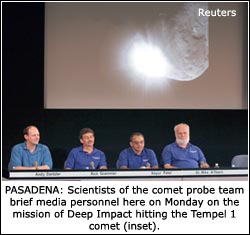 PASADENA (USA), July 4: A US spacecraft collided with a comet half the size of Manhattan on Monday, creating a brilliant cosmic smash-up that capped a risky voyage to uncover the building blocks of life on Earth. “We hit it just exactly where we wanted to,” said Don Yeomans, a scientist at the National Aeronautics and Space Administration’s Jet Propulsion Laboratory in Pasadena. The spectacular collision, 134 million kilometres away from Earth, unleashed a spray of below-surface material formed billions of years ago during the creation of the solar system. It was the first time a craft came in contact with a comet’s nucleus.
“As of now, I think we have a completely different understanding of our solar system,” said laboratory director Charles Elachi. “Its success exceeded our expectations.”
The washing machine-sized probe, which performed three final targeting manoeuvres in the mission’s last two hours, crashed into comet Tempel 1’s brightest spot right on schedule, snapping images of its rocky terrain up until 3.7 seconds before impact.
The craft was vaporized immediately following the collision, which occurred at 37,100 kilometres per hour — the speed it would take to fly from New York to Los Angeles in about six minutes.
An image of the 0552 GMT crash taken by Deep Impact, the mission’s mother ship, showed a brilliant burst of material coming from the bottom of the avocado-shaped comet. The probe was released by Deep Impact about 24 hours before the collision.
“The impact was bigger than I expected, and bigger than most of us expected,” Mr Yeomans said. “We’ve got all the data we could possibly ask for and the science team is ecstatic.”
Scientists and engineers in the $333 million mission’s control room cheered, applauded, and hugged one another upon confirmation of the crash.
A WEALTH OF DATA: It could take months to analyse all the data from the crash, according to Mike A’Hearn, the mission’s lead scientist. Three hours after the impact, just 10 per cent of the data had been transmitted back to Earth.—Reuters