0
0

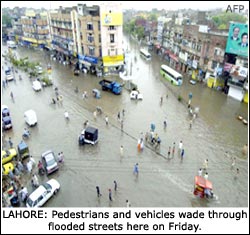 LAHORE, July 1: The first heavy rain of the monsoon season lashed the city on Friday morning, resulting in the death of at least eight people, including three children. Another 20 were reported seriously injured in separate incidents of roofs collapsing and by electrocution.
The heavy downpour during the morning rush hour completely paralysed life in the city, with motorists forced to break the journey and take shelter while it rained. When the heavy rain eased roads were submerged in knee-deep water in many parts of the city.
The rain disrupted power and water supply in most areas for several hours. Traffic was brought to a virtual halt, causing massive and long traffic jams across the city long after it ceased to pour.
The eight dead included a man and two minors belonging to the same family. The police said many of those killed or injured suffered burns as a result of electrocution. The injured also included victims of road accidents.
Mohammad Ashfaq, 35, together with his sister-in-law Raheela and her two daughters, Shameen, seven and Wajeeha, five, were on way to Shahdara when their motorcycle lost control and fell near the timber market on Ravi Road.
Quoting witnesses, the police said Ashfaq tried to grip an electric pole to maintain balance, and suffered a severe shock. He and the two minors received critical burns, and were rushed to a nearby hospital where doctors pronounced the three dead. Raheela managed to escape unhurt.
Naveed Masih, 28, and another unidentified man in his late- 20s, were killed and five others were injured when the roof of a roadside tea stall collapsed at Guldast Town in North Cantonment.
The police said a number of men were having tea during the rain when the roof of the cafe caved in. Rescuers rushed to the spot and joined the residents, who had already begun to clear the debris. Seven men were recovered alive. They were rushed to a nearby hospital where two of them succumbed to their injuries while the remaining were stated to be in a critical condition.
Another man, Barkat Ali, 33, died and two other workers suffered injuries when the roof of a plastic factory in Shafiqabad collapsed. Eight-year-old Ahmad Ali was reportedly bathing in the rain when an electric wire fell on him and he suffered a shock in Misri Shah. He died on way to a nearby hospital.
Farzand Ali, 40, a Lytton Road shopkeeper, also sustained an electric shock when he tried to rescue a tonga-horse caught in a live electric wire in deep water on the road.
The shopkeeper later died in a nearby hospital.
Sarfraz Bangash, his wife and five others of his family were 3 / ? trapped under rubble when the roof of their house collapsed in Sector C/1 of Green Town. Neighbours aided by the police recovered them from the debris, and rushed them to a nearby hospital.
Besides, around a dozen people received injuries in separate road accidents during and after the rain. They have been admitted in various city hospitals. At least five of them were stated to be in a critical condition.
The bodies of those who lost their lives have been returned to respective families without autopsy.
Cloudburst over the metropolis began at around 8.45am. Within half an hour roads and streets were flooded because of the sheer ferocity of the rain. The local meteorological office had recorded 137mm of rain at its Jail Road observatory and 86mm at the Allama Iqbal International Airport by 11am.
Chief Meteorologist Shaukat Ali Awan said that 100-200mm of rain was quite normal on a given day during the monsoon season. But, he said, the incidence of heavy rainfall in a few hours was rare. Lahore had last received a heavy rainfall, measuring 394mm over a 24-hour period in August, 1996.
The Water and Sanitation Agency (WASA) suspended the water supply to the city by switching off the tubewells to prevent the expected increase in the pressure on its sewerage and drainage system, which was completely choked after power supply was disrupted at the major pumping stations at Mahmood Booti, Gulshan-i-Ravi, Main Outfall Road, Shadbagh, Khokhar Road, Model Town, Nishtar Town, Bhati Gate and Gulshan-i-Ravi.
Operation of disposal stations by generators reduced the pumping capacity resulting in the flooding of drains and storm- water channels, delaying drainage of rain water from low-lying areas.
Punjab Chief Minister Chaudhry Pervaiz Elahi visited the Central Pumping Station at Gulshan-i-Ravi after the rain and promised to provide new power generators to ensure that storm- water drainage was not affected in the event of a power failure.
He said proper attention had not been paid to the problems related to water supply and drainage in the past. The government had now decided to improve the water supply and sewerage system. He said he was supervising the programme personally and promised to provide funds required to improve the water supply and drainage systems in the city.
The chief minister also inspected The Mall, GPO Chowk, Samanabad, Allama Iqbal Town, Bund Road, Bhati Chowk and other low-lying areas for the assessment of rain-related damage and issued orders for providing relief to affected people.
Torrential rain resulted in the inundation of roads in low- lying areas and its diversion to major roads caused traffic jams. Old Anarkali, Lakshmi Chowk, Bhati Chowk, Hospital Road, Gowalmandi, Ik Moria and Do Moria Bridges, Misri Shah, Ichhra, Samanabad, Gulshan-i-Ravi, Badami Bagh, Cooper Road, Ravi Road and Badami Bagh General Bus Stand were among the worst hit areas. 3 / ? Postal Colony on Wahdat Road and Khayaban-i-Jamia Punjab were also heavily flooded. Rain water accumulated in all the underpasses along the canal as the pumping system did not work owing to power failure.