



 0
0

 THE stocks turned into a highly volatile performance last week as leading investors and financial institutions played on both sides of the fence. They apparently awaited return of the bulls to the prevailing low altitudes.
The chief destabilizing factor was a relative weakness of the PTCL despite perception of a big rise in its share value, and of the oil shares followed by conflicting reports about the margin financing by a consortium of banks.
The long-term outlook appeared a bit bullish as basic fundamentals pointed towards a sustained run-up, possibly in late July or early August when the financial year of the majority of companies will end on June 30, with higher dividend expectations.
The stocks failed to sustain the post-PTCL privatization run-up as the follow-up support turned shy despite positive corporate news, including reports of final bidding date for the Pakistan State Oil’s sell-off - another mega state-owned unit. Investors were still in two minds about the future market direction.
However, the fact that a UAE company, Etisalat had won a stake in the PTCL by offering the highest price of $1.96 per share was an important milestone in the history of the KSE as it signalled a major shift in the Gulf investment perception. Pakistan could be a chief recipient in the years to come.
Not all the money in western coffers held by the investors of Gulf will find way into Pakistan. A good beginning had already been made by Etisalat, involving billions of dollars, analysts said.
Few banks such as the Faysal, the Al-Falah, the Meezan, the Saudi Pak Commercial, etc., already had massive financial stake here, the entry of Etisalat in the communication sector hinted at the diversification in investment.
The market’s terribly volatile performance was well-reflected in violent fluctuations in the KSE 100-share index which after hitting the four-month high at 7,700 points fell to finish around at 7,350.46 as bargain-hunters withdrew to the sidelines after taking profits at inflated levels.
The intriguing factor was that the investors both general and institutional were not inclined to move away from the safe havens, about a dozen shares including the PTCL, oil giants and the National Bank, indicating narrow trading base based on quick gains.
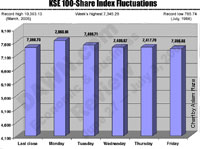
Click to view the larger image
The news of sell-off of the controlling shares of the PTCL to the UAE company at $1.96 per share was earlier well-received in the market as it reflected official thinking on its privatization programme irrespective of the allied problems. The stocks rose appreciably under the lead of the PTCL and oil giants but buying euphoria associated with such big news was lacking for obvious reasons.
Alternate bouts of buying and selling followed which did not allow the market to settle down and played on the tune of bears. Bargain hunters and speculative forces halted the snap run-up caused by the PTCL sell-off.
Despite the turmoil and fears of a big showdown by the striking union workers, the smooth sell-off allayed the fears but analysts cautioned investors to play safe until some irritants on the issue were removed.
The breach of three consecutive psychological barriers (7,400, 7,500 and 7,600 points) in a single session was significant but incidentally it was not matched by the price flare-up which was an instant outcome of such bullish news, brokers said adding, it reflected some reservations on the part of big players.
The UAE-based Etisalat won 26 per cent controlling for which it had to pay $2.6 billion to Privatization Commission in phases.
The PTCL shares responded favourably to the news but not on the scale widely speculated by some analysts during the post-sell-off trading. It rose by Rs3.35 at Rs70.65, the highest for the day but the talk of massive rise proved incorrect.
At $1.96 per shares, the local price of the PTCL share should come to Rs117 based on the exchange rate, analysts said adding, but we don’t think that level could be touched owing to typical pre-sell-off tussle with the union.
Earlier, this year its share value touched Rs100 and a premium of Rs13 on the reports of privatization.
Moreover, investors were cautious and did not go all out as some factions of the labour union were still at strike. How they decide the future course of action will have bearing on its share values, they said.
The KESC episode still haunted the investors as some suffered heavy losses who had taken big stake in it after the Saudi bidders backed out of the deal, brokers said.
But the PTCL’s sell-off reflected official resolve to go along with the phased out disinvestment programme of the state-owned units, irrespective of the employees’ resistance. Another mega unit, the PSO may follow it.
Leading oil shares came in for active short-covering and evoked strong support on other counters. The National Refinery and the PSO were the top scorers, while the Pakistan Services and Rafhan Maize were leading losers.
FORWARD COUNTER: With the exception of the PTCL which remained under pressure during the post-privatization sessions and shed extra weight, other leading shares, notably the OGDC, the Pakistan Petroleum, and the National Bank managed to close higher. Among prominent losers, the PSO was leading, although the fall was modest.
—Muhammad Aslam





























