



 0
0

 Punjab is the largest province and Sindh comes next; they are the most productive provinces in the agriculture sector, contributing the bulk of wheat, cotton, rice, sugar cane and other crops. But it is NWFP, third in size and way behind Punjab and Sindh in the potential of its agriculture that has come up with a concrete farming policy.
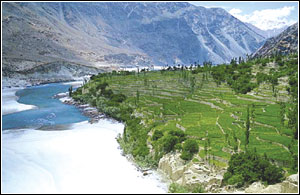
Not only is NWFP smaller but much of its land comprises rocky and barren stretches and many parts of the province are hilly with very small tracts for cultivation that are hardly viable farming units.
Owners of these mini farms are mostly small farmers who have no other source of income and their land holdings disallow meaningful investment, not that they have means for the required inputs.
Three things about the policy need to be noted. One: the province with a limited potential for boosting agriculture has come up with a meaningful agriculture policy. Two: the policy is based on the principles of equity. And three: it is genuinely aimed at reducing poverty.
While the federal government produces symphonies and dances about its billion rupee programmes for poverty alleviation and provinces follow suit with similar deafening music, the Frontier province has shown the way for supporting the poor citizen and giving him hope for a better future. It is a policy with a heart ticking for the poor.
For instance, each owner of a small land holding would be eligible for drawing an interest free loan worth Rs5 thousand. Similarly, owners of one or two animals would also be able to obtain interest free small loans. This would improve the liquidity of the farmer and the breeder and, with the policys emphasis on marketing facilities and mobile services for problems at the farm end and livestock, the entire face of the province can be changed for the better if the decisions are implemented sincerely, efficiently and effectively.
One can expect that from the MMA coalition in Peshawar because a majority of its leaders and workers are not moneyed people or members of landed aristocracy. They have worked their way up in politics and as far as one knows, have so far not been corrupted by the powers they wield, at least not as comprehensively as many of their counterparts elsewhere in the country have succumbed to benefits that can be derived from being important in the government. The political government has cadres of workers and the leaders follow a simple, homespun lifestyle that brings them close to junior level employees. This should help in the implementation of the programme.
The staff of the Agriculture Department, one presumes this means extension workers, would not be sitting in offices but would use the dairas, that is, places in villages where farmers gather and set up a family network to assist farmers in modernizing farming and its output. A net work of input supplies would be established close to clusters of villages so that obtaining seed, fertilizer, pesticides, etc, does not consume time and energies of growers. This would also assure them of quality services.
The policy lays emphasis on the building of farm to market roads so that fruits and vegetables can be transported fresh to consumers. This would, in turn, reduce prices for consumers and ensure quick sale of perishable commodities that would be profitable for farmers as their commodities would not be wasted. These are facilities farmers require, not pledges delivered with flamboyant expressions, as has become the wont of federal governments functionaries.
Two important relief and incentive measures of the government are exempting owners of land up to five acres from payment of land tax and fifty per cent rebate to farmers who clear their abiana dues by the end of 2005; those that make payments by end 2006 would get a 25 per cent rebate.
This contrasts with the federal governments policy of incentives that concentrates on rebate on vehicles on which duty has not been paid, that is, legalizing smuggling of vehicles that should be impounded or facilities to bank defaulters. The federal government seems committed to making the rich even richer while the NWFP administration appears to be genuinely striving for improving the lot of the impoverished members of rural areas.
According to the report on the policy in Dawn (June 14) the provincial government is to recover Rs184 million in abiana; if the rebate incentive is accepted by defaulters the amount would be reduced by half. Land tax relief has been calculated to cost the provincial authorities about Rs35 million. This is a sizable amount of money for a small province with limited resources.
The Chief Minister feels that land tax exemption would benefit about 1.5 million farmers while it is more realistic to recover half of the abiana dues instead of showing huge unpaid abiana in the books. While the policy on abiana can be debated, relief to small farmers is a step in the right egalitarian direction.
The policy is a major development and one hopes that other provinces as also the federal authorities take note of the NWFP effort instead of resenting it. Islamabad would do well to support it in every conceivable manner and try to assist the province in its implementation of its agenda to help reduce poverty in NWFP.
As for the provincial government, it should further strengthen the programme for development and improvement of agriculture in the province by concentrating on supporting crops that are not its mainstream produce. NWFPs main crops are sugar cane, wheat and maize. But its potential is tremendous in some other areas.
The province is rich in fruits but their marketing is virtually non existent and there are no facilities for preservation of fruits. In far flung areas, more than fifty percent of the fruit crops rot because means of transportation are extremely limited and people have not heard of cold chains for storage. Besides setting up storage facilities, the government should also work for fruit based industries and extend what already exists in this area.
Some years back, the federal government had undertaken a programme for developing sea buck thorn, a bush that grows on vast areas on NWFP. The fruit yield from this bush has been exploited to extract medicine, tea, jams, juices and all in all about two hundred products by the Chinese government. Pakistans programme was abandoned when the official who had initiated it left office.
The NWFP administration can revive it for reducing poverty in northern parts of the province and creating jobs for the people of those regions close to their homes.
Similarly, the governments tea plantation programme has not been taken to the fields. The province can take it to the private sector and help Pakistan reduce its tea import bill that the federal government can apparently not do because of powerful lobbies of importers. Olive production is another area in which considerable work has been done and the government should extent it further.






























