



 0
0

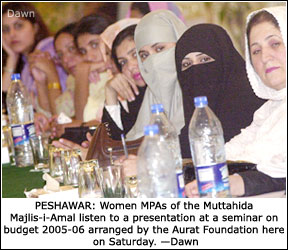 PESHAWAR, June 18: Speakers at a seminar on the NWFP budget for 2005-06 stressed the need of enhancing efficiency and capacity of line departments to ensure prompt and effective utilization of development funds. Dr Nasir Khan, an economist and director at the Institute of Management Sciences, Peshawar, said that availability of financial resources alone would not do the trick. Increasing the capacity of government functionaries to utilize the allocated funds would yield results.
He attached importance to the federal government’s strategic economic framework which sets four main objectives — poverty reduction, achieving growth rate of 6 to 8 per cent, introducing structural reforms and following them up with second-generation reforms.
Dr Khan said that under the Khushaal Pakistan Fund, every village would get funds to identify and carry out four projects on their priority. He also pointed out that the government had given importance to micro-financed units which, if properly utilized, could help improve the economic condition of the public.
The federal government had been receiving $400 million per annum in the shape of remittances from overseas Pakistanis before General Pervez Musharraf came to power. The amount, he added, had now reached $4.8 billion per annum because of strict monetary controls introduced in the backdrop of 9/11.
He said that a much larger amount of remittances was still being sent home by overseas Pakistanis without involving banks and financial institutions.
“The money could be doubled if the kerb market was strictly regulated,” said Dr Khan.
If the money came through banks and financial institutions, this could help the federal government get rid of foreign donors and pay its foreign debts far too easily, suggested Dr Khan.
He recommended to the NWFP government to develop a strategy to turn its geographical disadvantage into its gain. Marble, electricity and tourism industries should be developed and trade with Afghanistan given a boost for financial empowerment.
He said the lion’s share of federal resources was utilized on administration, debt servicing and defence, so instead of asking for more funds from the centre, the provincial government should develop strategies for generating its own resources.
For the last 60 years, successive governments had been utilizing public money without letting their benefit trickle down to the common man, he said, adding that it would take another 20-25 years for the fresh policies to yield good results.
He said the government needed to enlarge its tax base as there were only 1.3 million taxpayers in a population of 160 million. The country should have three million taxpayers.
The government should reduce tax rates for enlarging the tax base. The growth rate of 6-8 per cent should be maintained for the next ten years, Dr Nasir said.
Other speakers, including Haji Adeel of ANP, Abdul Akbar Khan of PPPP and Anwar Kamal Khan of PML-N denounced the federal budget 2005-2006 and said that the provincial budget would also not provide relief to the common man as NWFP had not been given its due share from the federal resources.
The federal budget protected the interest of big investors and it had not given any relief to the common man by reducing the prices of daily-use items such as ghee, sugar, flour, medicines and other items.
Public representatives including MPA Abdul Akbar Khan (PPP), Anwar Kamal Marwat (PML-N), women MPAs of Mutahidda Majlis-i-Amal, economists, NGOs and civil society representatives termed the federal and upcoming provincial budget unfriendly to the people.
The provincial government should have a vision of improving the overall situation and have stable tax policies so that the public could put trust in the government.
Those who avoid paying taxes would give up their practice once they knew that the tax money would be channelled into their welfare, MPA Anwar Kamal Marwat said.
He said that if relations with India had improved, there was no need for high allocation for defence in the current budget.
The speakers said they had low expectations from the provincial budget 2005-6 to be announced on Sunday.



























