0
0

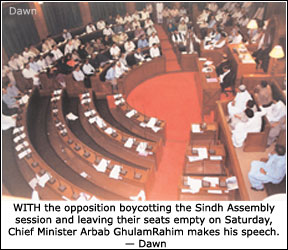 KARACHI, June 18: Sindh Chief Minister Dr Arbab Ghulam Rahim told the Sindh Assembly on Saturday that his government’s policies were aimed at improving the lot of common man in the province, adding that he would leave no stone unturned to achieve the objective. Dr Arbab was speaking at the end of the six-day general discussion on Sindh budget 2005-06. Opposition members were not present in the house, when he was speaking, as they had staged a walkout announcing boycott of the chief minister’s speech in protest against the arrest of MPA Zahid Bhurgari in a ‘false’ case.
The day’s deliberations were chaired by Speaker Syed Muzaffar Hussain Shah. The proceedings began at 10:30am and continued till 6pm.
Criticizing the opposition’s attitude in the house, Dr Arbab advised it to learn democratic traditions of tolerance and respect and uphold the sanctity of the elected house instead of indulging in politics of slogans, climbing up desks and burning documents.
The chief minister remarked that “democracy is incomplete without opposition which would pinpoint government’s mistakes.” But, he added, criticism should be constructive, and not for the sake of criticism. “They are welcomed to perform their functions within their limit.”
The chief minister said the government had presented a tax-free budget. Deficit budgets had also been presented in the past, but this year the deficit budget had become a surplus one credit of which should be given to Senior Finance Minister Syed Sardar Ahmed. He noted that allocation for education sector had been doubled.
He praised the finance minister for taking a strong stand on NFC Award to demand multiple criteria unlike the PPP which had never taken stand on the issue. On the contrary, he added, that party had caused harm to Sindh on the issue of water-sharing formula in 1991.
Dr Arbab pointed out that there were bumper crops this year in Sindh despite water shortage. He also expressed his determination to continue ‘Jihad’ against corruption and crime.
Without naming Zahid Bhurgari, he remarked that whoever would commit a crime, police would take action against him without any discrimination. He flayed opposition for terming action against any of its members ‘tyranny’.
He declared that his government would remain in power till 2007 and the opposition would have to tolerate it.
He claimed that Mr (Asif Ali) Zardari had been released ‘after a compromise on Kalabagh Dam issue’, but he returned to Dubai only after realizing that general elections were not going to be held this year.
The chief minister observed that power was a short-lived thing, but they (the opposition) would realize this only when they were in power. “Everyone knows how had they come to power… after entering into a pact with Ghulam Ishaq Khan…, and what had they done for people while in power in 1988 when there was so much cry for ‘Mr 10 per cent’.”
Reverting to the NFC Award, he said that if the dispute among provinces persisted, the president would have the right to announce the Award as such an authority had been given to the office of the president by all four provinces. He, however, hoped that no injustice would be done to Sindh province.
“The multiple criteria as the basis for the Award has been eulogized, but when we stick to this stand, this displeases the opposition.”
Minister for Finance Syed Sardar Ahmed, responding to the criticism of the budget, said deficit financing was cardinal principal for the growth of economy.
He regretted that opposition members, instead of pointing out that what should be done to improve the budget, indulged in criticism for the sake of criticism, and kept insisting that the budget sans NFC Award was unconstitutional.
“The budget is prepared under Article 118 and 125 of the constitution and there is no mention in the Article 160 that the budget cannot be presented without NFC Award.”
He said NFC Award was not announced for 15 years after 1975, but no one had raised any objection while the Award in 1997 was given by a caretaker government.
The minister said the Award could not have been announced because of the principled stand adopted by the Sindh government. “My all efforts are to ensure that the Award is in the interest of Sindh and its people.”
He said he had put forward a proposal last year that NFC be made independent on the pattern of one in India, and had also asked for the right of collecting sales tax and certain other taxes to be given to provinces. The proposals are still with the federal government.
Claiming that Sindh’s economy had improved, he indicated that today, there was no overdraft outstanding against the provincial government which also maintained a cash balance of Rs15 billion which was a record.
Mr Ahmad said that Rs1 billion had been allocated for clean drinking water supply to rural areas.
Regarding ADP allocation, the minister said that Sindh government would fund the ADP out of its own resources. “We have paid Rs7.20 billion loans to the federal government and has, thus, saved Rs1 billion as interest amount,” he added. He further stated that for development schemes in the next year, funds would be released in August and January after evaluating performance of departments.
Leader of the opposition Nisar Ahmad Khuhro, in his hour-long speech demonstrated his skills as an experienced parliamentarian when he summed up the performance of various government departments. Referring to the ADP allocations of Rs12 billion for 600 development schemes, he said that against the release of Rs7.09 billion, only Rs4.3 billion were utilized.
He severely criticized the poor performance of the departments of cultural and tourism, home, IT and education which failed to utilize more than 14-32 per cent of the funds they received. He, however, appreciated the departments of wildlife and industries in this regard.
Mr Khuhro disbelieved the pledge made in the budget documents that 5,000 new tubewells would be sunk next year, recalling that the same promise had been made four years back but not a single tubewell had so far been installed.
Pleading the case for agriculturists, he reiterated his suggestion of approaching the federal government in order to get fixed a flat rate of Rs4,000 per month as power charges for a tubewell as was in practice in Balochistan. The NWFP had also been demanding the same rate, he added.
Others who participated in the general discussion on Saturday were Aamir Moeen, Dr Sohrab Serki, Arshad Shah, Shabbir Qaimkhani, Ehsan Jatoi, Ghulam Quadir Chandio, Sasui Palejo, Makhdoom Jameeluz Zaman and Maulana Omar Sadiq.