



 0
0

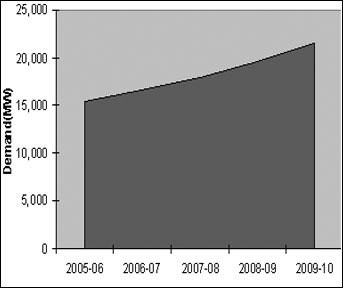 Out of the total population of 152.53 million, only 40 per cent has access to electricity. The demand/ supply projection as shown in figure No: 01, indicates that power shortages will appear from the year 2006, and increases to 5,500mw in the year 2010, if no measures are taken to bring in new capacity.
It is planed to increase the power generation capacity by 143,000MW in the next 25 years to 162,540me from the current 19,540mw to sustain GDP growth rate of 7-8 per cent. This planned addition includes 19,750MW coal based power production.
The private power and infrastructure board (PPIB) has advertised a 450MW coal fire project at Lakhra in Sindh and the Sindh government has signed memorandum of understanding for (i) a 600mw Thar coal power project by Shenhua Group of China, and (ii) a 1200mw project at Thar with an Australian firm using “underground coal gasification technique.
The per capita energy consumption is currently low at 14 MBtu as compared to 92 MBtu for Malaysia and 34 MBtu for China. The overall use of energy here is around 70 million tonnes of coal equivalent (Mtce) per annum, and it is estimated to grow to over 90 Mtce by 2008. Though coal rich, the country unfortunately has not been developed coal for the power generation for more than three decades due to lack of infrastructure, insufficient financing and absence of modern coal mining technical expertise.
Although Pakistan is sixth richest nation in coal resources, the share of coal in the overall energy mix is only about six per cent as shown in figure 2 and currently makes up merely one per cent of electric power generation. The one way to overcome this problem is to convert coal from solid to a clean gas, which can then be burned like natural gas. When linked with modern combined-cycle turbines, gasification is one of the most efficient and environmentally sound ways of producing electricity coal.
Advanced technologies when applied to our coal resources, can improve the efficiency and minimize environmental impacts of coal utilization. If properly exploited, Pakistan’s coal resources may generate more than 100,000MW of electricity for the next 30 years.
Pakistan has 19.5 gigawatts (GW) of electric generating capacity. The total power generating capacity has increased rapidly in recent years, but Pakistan often faces in peak seasons. The remaining recoverable reserves of crude oil is estimated at 310 million barrels, which indicate that there is no prospect for Pakistan to reach self- sufficiency in oil.
The country has 30.130 trillion cubic feet (Tcf) of proven gas reserves, and currently produces around 0.8 Tcf of natural gas per year. Consumption of oil in cement industry as well as in electricity generation has declined substantially as the former has shifted to gas as well as on coal while gas is increasingly being used to generate electricity.
In 1963 Wapda set up a power plant having two units, each of 7.5 MW capacities, at Sheikh Mandah near Quetta using pulverized coal technology. The plant used sub-bituminous coal from the Sore Range mines of Balochistan. The annual coal consumption of the plant was 30,000 tonnes. The plant has completed its life and Wapda has now closed both the units since they were functioning at de-rated capacity.
The plant is being upgraded to enhance the capacity. Another coal fire power plant with capacity of 150 MW was setup in 1994 at Lakhra with Chinese assistance comprising of three units of 50MW each, based on Lakhra coal using FBC technology in distract Dadu Sindh.
While operating the plant, WAPDA faced several problems such as boiler tube leakage, air pollution etc, that was due to supply of coal below the designed specification. At present, the plant is shut down due to running at de-rated capacity. The plant was consuming about half a million tonnes of lignite coal annually. The generation cost of the plant was Rs2.61 per kWh, including the cost of coal and lime stone. The plant is expected to resume operations after eliminating the problems.
In 2002-03, power sector has emerged as the largest consumer of gas (34.8 per cent), followed by fertilizer (23.9 percent), industries (18.9 per cent), households (17.7 percent), commercial (2.9 percent) and cement (1.6 percent). It may be noted that the share of the power sector in consuming gas has been rising continuously since 1998-99. This trend is due to fact that power sector is gradually reducing its dependency on imported fuel oil because of escalating prices. Liquid fuel has been used to supplement natural gas in the power plants.
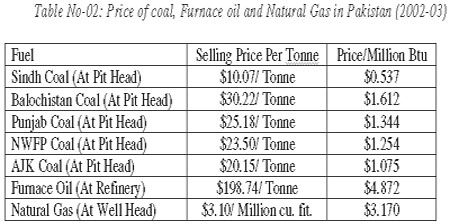
It appears that generation of power with liquid fuels is economically not very attractive and power generation using imported oil is higher than the cost of power generation using domestic coal almost at all locations. Natural gas is a preferred fuel for the manufacture of fertilizers, petrochemicals, and sponge iron etc.
The natural gas used for power generation can be used for these purposes if it can be replaced by an alternate fuel gas. The fuel gas produced by gasifying coal would be suitable to burn in the existing gas turbines of the combined cycle plant. The conversion from natural gas to coal based fuel gas needs addition of a coal gasification system in the combined cycle plant
Our cement industry has started using indigenous coal as fuel. It is reported that around 85 per cent of the cement industry has shifted on low-priced coal from relatively more expensive natural gas and furnace oil. The conversion has small impact on the local coal production because cement units are using high rank imported coal as the indigenous coal is of low quality. Indigenous coal is blended with imported coal in small proportion, which is necessary for smooth operation of the plant.
Sugar industry is also searching for alternate supplementary fuels which could be cheaper in price, reliable in quality, and consistent and continuous in availability. The industry mainly uses bagasse (residue of cane after extraction of juice) as fuel to produce steam for running process, steam turbines and turbo generators.
Total bagasse used as fuel in 1999-2000 was 8.897 million tons followed by fuel oil consumption of 30.903 million litres. The use of coal can save 8.897 million tons bagasse which (bagasse) can produce about 2.2 million tons of medium density fibre board, an excellent replacement of furniture-making wood and consequently saving our forests which are fast depleting.
Fuel gas from coal gasification can find many uses in industry and domestic sectors for heating and energy purposes. Fuel gas as town gas can be piped to homes and hotels for cooking supplementing the LPG presently used whose consumption was 1000 tons per day in 2003-04.
The government has announced that a coal gasification plant to be set up in Bhakkar, Punjab, will produce three million cubic feet of gas per day, consume 0.8 metric tonnes per day of coal and produce around 0.35 metric tonne per day of coke. The estimated cost of the coal gasification plant is around Rs250 million ($4.198 million) and will produce gas by adopting the “vertical retort destructive distillation process”.
In mid-fifties the Iskandarabad fertilizer factory was established. The source for production of gaseous mixture, which could be subjected to cracking and to generation of hydrogen, was coal from Makerwal. The process was gasification. The coal may contain high amounts of sulphur but it can still be put to sophisticated use by appropriate modification.
The basic necessities of life such as drinking water, road and electricity are not available in Thar coalfield, containing coal reserves of about 1.75 billion tonnes. The government has approved an Rs1.1 billion for road project to connect the coal-rich areas of the Thar desert to its existing road network. The project will include the rehabilitation of 219 km of roads and construction of 51.6 km of new roads. The project will provide transport facilities for the Thar coal power plant project from Hyderabad to Sanghario via Islamkot. Thar has potential for the major development comprising multiple mining/ power facilities extending over several decades. The infrastructural requirement should be evaluated in the long term perspective and not in immediate context of the first mining operation and associated power plant.
Despite the fact that Indian coal is of poorer quality, the share of coal was 54.5 per cent in the total energy mix in 2002. Power generation accounts for about 70 per cent of India’s total coal consumption. China is also producing more than half of her electricity through thermal power stations run by coal.
Absence of sufficient manufacturing capabilities of mining and power plant equipments and machinery is one of the main impediments to the rapid development of coal mining, and requires to be addressed through massive private investment. Large amounts of capital are required to setup commercial plants to produce fuel gas from coal gasification as a feedstock for gaseous and liquid fuels and chemicals etc.
Majority of the technologies available on commercial scale for production of the above products is based on coals with different characteristics than that of Pakistan’s coals specially ash content and ash fusion temperature which are low. Therefore these technologies cannot be applied directly to local coals but have to be adapted through indigenous demonstration and R&D before setting up large commercial scale plants. Thus we need capital for R&D, demonstration of technology with local coals and for commercial plants.






























