0
0

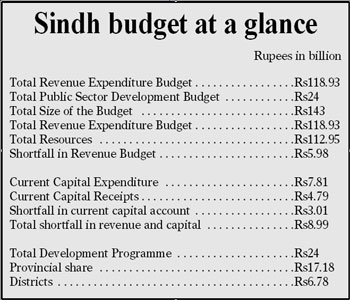
KARACHI, June 10: Sindh Finance Minister Syed Sardar Ahmad on Friday presented in the provincial assembly a Rs143 billion budget for 2005-06, showing a shortfall of Rs5.98 billion in the revenue expenditure and over Rs3 billion in the capital account budget, and leaving a big question mark on resource availability for financing an ambitious Rs24 billion development programme.
Delivering his budget speech amid desk thumping and shouting by opposition lawmakers, the minister announced a few relief measures and what he termed a rationalization of levies that sought to increase taxes on hotels and private security agencies.
Overall it is a record Rs33 billion deficit budget. But the finance minister informed the assembly that deficit on both accounts — revenue and capital — was of Rs8.99 billion. He did not say how would the Rs24 billion development outlay be funded.
Based on the 1997 National Finance Commission award for the third consecutive year, the 2005-06 budget stipulates Rs118.93 billion current revenue expenditure and Rs24 billion public sector development. The overall resource availability for the next fiscal year is Rs112.95 billion — Rs52 billion Sindh’s share in the federal divisible pool of taxes, Rs29.52 billion straight transfers, Rs12.15 billion compensatory grant for octroi and zila tax and the expected provincial receipts are expected at Rs19.28 billion.
The capital receipts are estimated at Rs4.80 billion against which the capital expenditure, mostly on account of wheat trading, is Rs7.81 billion showing a deficit of Rs3.01 billion.
The Rs24 billion development outlay is divided between the provincial government — Rs17.18 billion— and district governments — Rs6.78 billion. An additional Rs4.75 billion is indicated as foreign assistance which raises the total development outlay to over Rs28.75 billion.
He said the impact of a 15 per cent increase in pay-scales of government employees and 10 per cent in pension would be Rs12.8 billion on the provincial and district governments.
An increase of 15 per cent has been proposed in salaries of ministers, advisers, special assistants and MPAs. The MPAs will get an additional Rs40,000 as travel allowance each year.
Sardar Ahmed declared that his was a tax-free budget but said that it incorporated fiscal measures to rationalize some levies. “Rates of some of the levies are being enhanced or consolidated for making them public-friendly and revised upwards but in some cases are reduced as well,” he said. He announced a waiver of the Rs4 per bed fee charged by government hospitals.
The minister offered a big facility to drivers who, after merger of various levies and categories of vehicles will henceforth be given a ‘composite driving licence’ for three years, to be renewed every three years.
However a concession given to big hotels after September 11, 2001, is being withdrawn and the occupancy ratios of 70 per cent for big hotels and 60 per cent for small hotels is being re-imposed. These ratios were brought down to 25 per cent from July 2003.
The arms licence manufacturing fee is being doubled to Rs20,000 and the annual renewal fee increased to Rs10,000 from Rs7,000. However, he announced a reduction of penalty on delay in renewal of arms repairing licences and permit fee. The discretionary power of the home department is being removed.
The private security agencies will now have to pay Rs200,000 registration fee, instead of Rs100,000, and renewal fee has been increased to Rs25,000 from Rs20,000 a year. The fee for registration of a branch office is being increased to Rs50,000 from Rs40,000.
The finance minister announced abolition of security clearance fee of Rs300, Rs400 and Rs1,800 for guards of private security companies in Karachi and outside, and in the province and outside.
The food grant licence fee is being reduced from Rs10,000 to Rs2,500 and renewal for dealers and commission agents will now cost Rs1,500, instead of Rs5,000.
The provincial government has announced withdrawal of sales tax on marriage halls, laundries and dry-cleaners. The federal government was collecting these taxes on behalf of the provinces.
The finance minister informed the house that the province groaned under a heavy debt burden of Rs110.26 billion on which the federal government charged 12 per cent to 18 per cent interest.
There is a burden of Rs35 billion cash development loan taken from the federal government and Rs74.51 billion foreign loans. Even after repayment of Rs110.10 billion on normal SCARP CDLs, a principal amount of Rs35.75 billion remains outstanding.
The minister said that Rs92.66 billion or 84 per cent of the total payment was towards interest on loans. He disclosed that the current fiscal year was closing with revenue expenditure of Rs105.70 billion as against the budget estimates of Rs104.90 billion, mainly because of the impact of 15 per cent increase in salaries of government employees.
On the issue of the NFC award, the minister said the province had great hopes about getting the needed resources.