



 0
0

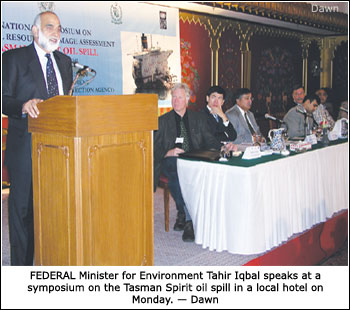 KARACHI, May 30: Pakistan will claim a compensation of $2 billion from the last owners of Tasman Spirit, the oil tanker which ran aground off the coast of Karachi some 22 months back. The incident caused a spillage of about 31,000 tonnes of crude oil, devastating the marine life and ecosystem. Pakistan had never witnessed such a socio-economic disaster in its history, as revealed by speakers at a national symposium held here on Monday.
Ministers and high-ranking officials at the symposium expressed the view that Islamabad had got all reasons to present a claim to the owners and get that realized with the support of international organizations so that the long-term activities for the restoration of ecosystem could be launched at the earliest.
The forum on Natural Resource Damage Assessment Arising From Tasman Spirit Oil Spill has been organized jointly by the Pakistan Environmental Protection Agency, UNDP, National Institute of Oceanography and Sindh Environmental Protection Agency.
Copies of a summary report on works pertaining to the damage assessment carried out by local experts, with the resources made available under the UNDP supported National Environmental Action Plan (NEAP), were distributed among the delegates of the symposium.
The Tasman Spirit, owned at that time by Palambros, was carrying about 67,500 tonnes of Iranian crude oil. The vessel had run aground on July 27, 2003 near the approach channel of Karachi harbour. Fifty-one per cent of the oil it spilled into the sea was estimated to have sunk to the seabed till the first week of September.
Besides contaminating the marine area of about 2,062 sq-kms with petroleum hydrocarbons, the spill had exposed as many as 300,000 people to toxic petroleum aerosol plume. A considerably big volume of the offshore habitat was severely polluted while a mangroves forest area stretched over 786 hectares sustained heavy damage.
Speaking as chief guest at the inaugural session, Federal Minister for Environment Maj (r) Tahir Iqbal categorically stated that Pakistan would try all options to get the compensation from the owners of the ship.
The ship’s owners accused Pakistani authorities of maintaining the harbour channel improperly and providing an incompetent pilot, instead of admitting their own faults, e.g. possession of a wrong ship certification, using a very old and weak ship for transportation of over 67,000 tonnes of oil, and delaying the vacation of the oil from the grounded ship, the minister maintained.
He said that the government would submit its claims to recover the losses from the shipping company as it was solely responsible for the spill damage.
“After keeping a proper document with us now, we are able to pursue our claim with regard to compensation,” he said, adding that the government was now on a stronger position to fight the case in a court as well. Help of the UNDP, UNEP and other organizations would also be sought in the process, he said.
Referring to some of the recommendations included in the NRDA report in regard to the signing of international plan and contingency plans, Major Tahir Iqbal said that a Marine Pollution Control Centre was being established whereas the oil spill contingency plan had been put forward for necessary approval from the prime minister.
The minister said that a Disaster Management Authority, headed by the naval chief, would also be set up. Pakistan, he said, would sign international protocols which could help the government tackle oil spill-related issues.
He pointed out that the Marine Pollution Control Board had already been revived to monitor marine pollution in Karachi and other coastal areas.
Talking to Dawn after the session, the federal minister said that the government was concerned over the Tasman disaster and its consequential effects on Karachiites, and that was why, efforts had earlier been made for realizing the claim through an out of the court deal as well. The Attorney General of Pakistan, he recalled, had approached the ship’s owners and the relevant body. Although they agreed to pay the compensation, the amount offered appeared so meagre that was not acceptable to the government. “We would try all options to sort out the claim issue in an honourable way and, if needed, we would go for a mobilization at international level, he added.
Speaking at the symposium, Adviser to the CM on Environment, Mohammad Noman Saigal, called for making joint efforts to get the claim realized. In this regard, he suggested setting up of a negotiating team that should include authorities from Sindh, particularly fishermen community which had suffered a lot.
The secretary environment, Pakistan, Javed Hasan Aly, said that several of the recommendations contained in the NRDA report would surely improve management and environment of coastal areas in future.
The adaptation of the report would also help build-up the capacity to respond such disasters in future, he noted. According to Mr Aly, the purpose of the NRDA study was to document natural resource or environment injury, to provide a basis for claim against the responsible party and to develop and implement a comprehensive restoration programme, and to inform the citizens of Pakistan of the extent and severity of damage to their coastal environment.
He said that the report in question represented a broad range of field sampling, laboratory analyses and synthesis of a huge amount of data by some of the top Pakistani scientific institutions, who all deserved gratitude.
The spill’s impact were so serious and extensive that in a very short time, it killed many fish and bottom-dwelling organisms, as well as birds, sea turtles, and porpoises, he added saying that a full ecological recovery was not expected to occur for five to 10 years.
The director general of PEPA, Asif Shuja, said that the disaster of Tasman Spirit oil spill was the worst example of negligence on the part of the ship-owners who could not decant the vessel after 17 days of its running aground, rather the company tried to pull the 29-year-old entangled vessel with a powerful ship by using six tag ropes. Had the experienced companies engaged to decant the vessel promptly, the leakage of oil could have been averted, he added.
He said that after relevant exercises, the damage caused due to the spill and package for restoration had been calculated by using different economic models, figure of which came to $1.5-$2 billion, which the ship’s owners must pay to the government of Pakistan.
The Secretary Environment, Sindh, Shamsul Haq Memon, said that compensation should be paid for the ecological/environmental injuries suffered by Sindh and all other stakeholders, including subsistence households, fishermen, business entities, restaurants, shops, hawkers, peddlers, vendors, fishing boats and trawlers, etc.
The Deputy Resident Representative of UNDP, Hoalang Xu, said that NRDA report was a document which could be utilized as a scientific base for undertaking the future work. He appreciated the local experts for providing a worthy document.
The Deputy Executive Director of UNEP, Shafqat Kakakhel, expressed the view that Pakistan should also move for joining the related international protocols and conventions.
Dr Richard G. Steiner of the University of Alaska, who has assisted local experts in their work, also spoke on the occasion.
The federal minister for environment also gave away shields and certificates to the principal investigators engaged in the preparation of NRDA report.




























