0
0

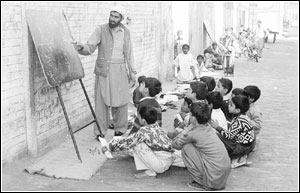 PRIMARY and secondary education provides basic skills and develops the required attitudes which are necessary for a workplace. It lays a foundation for further education and trading which has become increasingly important with fast changing technology, and the intense competition of the global marketplace.
Studies show that primary schooling improves the productivity of small farmers. The introduction of “packages” of technology through agricultural extension services is important for improving farm productivity. These “packages” are essentially combinations of practices and inputs tailored to specific crops and to land, water and climate conditions. Farmers need good quality basic education to use these extension services.
Also important is a good understanding of the basic principles behind the use of farming technologies, such as pesticides and fertilizers. Higher levels and better quality education increases the ability of farmers to use new agricultural extension services.
Surveys of the urban informal sector have shown that primary education increases the propensity to work in the urban informal sector and there is a positive correlation between education and earnings.
Primary schooling or less may suffice for lower level manufacturing involving single-task machines with workers performing one or a set of repetitive tasks. But secondary education will be required for medium and high level manufacturing.
Advanced production technologies like numerically-controlled and automated technologies where workers are organized in flexible production systems using multi- skilled teams that produce whole products will call for high levels of education.
Good quality primary and secondary education— say of 10 years— will equip students with the required level of skills like knowledge about solving to work in medium and high level manufacturing jobs.
In many developing countries like Pakistan, more can be done to improve the quality of primary school education. Crucial to the quality of schools appears to be the qualifications, experience, knowledge, level of teachers and also of textbooks and materials. Secondary school enrolment needs to be expanded. There is a need to reduce the number of drop-outs.
The school curriculum should be revised to ensure that it not only caters for the academically less inclined but also prepares them for the world of work. Without basic literacy, people’s ability to adopt changing production methods and technologies is severely constrained. This applies to agriculture, manufacturing and other industrial activity.
A country’s efforts to upgrade to higher technology and more skilled-intensive products with changing comparative advantage will be made more difficult. Without it an enterprise’s ability to move to higher value added production will be hampered.
Training by companies is cost-effective and efficient. Such training which should be structured and planned, can be on or off the job. Training in enterprises should be linked to its strategic plan and be based on analysis of the enterprise. On-the-job training (OJT) is one trading mode. Enterprises use OJT because it provides the specific skills needed for hob performance. Unlike other training systems, it enables the enterprises to quickly change the skills required if there are changes in technology, work process and product lines.
OJT is a good training option for smaller companies. Such companies cannot release their employees for training during working hours, especially if there is a tight labour market. Their employees are invariably unable to train after office hours as they need to work overtime or at another job to supplement their low basic wages. On the job training, conducted in Asia and the Pacific, tends to be structured in large companies, whereas in smaller local companies, it is unstructured.
The Asian Productivity Organization (APO) recently conducted a research project on HRD in twelve Asian economies which included a firm-level survey of corporate HRD policies and practices. The survey of firms in eight developing economies viz. Hong Kong, India, Indonesia, South Korea, Nepal, Pakistan the Philippines and Taiwan revealed immense scope for improvement and expansion of OJT.
Self-learning and observing seniors was more widely adopted while learning through exposure to various jobs was in general underutilized. OJT in enterprises in Asia and the Pacific can be improved. A national programme to improve and expand OJT, involving the government, enterprises and the relevant training body, is worth looking into.
A number of developing Asian and the Pacific countries are involved in labour- intensive lower technology manufacturing. They intend to or are already upgrading into medium technology manufacturing. Higher technology manufacturing involves fewer but more skilled workers and more technicians and engineers.
When Singapore decided to restructure into medium technology products from labour-intensive lower technology manufacturing in 1979, it expanded the training of skilled workers, technicians and engineer from 1980 onwards. An issue for developing Asian and the Pacific countries, which want to move into medium technology manufacturing is the need to expand post- secondary technical education and trading.
Given the time lag in education and training institutions producing the needed graduates, alternatives like importing foreign man-power and working with foreign companies to train skilled workers and technicians for the economy in excess of their own requirements may be considered. Some Asian and the Pacific developing countries intend to or are already upgrading into high technology and knowledge intensive manufacturing. Foreign advanced technology is difficult to access and is costly.
Asian and the Pacific developing countries embarking on high technology manufacturing need to develop indigenous research and development (R&D) capability. They need to expand tertiary education and more importantly to train more scientific and technological manpower. To compete in the league of industrialized countries means to operate in sophisticated highly competitive markets.
The most successful are those enterprises, which can innovate and produce new products and services. Merely to improve the quality of goods produced or producing at a lower cost is no longer enough. Asian and the Pacific developing countries need to move towards the innovation phase of their economic development.
As developing countries in Asia such as Pakistan industrialize further, the size and contributing to output and employment of the service sector will increase. Liberalization will increasingly affect the service sector. The development and productivity of the service sector will, therefore, become more important. Service industries, which are not exposed to international competitiveness, tend to a have lower productivity.
The countries in Asia and the Pacific will increasingly need to pay greater attention to the development of the service sector and the raising of their productivity. This may involve the development of new service industries, the rationalization of existing service industries, where applicable, and the improvement of productivity of individual service enterprises.
The attitude, knowledge and skills of workers is a major ingredient in service quality. Given the rapid spread of knowledge and the fast change in technology, there is an urgent need for continuing education and training on the part of all employees whether they are mangers, supervisors or rank and file workers. Government training agencies, employer’s organizations, education and training institutions and trade union should be involved in the exercise to review the existing situation in regard to continuing education and training and to map out its future development.
Presently, major national decisions on education and training in developing countries are invariably made by the government. Employers should also seek greater involvement in national education and training policy-making. They should be consulted as a matter of course in the formulation of major education and training initiatives.
The education and training system of countries in transition to a market economy was designed for a command economy. Under such a system basic education was of a high standard but subsequent training was too specialized. Adult education and training was neglected since workers were expected to be in one job throughout their working life.
Furthermore subjects such as economics, management science, law and psychology were ignored or under-emphasized. Such education and training system was inadequate for the needs of the market economy. The World Bank lists the financing, content and delivery of education as the three priority areas for education reform in countries in transition to a market economy. Much progress has been made in the reform of the education and training system in these countries. However much more remains to be done.